12 Best Games for Youth Groups
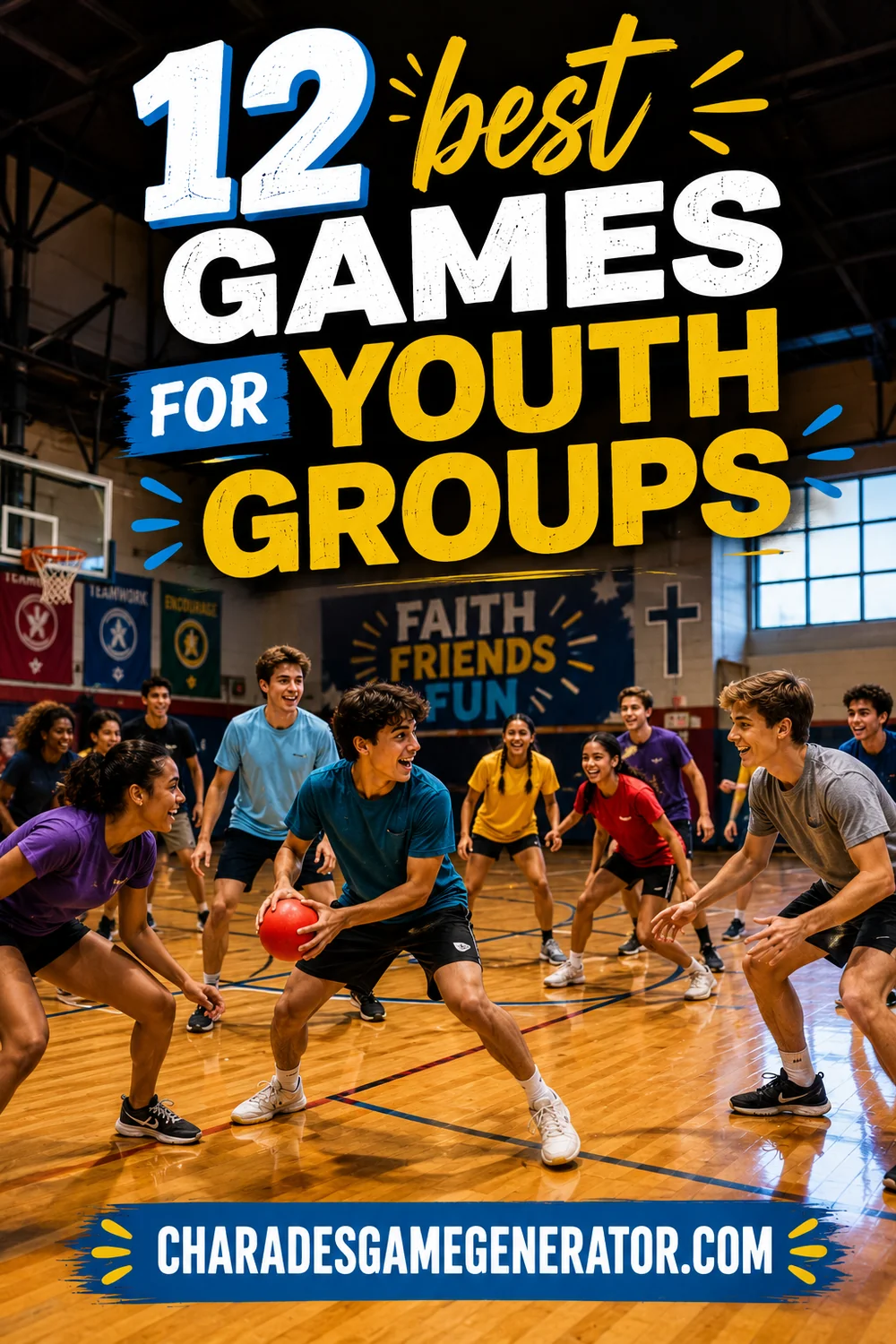
Games That Actually Work for Youth Groups
Youth group leaders know the challenge: games that are "too babyish" get eye-rolls, games with too many rules lose half the group, and anything that singles out individual kids for extended solo attention risks awkwardness fast.
The sweet spot is games that are physically engaging, team-based, and fast-moving. Competitive enough to create genuine energy, but structured so that no single person is the center of attention for too long.
This list covers 12 proven youth group games — a mix of no-equipment classics, physical activities, and digital tools that work for middle school through young adult groups. All tested, all effective.
1. Charades 🏆 (Best Pick)
Why it wins: Charades is uniquely effective for youth groups because the acting element removes the self-consciousness that kills other games. When you're miming "a helicopter taking off in a windstorm," the siliness of the situation takes over and shyness disappears. The free generator has clean, age-appropriate word sets, runs the timer automatically, and handles team scoring — leaders can facilitate without managing every detail.
Best for: Ages 10 and up. Works for groups of 6 to 60 with team adjustments.
2. Would You Rather — Clean Edition
Why it's great: Would You Rather Online generates clean, school-appropriate dilemmas that are genuinely engaging for teens. "Would you rather have to speak in rhyme for the rest of your life or sing everything you say?" produces real debate, real laughter, and real conversation between kids who might otherwise not talk. Perfect warm-up, discussion starter, or standalone activity.
Best for: All teen ages. Clean edition is fully appropriate. Use it to open a session or fill transitions.
3. Never Have I Ever — Clean Edition
Why it's great: The youth-group version of Never Have I Ever Online uses clean, relatable prompts — "Never have I ever laughed so hard I cried," "Never have I ever fallen asleep in class" — that build group familiarity without crossing any lines. It's a community builder, not a confession game. Teens reveal things about themselves in a low-pressure format.
Best for: Middle school and up. Always use the clean edition. Great icebreaker for new groups.
4. Human Knot
Why it's great: The group stands in a circle, reaches across to grab two different people's hands, then works together to untangle without letting go. It's a team-building exercise disguised as a game — requires communication, problem-solving, and light physical contact. Groups that solve it have genuine collective pride. Groups that fail while laughing are having just as good a time.
Best for: Groups of 8–15. Ages 10+. Keep groups single-gender if the group is not yet comfortable with mixed physical contact.
5. Scavenger Hunt
Why it's great: Split into teams and find or photograph a list of items or complete a set of challenges around the venue. Scavenger hunts build teamwork, create energy, and let quieter members shine in unexpected ways. A photo scavenger hunt with phones keeps teams accountable and adds a creative element.
Best for: Any group size, split into teams of 3–5. Ages 8+. Takes 30–60 minutes. Requires a list — the one prep item in this collection.
6. Relay Races
Why it's great: Classic physical relays — three-legged race, sack race, egg-and-spoon, balloon-between-knees — are reliably hilarious for teens who know they're silly but compete anyway. The key is the team format: no one is alone when they fall over. Creative modern variations (silent conga line, waddle relay) add freshness.
Best for: Outdoor groups, any age. Requires space; indoor adaptations are possible.
7. Mafia / Werewolf
Why it's great: Social deduction at its best — villagers try to identify the hidden wolves through debate, accusation, and elimination. The lying, the campaigning, the dramatic reveals: Mafia creates some of the most intense group moments of any game, and teens take to it immediately. One leader runs the game as moderator.
Best for: Ages 12+. Groups of 10–20. Takes 20–40 minutes per round. The one game that rewards strategic thinking over physical ability.
8. Two Truths and a Lie
Why it's great: Each person states three things about themselves — two true, one false — and the group guesses which is the lie. Excellent community builder for groups that are still getting to know each other. Teens consistently surprise each other, which is half the point. No materials, no setup, zero cost.
Best for: Groups of 6–20. Ages 10+. Best at the start of a year, a retreat, or a new group formation.
9. Four Corners
Why it's great: Label the four corners of the room 1–4. The person in the middle calls a number with eyes closed, everyone in that corner is out. Movement, luck, and mild strategy combine in a game that runs fast and requires nothing. For youth groups, add category questions ("Which corner is most likely to stay up past midnight?") to spark conversation between rounds.
Best for: Elementary through early high school. Any room with four corners. Takes 10–15 minutes.
10. Trivia Showdown
Why it's great: Team trivia with categories tuned to the group — pop music, sports, movies, history, current events — creates competitive energy that doesn't require physical ability. Quieter, knowledge-focused teens often shine here. Run verbally (one leader reads questions) or via Kahoot for a competitive digital scoreboard.
Best for: Any age, any group size with team format. Works especially well for groups where physical games disadvantage some members.
11. Skit Night
Why it's great: Small groups get 10–15 minutes to prepare and perform a short skit — a scenario, a Bible story retelling, a parody of a movie — and then perform for the full group. The preparation time builds team bonds; the performance builds confidence; the watching builds group identity. One of the highest-return investments in youth group programming.
Best for: Groups that have been together long enough to be comfortable. Ages 12+. Requires a space for performances and some prep time.
12. Balloon Games
Why it's great: Balloons are cheap, versatile, and make even reserved teenagers act ridiculous. Balloon stomp (each person ties a balloon to their ankle, last balloon intact wins), keep it up (team keeps a balloon in the air), and the balloon pop relay all deliver high energy with minimal preparation. Cleanup takes three minutes.
Best for: All ages, indoor or outdoor. One bag of balloons serves a group of 20 for the whole session.
🏅 Quick Comparison
| Game | Equipment | Group Size | Energy Level |
|---|---|---|---|
| Charades | Phone optional | 6–60+ | High |
| Would You Rather | Phone | Any | Low-medium |
| Never Have I Ever | Phone | 6–20 | Low-medium |
| Human Knot | None | 8–15 | Medium |
| Scavenger Hunt | List/phones | Any | High |
| Relay Races | Props | Any | Very high |
| Mafia / Werewolf | None | 10–20 | Medium-high |
| Two Truths and a Lie | None | 6–20 | Low |
| Four Corners | None | 10–30 | Medium |
| Trivia Showdown | Optional phone | Any | Medium |
| Skit Night | None | 10–30 | Medium-high |
| Balloon Games | Balloons | 10–40 | Very high |
Frequently Asked Questions
What's the best game for a youth group of mixed ages?
Charades works across the widest age range — a 10-year-old and a 17-year-old can be on the same team and both contribute. Would You Rather and Two Truths and a Lie also adapt naturally to mixed ages.
What games work for shy teenagers?
Team formats (charades, Mafia, Trivia) reduce individual exposure. Would You Rather generates conversation without performance pressure. Two Truths and a Lie lets shy members share at their own comfort level.
How do you keep a youth group energized during games?
Alternate between high-energy physical games (relay races, balloon games, Human Knot) and lower-energy social games (Would You Rather, Two Truths and a Lie, Trivia). The contrast keeps energy sustainable rather than burning the group out.
What games work for youth groups with no budget?
Charades (generator is free), Two Truths and a Lie, Human Knot, Mafia/Werewolf, Four Corners, and verbal Trivia all need zero budget. Balloon games cost $3–$5 for a bag that serves 20+ people.
What's the best icebreaker game for a new youth group?
Two Truths and a Lie for learning names and facts; Would You Rather for getting conversations started; Never Have I Ever (clean edition) for building familiarity quickly. Run all three in the first 30 minutes of the first session.
🔗 More Charades Resources
Ready to Play?
Load the charades generator, split into teams, and start immediately. For youth groups, the less setup time between arrival and activity, the better.
👉 Open the Free Charades Generator — 1000+ words, timer, team scoring. No app, no signup. 🎭