What to Do When the Actor Has Never Seen the Movie
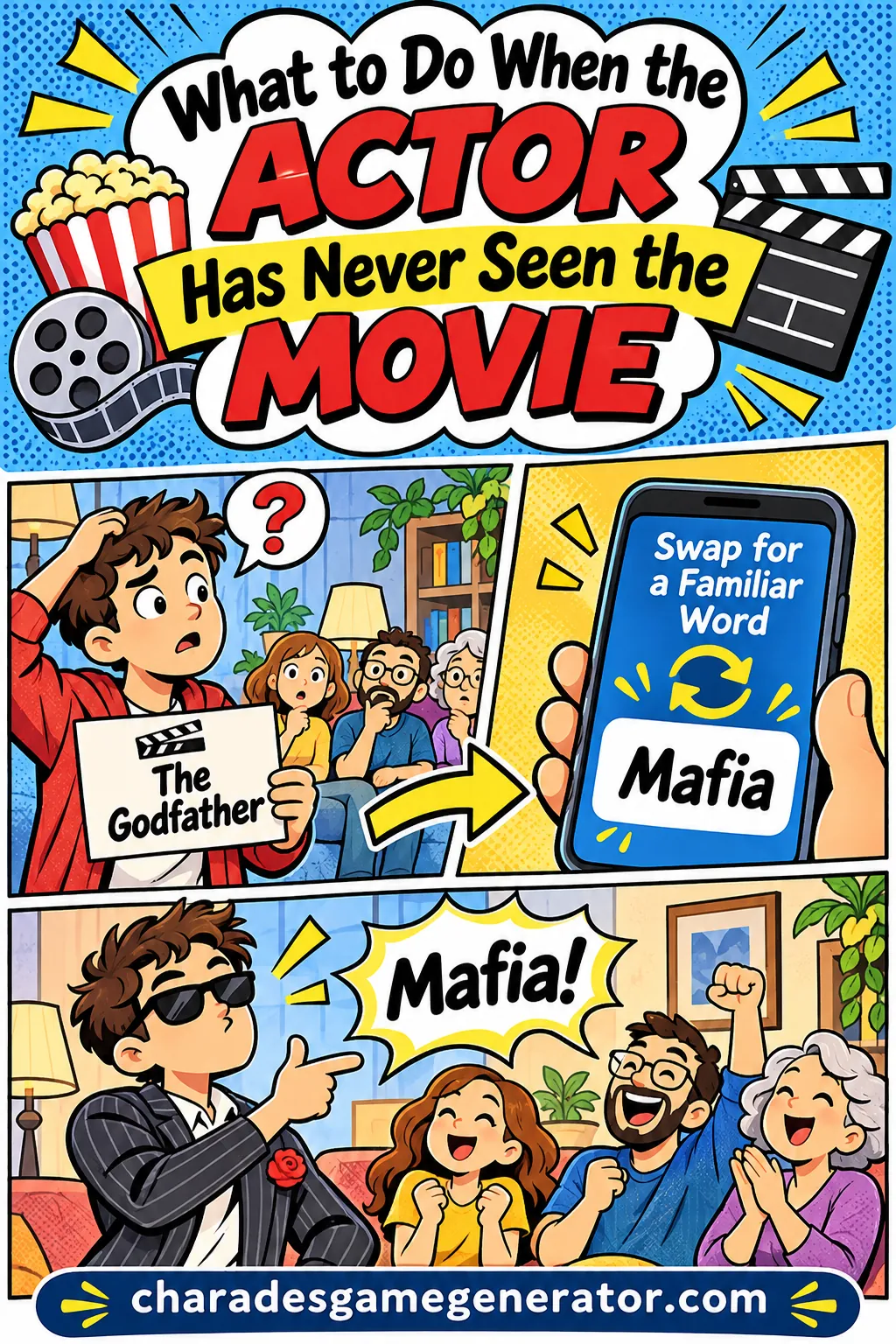
When a charades player doesn't know the word, the fair fix is to let them pass it and grab a new word from the same category right away, with one free pass per turn and a small cost for any extra passes. That keeps the round moving, keeps the actor from guessing wildly at a title they've never heard of, and stops the "that's not fair" argument before it starts.
The free charades game generator on our homepage makes this painless. The actor taps ↷ Skip — too hard! and a fresh word from the same category pops up while the timer keeps ticking. Below you'll find the exact pass rules, scoring options, a host script and a setup that keeps unknown words from wrecking game night in the first place.
Why This Happens So Often
Every group has a gap somewhere. The teenager hasn't seen the classic movie their parents quote. The parents have never watched the show their kids binge. A guest from another country doesn't know a regional saying. A grandparent draws a word that only makes sense if you've been online in the past two years.
It isn't just movies and shows, either. Charades players get stuck on:
- Titles they've never seen in the Movies or TV Shows categories.
- People they don't recognize in Famous People.
- Places they can't picture, like a landmark they've never heard of.
- Foods they've never eaten or words with a regional name.
- Odd vocabulary, like a sport position or a cooking term.
- Words they can't read, which is common with young kids or players reading in a second language.
When the actor freezes on an unknown word, a few bad things happen at once. The clock burns down. The team gets frustrated. The actor feels embarrassed, especially if someone says "How have you never seen that?" And if there's no clear rule, one team gets a do-over while the other didn't, and now you've got an argument.
The good news is that this is one of the easiest charades problems to fix. You just need to decide the rule before the game starts, not in the middle of someone's turn.
The Quick Fix: Pass It and Draw Again
Here's the short version you can read aloud before the first turn:
"If you don't know your word, skip it. You get one free skip per turn. After that, skips cost you. The clock keeps running either way."
That rule handles most stuck moments. It's quick, it's the same for everyone, and it gives the actor a dignified way out. No one has to admit they've never heard of something, and no one has to explain the plot of a movie in a whisper.
Why the clock should keep running
Some groups pause the timer when a player doesn't know the word. Don't. Pausing causes three problems:
- The actor can now "shop" for an easy word by claiming they don't know the hard ones.
- Someone has to pause and restart the timer, which slows every turn.
- The other team starts asking for the same treatment, and fairness slides away.
When the clock keeps running, skipping has a natural cost: the seconds you spent staring at the word. That's usually enough to stop people from skipping words they could act.
Why one free pass is the sweet spot
Zero passes is harsh. An actor who's stuck on a title they've never heard of will either flail or stand there, and the whole room loses interest.
Unlimited free passes are too generous for teens and adults. Players start skipping anything that looks slightly tricky, and the game becomes a race to find the easiest word.
One free pass per turn hits the middle. It covers the genuine "I've never seen that" moments without turning every turn into a word shopping trip. For young kids, beginners or players in a second language, you can allow two or three free passes, or unlimited.
House Rules for Unknown Words
Different groups need different levels of strictness. Pick one of these rule sets and announce it before you start. If you need help writing your full set of rules, our guide on charades house rules covers gestures, penalties and all the classic disputes.
| Rule set | Free passes per turn | Extra passes | Best for |
|---|---|---|---|
| Relaxed | Unlimited | No cost | Young kids, beginners, very mixed groups |
| Standard | 1 | Cost a few seconds of thinking time | Most family and friend game nights |
| Competitive | 1 | Minus 1 point each, tracked on paper | Rivals who love a close score |
| Strict | 0 | Minus 1 point each | Tournament-style or experienced groups |
| Know-it-or-not | 0, but actor can ask for a 10-second whisper | Whisper uses your pass | Groups with a big generation gap |
Rule details people always ask about
Can the actor show the word to a teammate? No. Once a teammate sees the word, they can't guess it. If the actor needs help understanding a word, they can show it to the host or someone on the other team.
Can the actor ask "What is this?" out loud? Only to the host, quietly, and only if your group uses the know-it-or-not rule. Otherwise, they just skip.
What if the actor already started acting? Once you start acting, you can still pass, but it counts as a pass. You can't act half a word, decide it's going badly and get a free swap.
What if the next word is unknown too? That's the second pass. Under the standard rule, it just costs time. Under the competitive rule, it costs a point. Most players will try harder to act the second word rather than give up another point.
Can a different player act the unknown word instead? Not in a normal turn. Turns rotate on the Next Team's Turn screen, and swapping actors mid-turn gets messy fast. If you want that kind of teamwork, try the "lifeline" variation later in this guide.
Tracking passes and scoring
The game keeps score automatically. Each time the actor taps ✓ GOT IT!, their team gets a point, and the totals appear on the Current Scores screen after each turn. Tapping ↷ Skip — too hard! simply serves the next word, so the actor can keep going.
The game doesn't track how many times a team passed, so if you're using a pass limit or a penalty, keep a simple paper tally. Assign one person, usually the host or a player who's sitting out, to make a mark each time someone skips.
A simple pass tally sheet
Draw a grid like this on a sheet of paper or a whiteboard:
| Team | Round 1 | Round 2 | Round 3 | Round 4 | Round 5 | Extra passes | Penalty |
|---|---|---|---|---|---|---|---|
| Team A | |||||||
| Team B | |||||||
| Team C |
In each round box, write the number of passes that team used. Any pass beyond the first free one goes in the extra passes column. At the end of the game, subtract the penalty from the score shown on the Current Scores screen.
Three scoring options
| Scoring option | How passes affect the score | When to use it |
|---|---|---|
| Time cost only | Passes cost nothing on paper, just the seconds lost | Casual nights, younger players |
| Half-point penalty | Every extra pass is minus half a point | Groups that want light stakes |
| Full-point penalty | Every extra pass is minus 1 point | Competitive groups and tournaments |
If you're new to scoring systems, start with time cost only. You can always add penalties next time if people start skipping too freely.
Set It Up in the Game So Unknown Words Rarely Happen
The best way to deal with unknown words is to draw fewer of them. A few smart settings on the Set Up Your Game screen make a big difference.
Open the free charades game with skip and timer and choose these settings for a group with a wide range of tastes and ages.
| Setting | Choose this | Why |
|---|---|---|
| Teams | 2 for up to 10 players, 3 or 4 for bigger groups | Shorter waits between turns |
| Category | Actions, Animals, Places or Food | Things nearly everyone has seen in real life |
| Custom words | Add a few shared favorites (optional) | Words your group definitely knows |
| Timer | 60 sec | Enough time to skip once and still act a full word |
| Rounds | 5 | Gives every player a fair number of turns |
| Difficulty | 🎲 Mixed | A blend of easy and tricky words |
Step by step
- On Set Up Your Game, choose 2, 3 or 4 teams.
- Pick a category. If your group's tastes vary a lot, skip Movies and TV Shows for the first game and start with Actions or Animals instead.
- Optional: open ✏️ Add Custom Words and tap + Add for each word your group shares, like a favorite local spot or a family tradition.
- Set the timer to 60 sec.
- Choose 5 rounds.
- Pick 🎲 Mixed difficulty.
- Read your pass rule out loud, then hand the device to the first actor.
When you do want movies and shows
Movies and TV Shows are some of the most fun categories in charades, so don't avoid them forever. Just set them up for success:
- Use 😊 Easy difficulty. Easy words in these categories tend to be the widely known ones, so there's less chance of a total blank.
- Bump the timer to 90 sec. Title words take longer to act because players often break them into syllables or words.
- Go relaxed on passes. With pop culture, unknown words are more likely, so allow two or more free passes.
For a closer look at how the three difficulty levels feel in practice, check out our guide to charades words by difficulty.
How to Act a Word You Only Half Know
Sometimes the actor sort of knows the word. They've heard the title, they know it's a movie, but they've never seen it. Before using a pass, they can try a few tricks that work even with zero background knowledge.
Act the words, not the story
You don't need to know what happens in a movie to act its title. Most titles are made of ordinary words. Break the title into words, hold up fingers for the total, then act each word on its own. A title about a "frozen castle" can be acted as "cold" plus "castle" without knowing a single scene.
Here's the classic order:
- Signal the category. Crank an old-time movie camera for a film, or draw a rectangle in the air for a TV show.
- Hold up fingers for the number of words.
- Hold up one finger to show which word you're acting first.
- Act that word. If it's tough, tug your ear for "sounds like" and act a rhyming word.
- Move to the next word.
If you need a refresher on the full set of gestures, our list of charades hand signals walks through each one with simple descriptions.
Use "sounds like" for strange words
Even an unfamiliar name can be broken down by sound. If the word is a made-up name, act a word that sounds close. Tug your ear, then act it. Your team doesn't need to know the movie either; they just need to hear the sounds come together.
Act the small words fast
Little words like "the," "a," "of" and "and" slow teams down. Pinch your thumb and finger together to signal a small word, and let the team shout out small words until they hit it. Then move on.
Know when to bail
Give yourself a quick gut check in the first five seconds. If you can't think of a single way to act any word in the title, pass right away. Every second you stare at it is a second you don't have for the next word. A fast pass is a smart pass.
Ready Word Lists Everyone Knows
If unknown words keep showing up, load the game with words your whole group recognizes. These lists avoid specific titles and names entirely. They're built from things people see in everyday life, in stories or in movies of every kind, so nobody needs to have watched anything in particular.
Type any of these into ✏️ Add Custom Words, one entry each.
Easy (anyone can act these)
- Swimming
- Sleeping
- Dancing
- Cooking
- Crying
- Laughing
- Jumping rope
- Climbing a ladder
- Painting a picture
- Driving a car
- Throwing a ball
- Walking a dog
- Eating spaghetti
- Opening a present
- Blowing bubbles
Medium (story and movie ideas without the titles)
These are movie-style ideas that most people know from many different stories, so they work in a Movies round without anyone needing to have seen one specific film.
- Haunted house
- Treasure map
- Car chase
- Space rocket
- Pirate ship
- Robot
- Dragon
- Wizard
- Detective
- Zombie
- Spy
- Cowboy
- Shipwreck
- Time machine
- Superhero landing
- Alien spaceship
- Knight in armor
- Castle under siege
- Monster under the bed
- Secret agent
Hard (still universal, just trickier to act)
- Lost in the jungle
- Escaping from prison
- Falling in a dream
- Bank vault
- Volcano erupting
- Stuck in an elevator
- Shrinking machine
- Invisible person
- Sleepwalking
- Jungle explorer
- Desert island
- Moon landing
- Ghost hunter
- Underwater city
- Giant footprint
That's 50 words, and every one of them can be acted by someone who has never seen a movie in their life.
When you want real titles
If your group loves title charades, have each player write two or three titles they know everyone in the room has seen, then add them in Add Custom Words before the game. Because players picked them, the chance of an unknown title drops a lot. For more ideas on choosing and acting film words, see our list of movie charades words.
Host Scripts for Stuck Actors
The host's tone matters as much as the rule. A stuck actor feels exposed. These lines keep it light.
Before the game:
"Quick rule. If you get a word you don't know, just hit Skip. You get one free skip each turn. Nobody's going to ask why, and nobody's allowed to say 'How have you never seen that?' Deal?"
When an actor freezes on a word:
"Don't know it? Skip! Clock's running, you've got plenty of time."
When someone teases the actor:
"House rule, no movie shaming. Everybody's got a list of things they haven't seen."
When an actor uses their second pass:
"That's one extra pass on the sheet. Totally fine, just keep it in mind for your next word."
When the other team complains:
"Same rule for everyone. Your team gets the same free pass every turn."
When a player is struggling with reading:
"Want me to read it to you quietly? I'm on the other team, so it's fair."
That last one is important. If a young kid or a player reading in a second language can't read the word, the host or someone on the other team can read it to them quietly. It doesn't use up a pass, because the problem is reading, not knowledge.
Settling the arguments
Unknown words cause some of the most heated arguments in charades. Here's how to rule fairly and quickly.
| Argument | Fair ruling |
|---|---|
| "They skipped three times! That's not fair." | Check the pass rule you agreed on. Apply the penalty from the tally sheet. |
| "Our actor got a harder word than theirs." | Words are random. Over five rounds, it evens out. |
| "They said they didn't know it, but they did." | You can't prove it. The running clock is the cost, so let it go. |
| "They paused the timer to look it up." | No looking things up mid-turn. Replay the turn with a new word, or take away that word's point. |
| "The actor showed the word to a teammate." | That teammate can't guess for the rest of the turn, or the word doesn't count. |
| "We never agreed on a pass rule!" | Use the standard rule from now on: one free pass per turn, clock keeps running. |
| "The word was misspelled or confusing." | Free skip, no penalty. That's the word's fault, not the actor's. |
The golden rule for the host: make a call in under ten seconds and move on. It's better to make one slightly imperfect call than to spend five minutes debating it.
Variations That Turn Unknown Words Into Fun
Once your group has a basic pass rule, you can add twists that make an unknown word part of the game instead of a dead end.
The lifeline
Each team gets one lifeline per game. When the actor draws a word they don't know, they can call the lifeline and pick one teammate to whisper a single acting idea, like "flap your arms" or "act a ghost." That teammate can't guess on this word. It's a fun way to use the knowledge on your team without breaking the game.
Choose one of two
Before each turn, the actor can look at the first word and, if they don't love it, tap ↷ Skip — too hard! once to see a second word. They must act one of those two, and they can't go back to the first one. Since the game serves new words in order, the "choice" is really one free pass, but framing it as a choice feels friendlier to nervous players.
The generation-gap round
This round leans into the problem on purpose. Split players by age group, so younger players write words they think older players won't know, and older players do the same for the younger ones. Add all of them in Add Custom Words. Each actor must try to act a word from the other generation's list, using only "sounds like" and word-by-word clues. It's chaotic in the best way, and everyone learns something.
Teach it after
When a player passes on an unknown title, write it on a sticky note. After the game, go around the room and have someone give a 20-second, spoiler-free description of each one. It turns blank moments into "Oh, we should watch that sometime," and it's a nice way to end a game night.
Speed passes
For a fast, high-energy game, use a 30 sec timer and allow unlimited passes. Actors flip through words quickly, acting only the ones they know instantly. This works well for teens and big groups that like a frantic pace.
Fixes for Different Kinds of Groups
The right pass rule depends on who's playing. Here's what tends to work best.
Families with a big generation gap
Grandparents and grandkids rarely know the same titles or famous people. Use the relaxed rule with unlimited passes, choose Actions or Animals, and set the timer to 90 sec. If you play Movies, add custom titles that both generations know, like classic stories that have been retold many times.
Friends with different tastes
Friend groups often split between people who watch everything and people who barely watch anything. Use the standard rule, one free pass per turn, and mix a non-pop-culture category into your night. Alternate Movies with Places or Actions so the non-watchers get some easy wins.
Guests learning English
A player learning English might know a word but not recognize it in writing, or know a movie by a different title in their language. Let the host read words aloud quietly, give two free passes per turn, and lean on simple, concrete categories. If a player knows the movie under a different name, they can still act it, since the actions and ideas are the same in any language.
Young kids
Kids under eight should get unlimited passes, no penalties and help reading the word. Pick the Kids or Animals category on 😊 Easy, and set 90 sec. The goal is for them to feel successful, not to learn the rules of competitive charades.
Serious players
For competitive groups, use the strict or competitive rule, 60 sec, and 😤 Hard words. Keep a careful tally sheet. Many serious players actually enjoy the challenge of acting a word they half know, so you'll see fewer passes than you'd expect.
A quick prevention checklist
Run through this list before game night and most unknown-word problems disappear before they start.
- Agree on a pass rule and say it out loud before the first turn.
- Start with a category everyone can relate to, then move to pop culture.
- Use 😊 Easy or 🎲 Mixed for groups with very different tastes.
- Add a handful of custom words the whole group shares.
- Put a pen and paper near the host for the pass tally.
- Ban teasing about what someone hasn't seen.
- Let the host, or someone on the other team, read words to anyone who needs it.
- Play a quick practice turn so everyone sees how Skip works.
Ready for game night? Open the free online charades game, choose your category, timer and difficulty, and read the pass rule before the first actor steps up. Nobody will get stuck staring at a word they've never heard of again.
Frequently Asked Questions
What happens in charades if the player doesn't know the word?
The fairest fix is to let them pass and draw a new word, with the clock still running. Most groups allow one free pass per turn, then add a small penalty for extra passes. Agree on the rule before the game starts so there's no argument later.
How many skips should you allow in charades?
One free skip per turn works for most adults and teens. For kids, beginners and players learning English, allow two or more, or make skips unlimited. Competitive groups can charge one point for every pass after the first.
Should the timer stop when the actor passes?
No, keep the timer running. Stopping it lets players hunt for easy words and slows down every turn. The seconds lost while looking at an unknown word are a natural, fair cost.
Can the actor ask someone what the word means?
Not a teammate, since that teammate would then know the answer. The actor can quietly ask the host or a player from the other team. Many groups allow this only for reading help, not for explaining a whole movie.
How do you act out a movie you've never seen?
Act the title word by word rather than the story. Hold up fingers for the number of words, act each one, and use "sounds like" for unusual names. Your team only needs to hear the words, not know the plot.
Does skipping a word cost points?
That's up to your house rules. The game itself simply gives you the next word when you skip, and you only score for words your team guesses. If you want a penalty, keep a paper tally and subtract it at the end.
How do you stop players from skipping every hard word?
Limit free passes to one per turn and keep the timer running. Add a point penalty for extra passes if people keep skipping. Most players will try harder once each skip has a clear cost.
What categories have the fewest unknown words?
Actions, Animals, Places and Food tend to have words nearly everyone knows from everyday life. Movies, TV Shows and Famous People have the most gaps between players. Start with an everyday category and move to pop culture once everyone is warmed up.