Charades Arguments: Does a Close Guess Count?
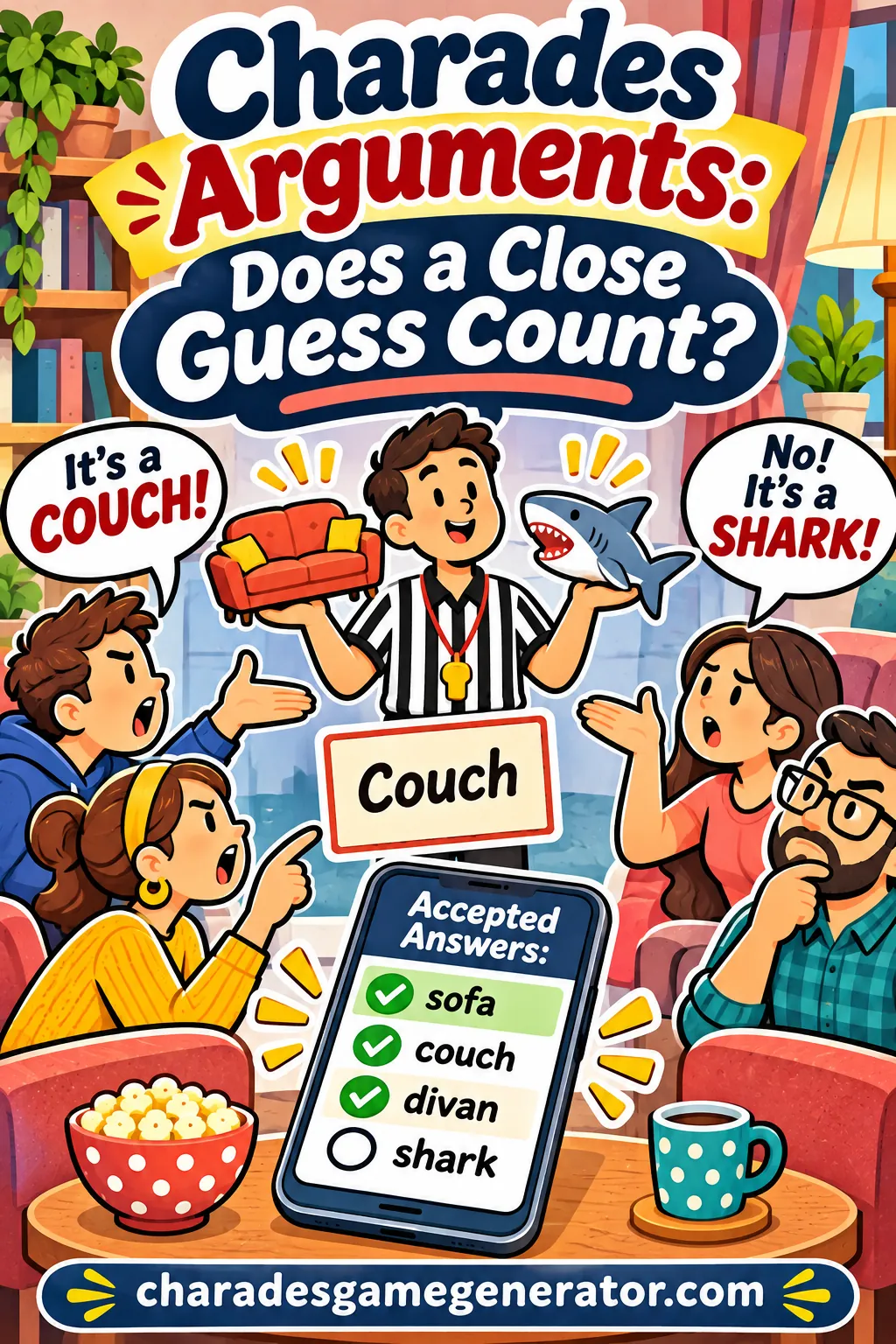
A close guess counts only if your group agreed on a "close enough" rule before the first turn, and the simplest fair rule is this: the guess must match the card's main word, with plurals, verb endings and an added "a" or "the" allowed, but synonyms don't count until the guesser says the exact word. That one sentence ends most charades arguments before they start. The trick is to say it out loud, show everyone the card on screen after each turn, and name one judge who has the final say.
The free charades game on our homepage makes this easier because the word sits right on the actor's screen. When the timer ends, you can turn the phone around and everyone sees exactly what the card said. No crumpled slips, no "I swear it said sofa." Below you'll find ready-to-use house rules, a scoring table for near misses, a judge script, practice word lists full of tricky synonyms, and fixes for the arguments that come up again and again.
Why "Close Enough" Starts So Many Fights
Charades is a silent game, but it has a loud problem. The actor knows the exact word. The guessers only see a performance. So when someone yells "sofa!" and the card says "couch," there are suddenly two reasonable positions in the room.
The guessing team says: "We obviously knew what it was. Sofa and couch are the same thing." The other team says: "The card says couch. You didn't say couch." Both sides have a point, and nobody set the rule ahead of time. That's the whole fight in a nutshell.
Here are the most common kinds of near misses that cause trouble:
- Synonyms. Sofa for couch, bunny for rabbit, kitty for cat, ocean for sea.
- Word forms. Run for running, swimmer for swimming, dance for dancer.
- Plurals and articles. Puppies for puppy, "the moon" for moon, "a ghost" for ghost.
- Partial phrases. "Brushing" when the card says "brushing teeth," or "castle" when it says "sandcastle."
- Related but wrong. "Shark" when the card says "fish," or "doctor" when it says "nurse."
- Category guesses. "A sport!" when the card says "tennis."
Some of these are clearly fine. Some are clearly not. The middle ones are where game night goes sideways. If you decide which bucket each type falls into before you play, the argument has nowhere to go.
There's also a timing issue. Most disputes happen in the last few seconds of a turn, when the clock is about to run out and everyone is shouting at once. The actor nods at something, the timer beeps, and then someone asks, "Wait, did that count?" A clear rule and a single judge fix that too.
The Close Enough Rule, Explained
Most groups end up with one of three standards. Pick one, announce it, and stick with it for the whole game. You can switch next time, but changing mid-game is how friendships get tested.
Option 1: Exact word only
The guess must match the card word exactly. "Couch" is right, "sofa" is not. "Running" is right, "run" is not.
This is the strictest version and the easiest to judge, because there's nothing to debate. It's popular with competitive groups and older teens. The downside is that it can feel harsh, especially for kids or players who don't speak English as a first language.
Option 2: Same word, any form (the recommended default)
The guess must contain the card's main word, but small changes are fine:
- Plurals and singulars count (puppy or puppies).
- Verb endings count (run, runs, running, ran).
- Little words count or don't matter (a, an, the).
- Obvious mispronunciations count if the word is clearly the same.
Synonyms don't count on their own. If someone says "sofa," the actor keeps going, maybe by pointing at the guesser and making a "you're close, keep going" gesture. Once anyone says "couch," it's a point.
This is the rule we'd suggest for most mixed groups. It's fair, it's quick to judge, and it still rewards guessers for getting the actual word.
Option 3: Same meaning counts
Any word that means the same thing earns the point. Sofa for couch, bunny for rabbit, ocean for sea.
This is the friendliest version. It works well for young kids, family gatherings with a wide age range and ESL groups. The catch is that "same meaning" is fuzzy. Is "fish" the same as "shark"? Is "jog" the same as "sprint"? You'll need a judge with the final say, and you'll want a few examples agreed on before you start.
| Rule | What counts | What doesn't | Works best with |
|---|---|---|---|
| Exact word only | The card's word, spelled out loud as written | Synonyms, other word forms | Competitive adults, tournament nights |
| Same word, any form | Plurals, verb endings, a/an/the, small slips | Synonyms, related words | Most mixed groups, family game night |
| Same meaning counts | True synonyms and common nicknames | Related but different things | Young kids, ESL groups, casual parties |
A ready-to-read house rule for guesses
If you'd like a rule you can read aloud word for word, use this one. It's written for the "same word, any form" standard:
"A guess counts when you say the main word on the card. Plurals, verb endings, and little words like 'a' and 'the' are fine. Synonyms are close, not correct, so the actor will signal you to keep going. For phrases, you need every main word, in any order. The judge sees the card at the end of each turn and has the final call."
Read it once before the first turn. Read it again if new players join halfway through. It takes fifteen seconds and saves you fifteen minutes of debate.
You can add this to the other agreements your group makes about pointing, mouthing words and signals. Our charades house rules page has a full set of starter rules if you want everything in one place.
Rules for phrases and two-word cards
Phrases cause their own arguments. Say the card reads "brushing teeth." The guessing team yells "brushing!" and then "teeth!" a few seconds apart. Does that count?
Here's a clean way to handle it:
- All main words must be said by the guessing team during the turn.
- Order doesn't matter. "Teeth brushing" is fine.
- Different people can say different parts. Teamwork counts.
- The actor confirms each piece with a nod or a finger touch to the nose, so guessers know what they've already got.
- Filler words don't need to be said. For "walking the dog," "walking dog" is enough.
If your group plays a lot of multi-word cards, have actors split phrases into pieces: hold up fingers for the word count, then act one word at a time.
Choose a Judge Before the First Turn
The single best fix for close-guess arguments isn't a rule. It's a person. Before you start, pick a judge whose call is final.
A good judge has a few traits:
- They're not on either team, or they rotate so every team gets a fair share of judging.
- They can see the actor's screen at the end of each turn.
- They make the call quickly and don't reopen it later.
- They stay calm when people groan.
In smaller groups, the judge can be the actor's opponent captain. That works because the person with the most reason to say "no" is the one deciding, which makes any "yes" feel earned. In big groups, a neutral host is better.
What the judge actually does
The judge's job is small but important:
- Before the turn, they confirm which rule is in force (exact, any form, or same meaning).
- During the turn, they listen for the winning guess.
- When there's a near miss, they make a quick hand signal: a flat hand wobbling means "close, keep going."
- When the guess is right, they point at the actor, who taps ✓ GOT IT! on the screen.
- After the turn, they look at the card on the screen if anyone questions a call.
- If it's still unclear, they decide, and the game moves on.
That last step matters most. A judge who says "Let me think about it" invites the whole room to chime in. A judge who says "Close, but no point. Next team!" keeps the night moving.
Judge hand signals that work
Since the actor can't talk, a judge with clear signals helps everyone. Teach these before you start:
| Signal | Meaning |
|---|---|
| Flat hand wobbling side to side | Close, keep guessing |
| Finger touching nose | Exactly right |
| Thumbs up, then point at actor | Point awarded, tap GOT IT |
| Hands crossed in an X | That guess doesn't count |
| Hand cupped behind ear | Say it again, I didn't hear |
| Time-out T with both hands | Pause, ruling coming |
Some of these overlap with the classic acting signals, which is fine. If your group wants the full set of actor gestures, the charades hand signals guide walks through the rest.
How to Set It Up in the Game
The biggest cause of close-guess arguments is that nobody can check the card. Paper slips get folded, dropped, or shoved back in the bowl. With the free online charades game, the word is right there on the actor's screen, so the judge can confirm it in a second.
Here's a setup built to keep guessing disputes to a minimum.
Step-by-step settings
- Open the homepage on one phone or tablet. No app or signup needed.
- Under Set Up Your Game, choose your teams. Pick 2 teams for most living-room games, 3 or 4 for bigger crowds.
- Pick a category. For this kind of game, Animals, Actions or Kids work well because the words are concrete. Concrete words are easier to judge than ideas.
- Set the difficulty to 😊 Easy for your first game. Easy words tend to have one clear name, so there's less room for "close but not quite."
- Set the timer to 60 sec. It's long enough that guessers can fix a near miss, but short enough to keep the energy up.
- Choose 5 rounds. That gives every team several turns without the game dragging.
- Optional: tap ✏️ Add Custom Words and type in a few practice words from the lists below. Tap + Add after each one.
- Read your guess rule aloud before the first team starts.
During each turn
- The actor sees the word and starts acting.
- When the guessing team says the word according to your rule, the actor taps ✓ GOT IT! and the next word appears.
- If the word is too hard, the actor taps ↷ Skip — too hard! and gets a new one.
- When the clock runs out, the Time's Up screen appears, and the Current Scores show the totals.
- Before tapping Next Team's Turn, the judge can ask the actor to show the last card if anyone questions it.
A setup cheat sheet by group
| Group | Teams | Category | Timer | Rounds | Difficulty | Guess rule |
|---|---|---|---|---|---|---|
| Family with young kids | 2 | Kids or Animals | 90 sec | 3 | 😊 Easy | Same meaning counts |
| Mixed-age family night | 2 | Actions | 60 sec | 5 | 🎲 Mixed | Same word, any form |
| Teens and adults | 2 or 3 | Movies or Famous People | 60 sec | 5 | 🎲 Mixed | Same word, any form |
| Competitive adults | 2 | Any | 60 sec | 7 | 😤 Hard | Exact word only |
| Big party | 4 | Office Party or Places | 30 sec | 3 | 🎲 Mixed | Same word, any form |
| ESL or language class | 2 | Food or Animals | 90 sec | 3 | 😊 Easy | Same meaning counts |
A quick note on the Movies and TV Shows categories: titles are the hardest cards to judge because people remember them slightly wrong. If your group plays those categories, agree that the title must be said with all its main words, but small words like "the" or "of" can be dropped.
Making the rule obvious with a 30-second practice
Before the real game, run one practice turn with no points. Have the host act out "couch" and let people guess. Someone will almost always say "sofa." That's your moment. Stop, smile, and say, "Close! That's exactly the kind of guess that keeps going. Now say the word on the card." Once someone says "couch," tap ✓ GOT IT! and show the screen.
Everyone now knows the rule in action, not just in theory. It's the fastest training you'll ever do.
Practice Word Lists Full of Near Misses
These words are chosen because they have common synonyms or look-alike guesses. Use them for a practice round, a warm-up, or a whole "near miss" challenge game. Type them into ✏️ Add Custom Words, or read them from your phone.
Each word includes the near miss people usually shout first, so the judge knows what's coming.
Easy (great for kids and first-timers)
| Card word | Common near miss |
|---|---|
| Couch | Sofa |
| Rabbit | Bunny |
| Cat | Kitty |
| Puppy | Dog |
| Hat | Cap |
| Car | Truck |
| Rock | Stone |
| Ocean | Sea |
| Sleeping | Napping |
| Jumping | Hopping |
| Running | Jogging |
| Mom | Mother |
| Present | Gift |
| Trash can | Garbage can |
| Stairs | Steps |
| Sweater | Hoodie |
| Ball | Balloon |
| Bird | Chicken |
| Pillow | Cushion |
| Shouting | Yelling |
Medium (good for mixed-age groups)
| Card word | Common near miss |
|---|---|
| Shark | Fish |
| Jogger | Runner |
| Firefighter | Fireman |
| Teacher | Principal |
| Doctor | Nurse |
| Thunderstorm | Rain or lightning |
| Sneezing | Coughing |
| Cupcake | Muffin |
| Sandcastle | Castle |
| Tightrope | Balancing |
| Snowman | Snowball |
| Astronaut | Rocket |
| Skateboarding | Surfing |
| Bicycle | Motorcycle |
| Waving | Saying hello |
| Laughing | Smiling |
| Painting | Drawing |
| Ladder | Stairs |
| Burger | Sandwich |
| Gardening | Planting |
Hard (for teens, adults and competitive groups)
| Card word | Common near miss |
|---|---|
| Lifeguard | Swimmer |
| Mechanic | Fixing a car |
| Librarian | Reading |
| Hiccups | Burping |
| Daydreaming | Thinking |
| Tornado | Hurricane |
| Volcano | Mountain |
| Detective | Spy |
| Plumber | Fixing a sink |
| Conductor | Musician |
| Juggling | Throwing |
| Escalator | Elevator |
| Archaeologist | Digging |
| Surgeon | Doctor |
| Tiptoeing | Sneaking |
| Shivering | Cold |
| Pharmacist | Doctor |
| Typing | Texting |
| Whispering | Telling a secret |
| Blizzard | Snowstorm |
That's 60 words across three levels. Mix them into any category, or play them on their own as a "close call" warm-up.
How to use these lists well
- Read the near miss column to the judge only. The guessers shouldn't see it.
- Decide in advance whether any near miss is actually acceptable under your rule. Under "same meaning counts," "snowstorm" for "blizzard" is probably fine. Under "same word, any form," it isn't.
- Use the near miss as a coaching tool. When someone says the near miss, the actor can flash the "close, keep going" wobble. That's part of the fun.
How actors can help guessers get the exact word
A good actor doesn't just get people near the word. They steer people onto it. These moves help turn "sofa" into "couch" without a single sound.
The wobble. Hold your flat hand out and tilt it side to side. Everyone recognizes this as "close." Keep acting while you do it.
Point and pull. Point at the person who said the near miss, then make a "come here" motion with your fingers. It means "you're almost there, keep going in that direction."
The stretch. For word forms, like "run" when the card says "running," pretend to stretch a rubber band between your hands. That's the classic sign for "make it longer." For a shorter word, squeeze your hands together.
Sounds like. Tug your ear, then act out a word that rhymes with the answer. For "couch," you might tug your ear and then act "ouch" by stubbing your toe. This works best with older players who know the signal.
Show the number of syllables. Lay fingers on your forearm. Two fingers for two syllables. It helps guessers pick between "dog" and "puppy."
Act the difference. If people keep saying "fish" for "shark," don't just swim. Put your hand on your head like a fin and snap your arms like jaws. Act what makes the card word special.
These tricks aren't just for close guesses. They make you a better actor in every round. For more ideas, the how to win at charades guide has a full set of strategies for actors and guessers.
Scoring Options for Near Misses
Some groups like a middle ground. Instead of "yes or no," they give partial credit for close guesses. This can cool down arguments because nobody walks away with nothing.
Just keep in mind that the game's built-in scoreboard counts one point per ✓ GOT IT! tap. If you want half points, keep a quick tally on paper or a notes app alongside the game, and add it to the Current Scores at the end.
| Scoring style | How it works | Pros | Cons |
|---|---|---|---|
| All or nothing | Exact word (under your rule) earns 1 point. Near misses earn nothing. | Simple, uses the built-in scoreboard | Can feel harsh for kids |
| Keep going | Near misses earn nothing, but the actor keeps acting until the real word comes | Fair and fast, no extra math | Takes a few extra seconds |
| Half point | A judge-approved synonym earns half a point; the actor then skips | Reduces arguments, rewards effort | Needs a side tally |
| Bonus for exact | Synonym earns 1 point, exact word earns 2 | Rewards precision without punishing | Needs a side tally |
| Steal on a miss | If time runs out with a near miss, the other team gets one guess to steal | Keeps everyone watching | Can slow the game |
For most groups, "keep going" is the winner. It needs no extra scoring, and the near miss becomes part of the fun instead of a reason to argue. If you want more ways to keep score across rounds, our charades scoring guide covers bonus points, penalties and team totals.
Troubleshooting the Most Common Arguments
Even with a clear rule, some situations still come up. Here's how to handle each one quickly and fairly.
"We said it at the exact same time the timer beeped!"
This is the classic. Make a rule now: the guess must be finished before the Time's Up screen appears. If the judge can't tell, give it to the guessers once per game, then hold the line. A "tie goes to the guesser" rule feels generous and rarely gets abused.
"Someone on the other team said it first!"
In standard team charades, only the actor's team can score. If an opponent blurts out the answer, it doesn't count for anyone, and the actor taps ↷ Skip to move on. Some groups add a small penalty for blurting, like the blurting team losing its next skip. Decide before you start.
"The actor nodded, so it counts!"
Actors sometimes nod at a near miss by accident, just because they're excited. The nod isn't the ruling; the word is. The judge should check the card. If the guess doesn't match the rule, there's no point, even if the actor looked happy. A good habit: actors only tap ✓ GOT IT! when the judge gives a thumbs up.
"That's what we call it at home!"
Regional words can be tricky. One family says "soda," another says "pop." One says "sneakers," another says "tennis shoes." Under "same meaning counts," regional names should count. Under the stricter rules, the guessers can quickly try the other version. Most of the time they get it within a second or two.
"The actor mouthed the word!"
Mouthing or whispering the answer breaks the silent rule. The usual fix is simple: the word doesn't count, the actor skips it, and the turn continues. If someone does it again, that team loses the point for the turn. Keep the tone light. Most mouthing happens by accident when an actor gets excited.
"They guessed the whole category, not the word!"
Shouting "an animal!" or "a sport!" doesn't count. The card says "giraffe" or "tennis." Guessers need the specific word. A good actor can help by first confirming the category with a nod, then acting out the specific details.
"They guessed half of the phrase!"
For multi-word cards, all the main words need to be said. If the guessers only got "brushing," the actor keeps going until someone says "teeth." If time runs out with only half the phrase, there's no point. That's one reason many groups choose 😊 Easy or 🎲 Mixed difficulty for younger players, since simpler cards are quicker to finish.
"The card itself is wrong!"
Sometimes a word is just confusing, or a custom word was typed with a mistake. If the judge agrees the card is unclear, the actor can tap ↷ Skip — too hard! without any penalty. Fix any typos in your custom words before the next game.
"We would have gotten it if the actor had been clearer!"
That's not a ruling question, it's a performance question. The score stands. Offer the team a quick tip instead: try the acting tricks above, or switch to a longer timer next game.
Variations by Age and Group Size
Your rule should fit your crowd. Here's how to adjust for different groups.
Young kids (about 4 to 8)
Use "same meaning counts." Little kids often know the idea but not the exact word. If a five-year-old says "doggy" and the card says "puppy," let it count. The goal is fun and confidence. Set the timer to 90 sec, choose the Kids or Animals category, and pick 😊 Easy. If you're running a kids' party, our charades rules for kids page has more ways to keep things gentle.
Older kids and tweens (about 9 to 12)
Try "same word, any form." This age group loves a clear rule and will hold everyone to it. Let them help pick the judge. You might be surprised at how fair they are when they're in charge.
Teens
Teens can handle the stricter rules, especially if they're competitive. "Same word, any form" is still the best default, but "exact word only" makes a fun challenge round. Use 🎲 Mixed or 😤 Hard difficulty and a 60 sec timer.
Adults
Adults are the most likely to argue, honestly. They're also the most likely to want a rule spelled out. Use "same word, any form," appoint a neutral judge, and stick to the card on screen. For a dinner party, the 30 sec or 60 sec timer keeps things lively.
Mixed ages
When kids and grown-ups play together, use a split rule: "same meaning counts" for players under 10, "same word, any form" for everyone else. It sounds complicated, but in practice everyone gets it. Grown-ups usually enjoy being held to a slightly higher standard.
Big groups
With 3 or 4 teams, appoint one host as the permanent judge. They hold the phone between turns, check the card on the screen and announce scores. That keeps one person in charge of every ruling, which is much fairer than letting each team judge its own turn.
Two or three players
In tiny games, there's no separate judge. Let the actor make the call, with one rule: if the guesser disagrees, the actor shows the screen and the card decides. It's simple and honest.
A Short Script for the Host
Hosts set the tone. Here's a script you can read before the first turn, during a dispute and at the end. Feel free to put it in your own words.
Before the first turn:
"Okay, quick rules on guessing. You need the word on the card. Plurals and endings are fine, and 'a' or 'the' don't matter. Synonyms are close, not correct, so if the actor wobbles their hand, keep going. For phrases, you need all the main words. I'm the judge tonight, and I'll check the card on screen if anyone asks. My call is final, and I promise to be fair. Let's play!"
When there's a dispute:
"Let's look at the card. The card says couch. You said sofa. That's close, but under our rule it doesn't count. No point this time. Next team!"
Or, when it does count:
"The card says running. You said run. Same word, different ending, so that counts. Point!"
At the end of the game:
"Thanks for keeping it friendly. If anyone wants to try a different guess rule next game, we can vote on it now."
That last line matters. It gives people a place to air small frustrations without fighting about the last turn.
Building the rule into your game night routine
Once your group settles on a rule, make it part of the routine. That way you don't have to debate it every time.
- Write it on a card. Keep a small note with your house rules near your games shelf.
- Say it in the same words every time. People remember rules better when they hear them the same way.
- Practice with a "close call" warm-up. Use the lists above for one quick round before the main game.
- Rotate the judge. Give different people a turn so it never feels like one person is in charge.
- Revisit after the game. If the rule caused trouble, adjust it next time, not mid-game.
If you're putting together a whole evening, plan the snacks and breaks around the game so nobody has to step away mid-turn.
When you're ready, open the charades game, set your teams, timer and rounds, read your guess rule out loud and start the first turn. With the card right on the screen, there's not much left to argue about.
Frequently Asked Questions
Does a synonym count in charades?
It depends on your house rule. Under the common "same word, any form" rule, a synonym is close but not correct, so the actor signals the guessers to keep going. Under a "same meaning counts" rule, synonyms earn the point. Decide which one you're using before the first turn.
What is the charades close enough guess rule?
It's an agreement about how close a guess must be to earn a point. Most groups allow plurals, verb endings and small words like "a" or "the" to differ, but ask for the card's main word itself. The key is setting it before the game, not during an argument.
Who decides if a guess counts in charades?
A judge chosen before the game starts. It can be a neutral host, the opposing team's captain or the actor in a two-player game. The judge checks the card on screen if needed, makes a quick call and moves the game on.
Does "run" count for "running" in charades?
Under most house rules, yes. Different forms of the same word, like run, runs, ran and running, usually count. Only the strictest "exact word only" rule would ask for "running" itself.
What if the guessing team says the word right as the timer ends?
Agree that the guess must be finished before the Time's Up screen appears. If the judge honestly can't tell, many groups give it to the guessers once per game. After that, the clock wins.
Do you need to say every word of a phrase?
Yes, under most rules you need every main word, but order doesn't matter and small filler words can be skipped. Different teammates can say different parts. The actor confirms each piece with a nod so guessers know what's left.
How do you stop charades arguments for good?
Pick a guess rule before you start, name a judge with the final say and check the card on screen when anyone asks. A quick practice turn with a word like "couch" shows everyone how near misses work. After the game, vote on any rule changes for next time.
Should kids follow the same guessing rules as adults?
Not necessarily. Young kids often know the idea but not the exact word, so "same meaning counts" keeps the game fun. In mixed-age groups, many families use a looser rule for younger players and a stricter one for grown-ups.