Charades Players Keep Shouting Out Answers: How to Fix It
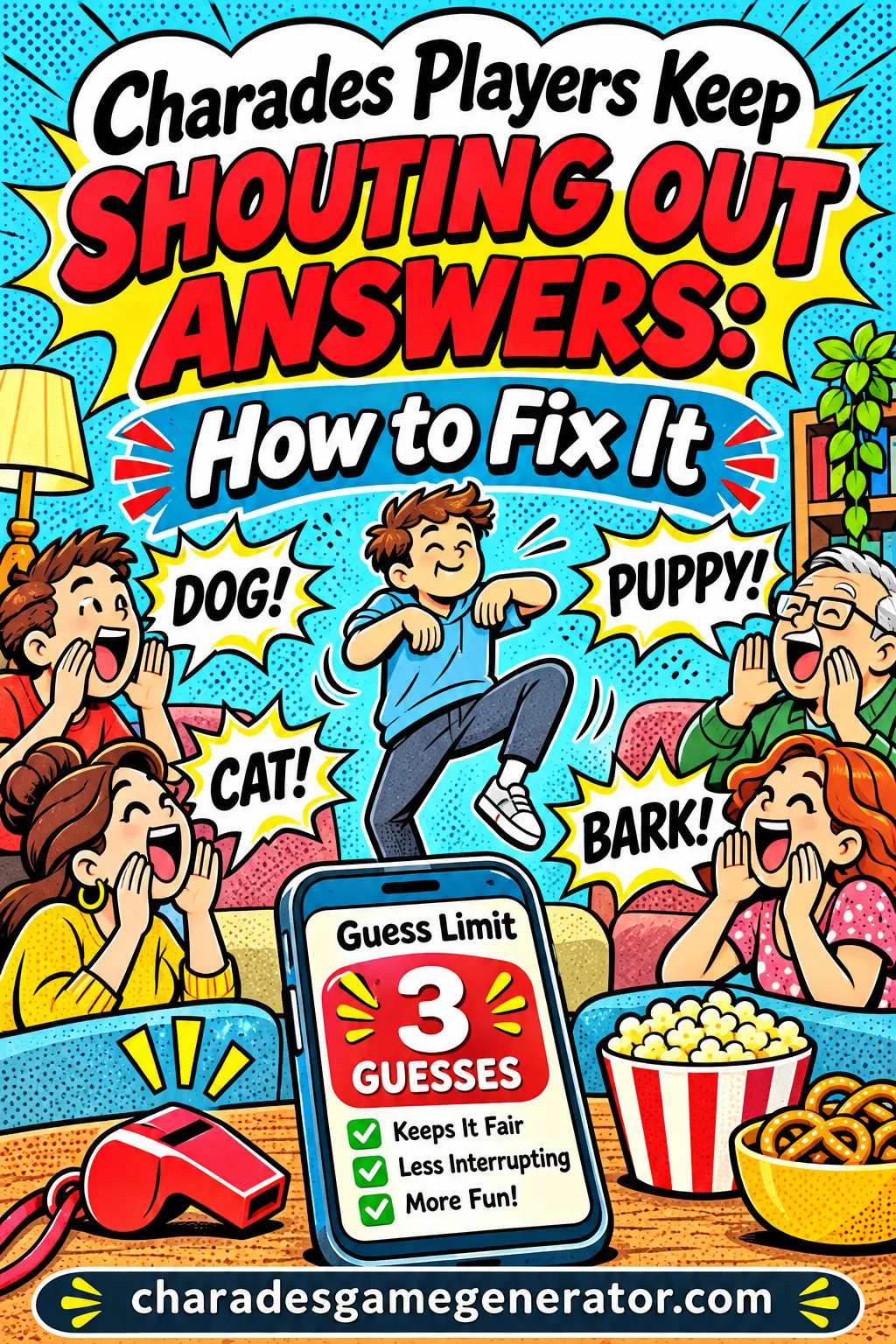
When everyone shouts answers at once in charades, the fix is to name one guesser per word, cap that guesser at three guesses, and only count an answer from the person whose turn it is. That one change quiets the room, gives quieter players a real shot and stops the loudest person from winning every round. The free charades game on our homepage handles the timer, teams and scores, so you can focus on running these house rules.
If you've ever had a round where five people yell "dog! wolf! fox! coyote! werewolf!" in the same breath, you know the problem. The actor can't tell who said what. The person who whispered the right answer gets ignored. And the one guest with the biggest voice ends up with all the points, while everyone else stops trying.
Charades everyone shouting answers is one of the most common game-night complaints, and it's easy to fix once you change who's allowed to talk and when.
Why Shouting Takes Over a Charades Game
Shouting isn't usually rude on purpose. It happens because the classic rules don't say anything about it. Traditional charades says the actor's team guesses, and that's about it. So the whole team guesses at once, as fast and loud as they can, because speed is the only thing that seems to matter.
Here's what that does to a game:
- The loudest person wins. Not the best guesser. The loudest. Even if someone else said it first, the actor hears the big voice.
- Shy players drop out. After two rounds of being talked over, quieter guests stop trying. They become spectators at their own game night.
- Actors get confused. An actor hearing six guesses at once can't nod at the right one or steer toward a close guess. The acting gets worse.
- Arguments start. "I said it first!" "No you didn't!" Nobody can prove it, and the fun stalls.
- Kids melt down. For younger players, losing to a louder sibling or cousin every turn is a fast route to tears.
There's also a sneaky problem: when everyone yells, people stop watching the actor carefully. They just fire off every word in the category hoping one sticks. That's not guessing. That's a list read at top volume, and it takes the acting out of the game.
Signs your game has a shouting problem
| What you notice | What's really happening |
|---|---|
| One person scores most of the team's points | Volume is beating attention |
| Quiet players stop guessing after round two | They've learned they won't be heard |
| Actors keep saying "Wait, who said that?" | Too many voices at once |
| Guessers rattle off whole categories | Spamming instead of reading the actor |
| Every correct guess ends in an argument | No clear rule about who counts |
| The other team complains about noise | Shouting is spilling into their turn |
If you see two or more of these, it's time for a guess rule.
The Fix: One Guesser, Three Guesses
The simplest fix that works for almost every group is this: one guesser per word, three guesses each. Here's how it works.
- Name the guesser. Before the actor sees the word, the team picks one person to guess. Everyone else on the team watches silently.
- Three guesses only. The guesser gets up to three spoken guesses for that word. A guess is any full answer said out loud.
- Correct guess scores. If the guesser gets it, the actor taps ✓ GOT IT! and the team scores.
- Out of guesses, move on. If all three guesses miss, the actor skips to the next word, and a new teammate becomes the guesser.
- Rotate. Each new word gets a new guesser, going around the team in order.
That's it. The room gets quieter right away, because only one person is talking. The quiet cousin finally gets a turn. And the person who loves to shout? They get their turn too, but only one turn in four.
Why three guesses?
Three is a sweet spot. One guess feels harsh, especially for kids, and leads to long silences while the guesser panics. Unlimited guesses lets the guesser spam the whole category. Three gives enough room to get close and adjust, but not enough to just list everything. If the actor gives a "close" signal on guess two, the guesser has one more shot to nail it.
Some groups like other numbers. Here are the options:
| Guess limit | Best for | Feels like |
|---|---|---|
| 1 guess per word | Competitive adults, hard mode | Tense, every guess counts |
| 2 guesses per word | Teens and adults who play often | Fast, still forgiving |
| 3 guesses per word | Most families and mixed groups | Balanced, the default to start with |
| 5 guesses per word | Young kids, first-time players | Relaxed, lots of tries |
| Unlimited, one guesser | Shy groups getting comfortable | No pressure, still one voice |
Start with three. Adjust after the first game if it feels too tight or too loose.
What counts as a guess?
You'll want to settle this before you start, because it's the first thing people argue about.
- A guess is a full answer said out loud. "Elephant" is a guess. "Um, is it, like, a big animal?" is not.
- Thinking out loud counts after the first time. Give one friendly warning, then start counting mumbles.
- Changing your answer mid-word counts as one guess. "Hippo, no, rhino!" is one guess. The rhino counts.
- Teammates whispering hints counts against the team. If a silent watcher helps, the actor skips the word. No points.
How to Set It Up in the Game
The free charades game doesn't have a guess counter built in, but it handles everything around it: teams, the timer, scoring and turn order. The guess rule lives with your host. Here's the exact setup for a group of eight.
Step 1: Teams. Pick 2 teams of four. With four players, each team has one actor and three guessers who take turns. That's the size where the one-guesser rule shines. If you have twelve, go with 3 teams of four. Sixteen people? 4 teams of four.
Step 2: Category. Pick something with clear, guessable answers for your first game. Animals, Actions or Sports are great. Avoid very hard categories at first so the guess limit doesn't feel brutal.
Step 3: Custom words (optional). If you want, tap ✏️ Add Custom Words and use + Add for a few calm, slow-to-act words like "knitting" or "bird watching." These are great for teaching the new rule because they reward careful watching over fast shouting.
Step 4: Timer. Pick 90 sec. With one guesser at a time and three guesses each, turns move a bit slower at first. Ninety seconds gives each team time to rotate through two or three guessers per turn. Drop to 60 sec once everyone has the hang of it.
Step 5: Rounds. Pick 5 rounds. That's enough for every player on a four-person team to be the actor at least once, with a turn or so left over.
Step 6: Difficulty. Start with 😊 Easy. Easy words help everyone learn the new rhythm. Switch to 🎲 Mixed for the second game.
Then play. When the actor's team gets the word, the actor taps ✓ GOT IT! When the guesser uses all three guesses, the actor taps ↷ Skip — too hard! and the next teammate becomes the guesser. When the Time's Up screen appears, check Current Scores and hand the phone to the Next Team's Turn.
Who decides the guesser order?
Keep it simple: go clockwise from the actor. The person to the actor's left guesses first, then the next person, and so on. When the team gets a new actor next turn, the order starts fresh from that actor's left. Nobody has to remember a list, and everybody gets a fair shot.
Other Guess Rules That Stop the Shouting
The one-guesser rule works for most groups, but it's not the only way. Some groups want everyone involved on every word. Some have a team of two, where "one guesser" is automatic. Here are other house rules you can mix and match.
Hand-raise rule
Everyone on the team can guess, but only after raising a hand and getting a point from the actor. The actor points at one person, that person guesses, then the actor can point at someone else. This keeps the whole team involved while making sure only one voice talks at a time.
It works best with kids and classrooms, where hand-raising already feels natural. It's slower than shouting, so pair it with a 90 sec timer.
Round-robin guessing
The team sits in a circle. Guesses go around in order, one per person. If guess one misses, the next person in the circle guesses, and so on. Nobody can jump the line.
Round-robin is great for teams of five or six, where one guesser per word would leave too many people waiting. Everyone guesses on every word, but in order, so the loud player can't steamroll anyone.
Whisper rule
Guessers can talk, but only in a whisper. It sounds silly, and it is. That's part of the fun. A room full of whispered guesses is a lot calmer than a room full of yelling, and the actor has to lean in and pay attention. It also tends to make everyone laugh, which lowers the competitive temperature.
The whisper rule doesn't fix the "who said it first" problem on its own, so pair it with round-robin or hand-raising for competitive groups.
Write-it-down rule
Each guesser has a small notepad or scrap of paper. Instead of shouting, they write a guess and hold it up. The actor reads the cards and points at the right one. First correct card scores.
This is the quietest possible version, and it's fantastic for groups with one very loud player and several shy ones. It's also handy in a loud room where voices don't carry. It's slower, so use 90 sec or 2 min turns.
Steal rule
Only the actor's team guesses during the turn. But if the timer runs out on a word, the other team gets one guess to steal it. This keeps the other team quiet and watching, because they know they might get a chance. No more blurting during the opponent's turn.
Comparing the options
| Rule | Noise level | Speed | Best group | Fixes "who said it first?" |
|---|---|---|---|---|
| One guesser, three guesses | Low | Medium | Most groups, teams of 3 to 5 | Yes |
| Hand-raise | Low | Slower | Kids, classrooms | Yes |
| Round-robin | Low to medium | Medium | Teams of 5 or 6 | Yes |
| Whisper | Very low | Fast | Silly, relaxed groups | No, pair it with another rule |
| Write it down | Silent | Slow | Very mixed loud and shy groups | Yes |
| Steal | Medium | Fast | Competitive adults | Helps with the other team |
You don't have to pick just one. Plenty of groups use one guesser plus the steal rule, or round-robin plus whispering. Try one for a game and swap if it doesn't fit.
For a bigger collection of rules you can bolt onto any game, the page on charades house rules covers everything from signals to penalties.
Scoring Options That Reward Good Guessing
Rules about who talks only go so far if scoring still rewards speed above everything. A small scoring tweak can make careful guessing worth more than fast shouting.
| Scoring option | How it works | What it encourages |
|---|---|---|
| Standard | 1 point per word guessed | Speed |
| First-guess bonus | 2 points if right on the first guess, 1 point on the second or third | Careful watching before guessing |
| Guesser points | Track points per guesser, not just per team | Everyone wants their turn |
| Penalty for blurting | Lose 1 point if a non-guesser shouts the answer | Teammates staying quiet |
| Shy player bonus | 2 points if a player who hasn't scored yet gets it | Teams helping quieter players |
The game itself tracks team scores on the Current Scores screen, with one point for every ✓ GOT IT! tap. If you want to use a bonus system, keep a simple tally on paper alongside it and add the bonuses at the end. The first-guess bonus is the easiest one to start with. It's simple and it changes behavior fast: people start watching longer before they open their mouths.
The blurt penalty, done kindly
A blurt penalty works, but keep it light. A blurt is when someone who isn't the guesser shouts the answer. When that happens:
- The word is skipped, even if the blurt was right.
- No points for that word.
- The blurter becomes the next guesser (so they still get to play, just on their own turn).
That last part matters. You're not punishing enthusiasm, just redirecting it. The excited player still gets the spotlight. They just have to wait for it.
If you'd like a deeper look at different ways to keep score over a whole evening, see our guide to charades scoring.
A Host Script for Introducing the New Rules
New rules land better when the host explains them with a smile. You don't want it to feel like a lecture aimed at the one loud uncle. Here's a script you can borrow.
Before the first game:
"Quick change tonight to make it fair for everybody. Each word gets one guesser. You get three guesses, then the word moves on and the next person guesses. Everyone else on the team watches and stays quiet. If someone who isn't the guesser shouts it out, the word gets skipped, and the blurter guesses next. Easy, right?"
When someone blurts for the first time:
"Ooh, so close! But that's a blurt. Word's skipped, and guess what, you're up next."
When the guesser uses all three guesses:
"That's three! Skip it, next guesser, let's go."
When a quiet player gets a word right:
"Yes! Big round of applause for that one."
When the team argues about whether something was a guess:
"If you said a full answer, it counts. Let's keep moving."
Halfway through the night:
"You're all doing great. Want to drop to two guesses for the next game? Or keep it at three?"
That last question is a nice move. Letting the group vote on the guess limit makes everyone feel like the rules belong to them, not to the host.
Tips for the host
- Explain the rule once, then enforce it gently. A quick reminder works better than a long speech.
- Be the referee, not a player, for the first round. It's hard to enforce rules while guessing. Sit out one round if you can.
- Call blurts fast. The longer you wait, the more it feels like a big deal. A quick "blurt, skip!" keeps things playful.
- Praise good watching. When someone gets it after a long, careful look, say so out loud. People copy what gets praised.
60 Words That Reward Watching Over Shouting
Some words almost beg to be shouted out, because the first motion gives them away. Others need a guesser to watch the actor build the scene. When you're teaching a new guess rule, slower-to-reveal words help a lot. They make the guesser use all three guesses wisely, and they show the team why careful watching pays off.
Here are 60 clean, mixed-company words grouped by age. Add any of them through ✏️ Add Custom Words.
For kids (ages 5 to 10)
- Knitting
- Butterfly
- Turtle
- Owl
- Snowfall
- Fishing
- Baby sleeping
- Tiptoeing
- Brushing hair
- Planting a seed
- Ice skating
- Building a sandcastle
- Rainbow
- Snail
- Blowing bubbles
- Making a bed
- Sneaking a cookie
- Puppy learning to sit
- Picking flowers
- Hide and seek
For teens
- Librarian
- Bird watching
- Meditation
- Mime in a box
- Reading a map
- Tai chi
- Photographer
- Bowling
- Doing homework
- Sleepwalking
- Tightrope walker
- Skateboarding down a hill
- Lost phone
- Taking a selfie
- Locker that won't open
- Waiting in line
- Video call frozen
- Studying for a test
- Getting a haircut
- Learning to drive
For adults and mixed groups
- Assembling flat-pack furniture
- Whispering a secret
- Jury duty
- Job interview
- Giving a wedding speech
- Gardening
- Window shopping
- Carrying a sleeping toddler
- Finding a parking spot
- Folding a fitted sheet
- Trying on shoes
- Sorting the recycling
- Waiting for a delivery
- Morning commute
- Changing a tire
- Watching a scary movie
- Restaurant server
- Wedding photographer
- Packing a suitcase
- First day at a new job
Notice that many of these are slow, calm or detailed. "Folding a fitted sheet" takes a minute to build. A guesser who blurts "laundry!" too fast has burned a guess. One who watches long enough to see the corners fighting back gets it right. That's exactly the habit you're trying to build.
Troubleshooting the Arguments That Still Come Up
Even with a guess rule, a few disputes pop up. Here's how to settle the common ones in a few seconds and get back to the game.
"Two people said it at the same time!" With a one-guesser rule, this can't really happen, because only one person is allowed to guess. If it does happen, the non-guesser's answer is a blurt. The word is skipped. If you're using hand-raising or round-robin, only the person whose turn it was counts.
"That wasn't a guess, I was just thinking out loud." Give one friendly warning per player per night. After that, any full answer said out loud counts. Remind people they can think silently, mouth words, or count on their fingers. Just not out loud.
"The other team keeps yelling during our turn." Use the steal rule. When the other team knows they might get a chance to steal a word, they suddenly get very quiet and very focused. If they still shout, any answer they blurt during your turn is a free point for your team.
"One person is still dominating." Look at your team sizes. A loud player on a team of six can still take over a lot of turns, even with round-robin. Smaller teams of three or four spread the turns out evenly. You can also put the two loudest players on the same team so they have to share.
"The guesser froze and won't say anything." Set a soft limit. If the guesser hasn't said anything in about fifteen seconds, the actor can tap ↷ Skip — too hard! and move to the next guesser. Don't make it a penalty. Some people just need a break, and that's okay. The next word might be the one they nail.
"The kids think the rules aren't fair." Kids care a lot about fairness, which is good news. Let them help enforce the rules. Give one child the job of "blurt referee" for a round, with a whistle or a bell they can ring when someone shouts out of turn. They'll take the job very seriously.
"The guess limit is making the game too slow." Try the two-guess limit for a faster pace, or switch to round-robin so the team keeps guessing without waiting. You can also drop the timer from 90 sec to 60 sec. A shorter turn creates natural urgency without anyone needing to shout.
"Somebody gave the answer with a gesture." In some groups, silent teammates start acting along or pointing to help the guesser. Count it as a blurt. Watchers stay still and quiet, hands in their laps. Only the actor acts.
A quick reference card for the host
| Situation | Ruling |
|---|---|
| Non-guesser shouts the right answer | Skip the word, no points, the blurter guesses next |
| Guesser uses all three guesses | Skip, next teammate guesses |
| Guesser changes answer mid-sentence | Counts as one guess, last answer stands |
| Other team shouts during your turn | Free point for the acting team |
| Guesser silent for about 15 seconds | Actor may skip, no penalty |
| Teammate helps with gestures | Treat it as a blurt |
Print or screenshot this and keep it next to you. Fast, clear rulings stop arguments before they grow.
Variations by Group Size, Age and Setting
The best guess rule depends on who's in the room. Here's how to adjust.
Two teams of two
With only two people per team, one is the actor and one is the guesser. The one-guesser rule happens automatically. The bigger issue is the other team blurting. Use the steal rule, and keep 60 sec turns so things move fast.
Teams of three or four
This is the sweet spot for the one-guesser, three-guess rule. Every player gets plenty of chances to guess, and nobody waits too long. Rotate clockwise and you're set. If you're not sure how to split your crowd, the guide on how many people you need for charades walks through team sizes for every headcount.
Teams of five or more
Large teams are where shouting gets worst. Use round-robin so everyone guesses in order, or split into more teams. The game supports up to 4 teams, so a group of twenty can play as 4 teams of five. With more people per team, use the 2 min timer so the round-robin has time to come around. For more ideas on wrangling a crowd, see our tips on charades for large groups.
Young kids
Kids are the loudest shouters, and also the ones who feel it most when they lose to a louder sibling. Use hand-raising, five guesses per word and 😊 Easy difficulty. Give lots of praise for waiting your turn. A sticker or a high five for good listening goes a long way.
Teens
Teens often love competitive rules. Try the one-guess limit with the first-guess bonus. It turns guessing into a skill, and teens tend to respect that. Let them vote on the guess limit at the start.
Shy or quiet groups
If your group leans quiet, the write-it-down rule is magic. No one has to speak up in front of the room, and quieter players often turn out to be the best guessers. The guide to charades for shy people has more ways to make the game comfortable for everyone.
Mixed ages at a family party
Put a mix of ages on each team, and use the one-guesser rule so every age gets an equal turn. Let kids have five guesses and adults have three. Nobody complains about the difference, because it feels fair.
Loud rooms
At a big party or a busy community space, shouting happens partly because people can't hear. Bring teams closer together, sit in a tight circle and use the write-it-down rule or hand signals. Quieter is easier to follow when the background is noisy.
Sample settings by group
| Group | Teams | Timer | Rounds | Difficulty | Guess rule |
|---|---|---|---|---|---|
| Family of 6 with young kids | 2 | 90 sec | 3 | 😊 Easy | Hand-raise, 5 guesses |
| 8 adults at a dinner | 2 | 60 sec | 5 | 🎲 Mixed | One guesser, 3 guesses |
| 12 teens at a sleepover | 3 | 60 sec | 5 | 😤 Hard | One guesser, 2 guesses, first-guess bonus |
| 20 people at a reunion | 4 | 2 min | 3 | 🎲 Mixed | Round-robin plus steal |
| Quiet book club of 6 | 2 | 90 sec | 5 | 🎲 Mixed | Write it down |
Ready to try a quieter game?
A calmer game night isn't about stopping people from having fun. It's about making sure everyone gets a turn to have fun. Name one guesser, cap the guesses, call blurts kindly and reward careful watching. Your loud players will still be loud, just on their own turn, and your quiet players will finally get to shine.
Set up the free charades game with 2 teams, a 90 sec timer and 😊 Easy words, read the host script out loud, and see how much better a round sounds when only one person is guessing.
Frequently Asked Questions
How do you stop people from shouting answers in charades?
Name one guesser for each word and cap them at three guesses. Everyone else on the team watches silently. If a non-guesser shouts the answer, the word is skipped and the blurter becomes the next guesser.
How many guesses should a player get in charades?
Three guesses per word works well for most groups. Young kids do better with five, and competitive adults can try one or two. Start with three and let your group vote to change it after the first game.
What is the one guesser rule in charades?
It means only one person on the acting team can guess each word. The guessers take turns, usually going clockwise from the actor. It keeps the room quiet and gives every player a fair chance.
What should happen if someone blurts out the answer?
Skip the word with no points, even if the blurt was right. Then let the person who blurted be the next guesser, so their excitement gets a turn instead of a punishment. Keep the ruling quick and friendly.
Does the charades game count guesses for me?
No. The game handles teams, the timer, turn order and team scores, but the guess limit is a house rule the host runs. The actor taps ✓ GOT IT! for a correct guess or ↷ Skip — too hard! when the guesses run out.
What's the best team size to avoid shouting?
Teams of three or four work best. That gives each team one actor and two or three guessers who take turns. Bigger teams tend to get louder, so split into more teams or use round-robin guessing.
How do I keep the other team from shouting during our turn?
Use the steal rule: if your team doesn't get a word before time runs out, the other team gets one guess to steal it. Any answer they shout during your turn gives your team a free point instead. They'll quiet down fast.
Is there a quiet way to play charades with a very loud group?
Yes. Try the write-it-down rule, where guessers hold up written answers instead of speaking, or the whisper rule, where all guesses must be whispered. Both lower the volume a lot and give shy players an easy way to join in.