Seated Charades for Someone With Limited Mobility or in a Wheelchair
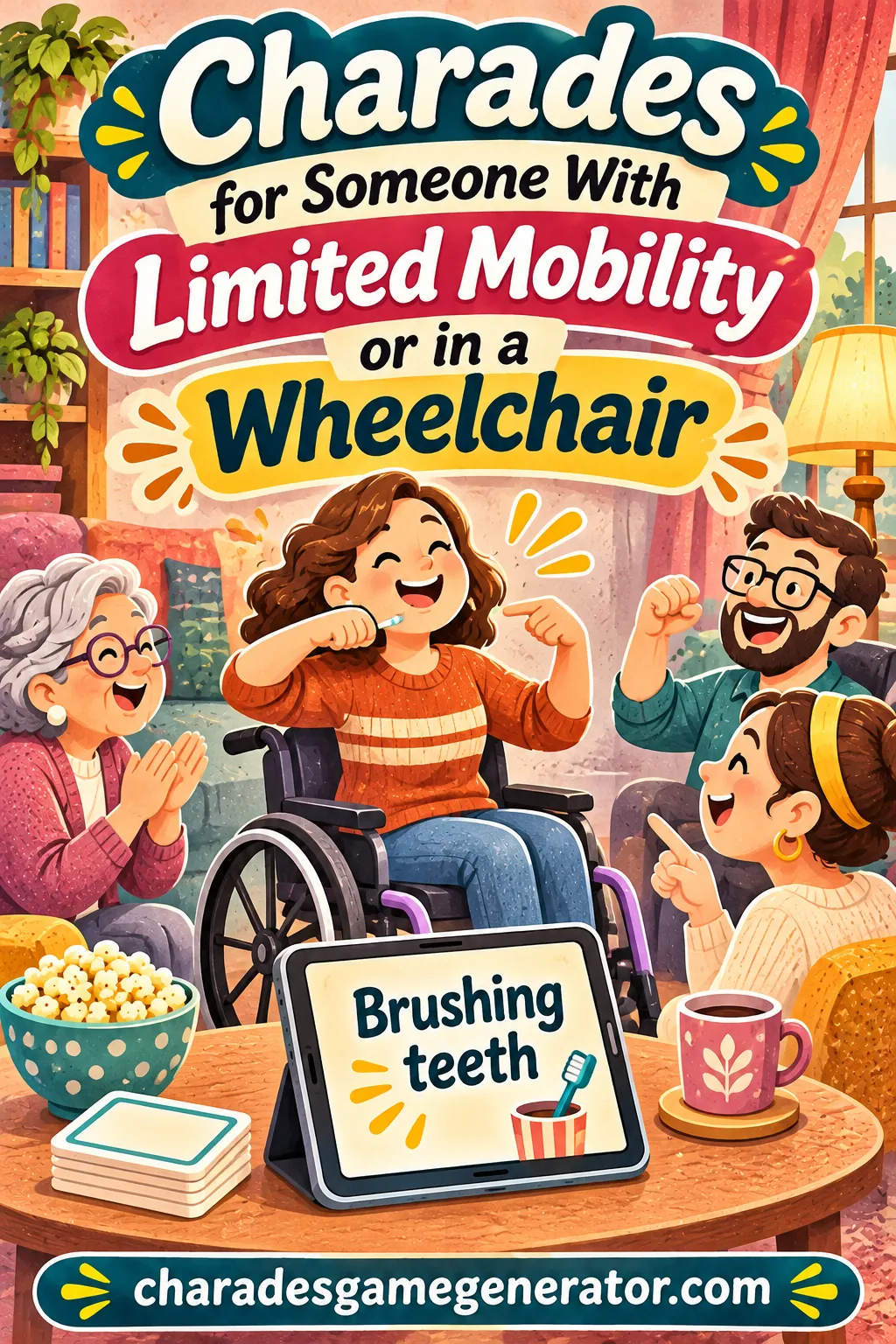
Seated charades works when you pick words that can be acted with the face, hands and upper body, give the seated player a longer timer, and have everyone stay seated so the whole game happens at the same level. Emotions, food, hobbies, small animals and everyday tasks like brushing your hair all play beautifully from a chair. Swap out the jumping-jacks style words, and a guest in a wheelchair or recovering from surgery can act and guess with everyone else.
The free Charades Game Generator makes this easy: it serves the words, runs the timer and keeps team scores, and you can type your own seated-friendly words into it before the game starts.
Why Standard Charades Leaves Some Players Out
Classic charades leans heavily on full-body words. "Skiing," "kangaroo," "surfing," "climbing a ladder" and "doing the limbo" are fun for people who can leap around the room, but they're a wall for someone who can't stand or move their legs, or who tires quickly.
The fix isn't to make a "special" version for one person. It's to choose a word pool that everyone can act from where they're sitting. When the whole group plays seated, nobody is singled out, and the game often gets funnier, because people lean into faces and hands instead of big stomping moves.
Here are the most common situations where seated charades helps:
- A guest uses a wheelchair or a mobility scooter.
- Someone is recovering from an injury, a broken leg or a surgery.
- Older relatives find standing and bending tiring or unsteady.
- A player has limited stamina due to a chronic condition, pregnancy or simple fatigue.
- The space is tight, like a dinner table, a hospital lounge or a small apartment.
- One arm is limited, so even upper-body words need tweaks.
Each of these calls for slightly different word choices, and we'll cover all of them below. The core idea stays the same: pick words that come alive above the waist.
Ask, don't assume
Before game night, have a quick, private chat with the guest. Something like: "We're thinking of playing charades. Would you like to play, and is there anything that would make it more comfortable for you?" Some people are happy to act anything they can and just want a longer timer. Others prefer to guess only, at least for the first round. Some want the whole group seated, and some honestly don't mind if others stand.
Let them lead. People with limited mobility are the experts on their own bodies, and a simple question shows respect without making a fuss.
What Makes a Word Seated-Friendly
Not every word that sounds small is easy to act from a chair, and not every big word is impossible. A good seated charades word passes three quick tests.
- Can it be shown with the face, hands, arms or shoulders? "Eating corn on the cob" is all hands and teeth. "Cartwheel" is not.
- Does it have a clear, recognizable gesture? "Brushing teeth" has one. "Thinking about the weekend" doesn't.
- Can it be acted in a small space? Words like "rowing a boat" or "driving a car" work beautifully from a chair because the motion is naturally seated.
Many everyday activities are already seated in real life: driving, typing, knitting, playing piano, eating, reading, sewing, rowing and fishing from a dock. These are gold for this version of the game, because the actor is doing exactly what the real activity looks like.
Word types that work best
| Word type | Why it works seated | Examples |
|---|---|---|
| Emotions and reactions | All face, very little movement | Surprised, sleepy, nervous, proud |
| Food and eating | Hands and mouth tell the story | Spaghetti, popcorn, sour lemon |
| Hobbies done sitting | Real activity is already seated | Knitting, painting, playing cards |
| Instruments | Hands and arms carry it | Piano, violin, drums, harmonica |
| Small animals | Faces and hand shapes | Owl, bunny, cat cleaning its paw |
| Grooming and daily tasks | Small, familiar gestures | Shaving, putting on glasses, brushing hair |
| Jobs with hand tools | Upper-body motion | Chef, barber, conductor, painter |
| Vehicles you sit in | Seated motion matches the real thing | Car, bus driver, rowboat, airplane pilot |
Word types to leave out
Skip words built around legs, balance or floor work: sports like skiing or soccer, dances that need footwork, animals that hop or gallop, and actions like jumping, kneeling, crawling or climbing. You don't need to ban them forever. Just leave them out of the deck while the seated version is running.
How to Set It Up in the Game
Here's a ready setup for a mixed group of six to ten people where one or more players will act from a seat. The aim is a slower pace, a calm deck and words everyone can show.
- Open the free charades game on a phone or tablet. A tablet is easier for older players to read. Bump up the device's text size if anyone has trouble with small print.
- Choose your teams. Two teams for six to eight people, three teams for nine or more. Place the seated player on whichever team suits the seating, not as a "special" pick.
- Pick a category. Animals, Famous People, Kids, Christmas and Fairy Tales all include plenty of face-and-hands words. A food category is a strong pick too, since eating is so easy to show from a chair.
- Tap ✏️ Add Custom Words and type in seated-friendly words from the lists further down this article, tapping + Add after each one. This is the best way to tilt the deck toward hands-and-face acting.
- Set the timer to 90 sec. The timer applies to every turn, so this gives the seated player extra time without singling anyone out. Everyone else benefits from the slower pace too.
- Choose 5 rounds. It's a comfortable length that won't tire anyone out. Go to 7 if your group is having a blast.
- Set difficulty to 😊 Easy. Easy words are usually concrete and familiar, which makes them more likely to have a clear hand gesture.
- Start the game and pass the device to the first actor. They read the word, act it out, and tap ✓ GOT IT! when their team guesses or ↷ Skip — too hard! when a word doesn't work from a seat.
- Check Current Scores on the Time's Up screen, tap Next Team's Turn, and pass the device. When you're done, tap Play Again for another game.
Settings at a glance
| Setting | Recommended | Why |
|---|---|---|
| Teams | 2 (or 3 for nine or more) | Keeps turns frequent for everyone |
| Category | Animals, Kids, Famous People, food, holiday themes | Lots of hand-and-face words |
| Custom words | Add 20 to 40 from the seated lists | Steers the deck toward seated acting |
| Timer | 90 sec | Relaxed pace without singling anyone out |
| Rounds | 5 | Enough fun without tiring anyone |
| Difficulty | 😊 Easy | Concrete words with clear gestures |
The "free skip" house rule
Even with a careful setup, a full-body word will sometimes pop up. Make it a standing rule that any actor can skip any word they don't want to act, no questions asked, and there's no penalty for skipping. Announce it for the whole group, not just the seated player. When the rule belongs to everyone, nobody feels like they're getting a special pass.
Seated Charades Word Lists (80 Words)
These lists are ready to type into ✏️ Add Custom Words. Every word can be acted from a chair or wheelchair using the face, hands, arms and shoulders. They're grouped by theme and roughly sorted from easiest to trickiest within each group, so you can pick a handful from each or load a whole theme for one round.
Feelings and faces (easy)
These are the friendliest seated words of all, because the whole performance happens on the actor's face.
- Happy
- Sad
- Surprised
- Scared
- Sleepy
- Angry
- Bored
- Proud
- Nervous
- Confused
- Embarrassed
- In love
- Disgusted
- Sneezing
- Hiccups
If your group loves this theme, the emotion charades page has a longer list of feelings, plus ideas for printable face cards.
Food and eating (easy to medium)
Eating is one of the most natural things to act from a chair, and everyone recognizes it.
- Eating spaghetti
- Popcorn at the movies
- Corn on the cob
- Ice cream cone
- Biting a sour lemon
- Peeling a banana
- Blowing on hot soup
- Cracking an egg
- Eating a hot pepper
- Slicing bread
- Licking a lollipop
- Making a sandwich
- Opening a stuck jar
- Eating with chopsticks
- Flipping pancakes
Hobbies and pastimes (medium)
Plenty of favorite hobbies are already done sitting down, which makes them easy to act and easy to guess.
- Knitting
- Painting a picture
- Reading a book
- Playing cards
- Doing a puzzle
- Sewing a button
- Writing a letter
- Taking a photo
- Bird-watching with binoculars
- Fishing
- Playing chess
- Crossword puzzle
- Gardening in a pot
- Playing video games
- Doing a magic trick
Music and instruments (medium)
Instruments are all about the hands and arms, and most are played seated in real life.
- Piano
- Guitar
- Violin
- Drums
- Trumpet
- Harmonica
- Harp
- Accordion
- Flute
- Orchestra conductor
Daily tasks and grooming (medium)
These are small, familiar motions that read clearly at a glance.
- Brushing your teeth
- Brushing your hair
- Shaving
- Putting on glasses
- Putting on lipstick
- Tying a tie
- Texting on a phone
- Talking on the phone
- Folding laundry
- Typing on a computer
Animals with face-and-hand clues (medium)
Pick animals with a signature face, sound shape or paw gesture, not ones known for running or jumping.
- Owl
- Cat washing its face
- Bunny nibbling a carrot
- Elephant (trunk with one arm)
- Crab (pinching claws)
- Fish (puckered lips)
- Squirrel holding a nut
- Lion (big mane, silent roar)
Seated jobs and actions (harder)
These take a little more acting skill, which makes them great for experienced players.
- Bus driver
- Airplane pilot
- Rowing a boat
- Dentist
- Barber
- Chef tasting soup
- Typing a secret code
That's 80 seated charades words. For a broader pool sorted by challenge level, the charades words by difficulty page is a handy place to pick more, just filter out the full-body ones as you go.
Acting tips for seated players
A few simple techniques make seated acting much easier to read. Share them with the whole group before the first round.
Go big with your face. In a seated game, your face does the work your legs used to do. Stretch every expression a little further than feels natural. Wide eyes, a deep frown or a huge grin all read clearly across a room.
Use your arms as props. One arm can be an elephant's trunk, a fishing rod, a violin bow or a steering wheel. Hold the "prop" steady for a second before you start moving, so guessers can see what it is.
Show the object first, then the action. For "eating corn on the cob," hold the cob with both hands, then bite and turn it. For "playing violin," tuck the pretend violin under your chin before you bow. Setting up the object gives guessers a head start.
Slow down. Small motions done fast blur together. A slow, deliberate yawn says "sleepy" much more clearly than a quick one.
React to imaginary things. For "biting a sour lemon," the bite is fine, but the pucker afterward is what wins the point. Reactions are often easier to guess than the action itself.
Use your chair. Gripping armrests can show "roller coaster" or "turbulence on an airplane," and leaning back can show "relaxing on vacation." The chair can become part of the scene.
Adapting for Different Mobility Needs
"Limited mobility" covers a lot of different bodies. The right adjustments depend on what the player can do comfortably. Here's a practical guide for the most common situations.
Wheelchair users
Many wheelchair users have full use of their upper body and can act every word on the lists above with no other changes. The main thing is placement. Make sure the actor's spot faces the guessers and that there's a clear, level path to it, or better yet, let the actor stay put and have the guessers face them. Some wheelchair users may enjoy using their chair in the performance, like rolling back for "surprised" or turning for "driving." That's their call.
Move coffee tables, rugs that bunch up and floor clutter before guests arrive. A little extra room makes the whole game feel easier.
Players recovering from injury or surgery
Someone with a cast, a fresh knee replacement or a sore back may be able to act most upper-body words but tire faster than usual. Keep the 90 sec timer, let them skip freely, and consider letting them act every other round while guessing in between. Check in at the halfway point with a simple "Still feeling good?"
Limited use of one arm or hand
If a player has limited use of one arm, from a stroke, an injury or a condition, choose words that can be shown with one hand and the face. Good picks include: "texting," "brushing teeth," "eating an ice cream cone," "taking a photo," "waving goodbye," "owl," "sour lemon" and every word in the feelings list. Skip two-handed words like "knitting," "rowing" or "tying a tie" during their turns.
Limited hand strength or fine motor control
For players with arthritis, tremors or reduced grip, big simple gestures work better than tiny precise ones. Favor feelings, facial expressions, head movements and broad arm motions. "Conductor" with a big swoop is easier than "threading a needle." Also hand the device to a helper, who can hold it and tap ✓ GOT IT! or ↷ Skip — too hard! for them.
Low stamina or fatigue
When energy is the limit, shorten the game rather than the turns. Play 3 rounds instead of 5, keep the 90 sec timer, and add a short snack break halfway. A guesser-only role is also fine, and guessing well is a real skill that can win a game.
Quick adaptations table
| Situation | Word focus | Timer | Helpful extras |
|---|---|---|---|
| Full upper-body use, can't stand | Any seated list | 90 sec | Clear sightlines, level path |
| Recovering from injury | Feelings, food, hobbies | 90 sec | Free skips, act every other round |
| One arm limited | One-hand words and faces | 90 sec | Skip two-handed words on their turns |
| Low grip or tremor | Faces and broad arm motions | 90 sec | Helper holds and taps the device |
| Low stamina | Easiest words first | 90 sec | 3 rounds, mid-game break |
| Prefers not to act | Guessing only | Any | Make them the scorekeeper or category picker |
Everyone Sits: Ground Rules for an Inclusive Game
The single most inclusive move you can make is to have the whole group play seated. It levels the field, keeps the game from feeling like a special version, and makes for a cozy, close-up atmosphere. Here are simple house rules for a fully seated game.
- Bottoms stay on chairs. Every actor performs from their seat. Leaning, twisting and big arm gestures are fair game.
- The actor doesn't move; the device does. Pass the phone or tablet around the circle, so nobody has to get up to act.
- Free skips for everyone. Any word that doesn't feel right from a chair can be skipped without penalty.
- Same timer for every team. The game uses one timer setting for all turns, which keeps things fair.
- Hand signals only, no talking. The usual charades rules apply.
Seated hand signals
Some classic charades signals use the body, like pointing at your feet or stepping forward. Here are seated versions everyone can use.
| Signal | Seated version |
|---|---|
| Number of words | Hold up that many fingers |
| Which word you're on | Hold up fingers again, then tap your forearm |
| Movie | Crank an old-style camera beside your head |
| Book | Open your palms like a book |
| Sounds like | Tug your earlobe |
| Short word | Pinch thumb and finger close together |
| Longer phrase | Stretch hands apart like taffy |
| Close, keep going | Wave fingers toward yourself |
| Exactly right | Touch your nose and point at the guesser |
For the full set of standard gestures, our charades hand signals guide covers them all, and nearly every one works from a chair.
Variations for Different Groups
Seated charades fits a lot of settings beyond a single guest in a wheelchair. Here's how to tune it for the groups that use it most.
Seniors and senior centers
For older adults, familiar words land best. Think everyday tasks, classic hobbies and foods that everyone grew up with: "knitting," "writing a letter," "playing cards," "shelling peas," "hanging laundry on a line" and "winding a clock." Use large print on a tablet, the 90 sec timer and 😊 Easy difficulty. Pair players who have trouble hearing with someone who can repeat the guesses at a normal volume.
Our charades for seniors guide has more ideas for activity directors and family visits, including memory-friendly word themes.
Rehab units and hospital lounges
In a rehab or care setting, short and gentle wins. Play 3 rounds, keep the deck to feelings, food and music, and let anyone guess-only without explanation. A single tablet propped on a table can serve the whole room. Check with staff about noise levels and how long the group has the space, and wrap up a few minutes early so no one feels rushed out.
Kids with mobility differences
Children notice when they're left out, so a fully seated game is a great default for a classroom or birthday party that includes a child in a wheelchair. Kids love animal faces and food words. Try "puppy begging," "bunny nibbling," "eating a giant sandwich," "blowing out birthday candles" and "licking a lollipop." Use the Kids or Animals category on 😊 Easy, and add a handful of custom words. Applause for every turn keeps the mood high.
Mixed family gatherings
At holidays, you might have a grandparent with a walker, a cousin on crutches and a pack of energetic kids. A seated round, followed by a standing round, keeps everyone happy. Just make sure the seated rounds don't feel like the "boring" part. Load them with the funniest words, like "biting a sour lemon," "sneezing," "hiccups" and "eating a hot pepper."
Around the dinner table
Seated charades is a natural fit for the table after a meal. Nobody has to move, plates can stay put, and the device passes hand to hand. A Christmas or other holiday category plus a few custom food words makes a lovely after-dinner round.
Group size quick guide
| Group | Teams | Rounds | Category idea | Notes |
|---|---|---|---|---|
| 4 to 6 people | 2 | 5 | Animals or food | Small circle, everyone close |
| 7 to 10 people | 2 or 3 | 5 | Famous People, Kids | Seat teams facing each other |
| 11 to 16 people | 3 or 4 | 3 to 5 | Holiday theme | Use a tablet so the word is easy to read |
| Care home or rehab group | 2 | 3 | Feelings, food, music | Guess-only welcome |
| Classroom | 3 or 4 | 3 | Kids, Animals | Fully seated keeps it calm |
Running the Night: Host Script and Troubleshooting
How you introduce the game sets the tone. The goal is to make the seated format sound like the fun version, not a workaround.
A host script you can use
"Tonight we're playing seated charades. Everybody stays in their chair, and every word can be acted with your face and hands. You've got 90 seconds a turn, and anyone can skip any word, no penalty. We'll pass the tablet around the circle. Ready? First team, here's your actor."
Notice what the script doesn't do: it doesn't mention any one person. The rules apply to everyone, so the game simply works for everyone.
Common bumps and how to smooth them
A full-body word comes up. Skip it. Remind the group that skipping is free, and keep going. If it keeps happening, load more custom words or switch to a more face-and-hands category.
Someone stands up out of habit. A light reminder works: "Seated round, back in the chair!" Keep it playful, not pointed.
Guessers crowd the actor. In a seated game, guessers sometimes lean in or stand to see better. Ask everyone to stay seated so the actor isn't boxed in, and arrange chairs in a circle or horseshoe so sightlines are clear.
The seated player seems tired. Offer a break for the whole group, not just for them. "Let's take five, then finish the last round" keeps everyone together.
Someone over-helps. Well-meaning friends sometimes jump in to "help" the seated player act or tap buttons. Let the player decide what help they want. If they ask a teammate to hold the device, great. If not, step back.
A guest doesn't want to act. That's fine. Make them the scorekeeper, the category chooser or the "final judge" for close calls. Guessing alone keeps them fully in the game.
Two teams argue about a close guess. Use a simple rule: the guess counts if the actor nods yes. The actor taps ✓ GOT IT! to confirm, and the game moves on.
Ready to Play From Your Seat
Seated charades isn't a watered-down game. With faces, hands and a well-chosen word list, it can be just as loud and silly as the jumping-around kind, and it lets a friend in a wheelchair, a grandparent with a sore hip or a cousin on crutches play every round. Load a few dozen words from the lists above, pick the 90 sec timer and 😊 Easy difficulty, and start your first round on the free Charades Game Generator.
Frequently Asked Questions
What is seated charades?
Seated charades is regular charades where every actor performs from a chair or wheelchair, using the face, hands, arms and shoulders. The word list leans on emotions, food, hobbies and everyday tasks instead of full-body actions. Everything else, from teams to the timer, works the same way.
What are good charades words for wheelchair users?
Feelings like surprised or sleepy, food words like eating spaghetti or biting a lemon, and hobbies like knitting, playing piano or fishing all work well. Vehicles you sit in, like bus driver or rowing a boat, are great too. Leave out words that depend on legs, like skiing or jumping rope.
Can you play charades without standing up?
Yes. Choose words that can be shown above the waist, keep everyone seated, and pass the device around instead of having actors walk to a stage. Most charades hand signals also work from a chair.
How do you make charades inclusive for someone with limited mobility?
Ask the person privately what would make the game comfortable for them, then set rules that apply to everyone, like free skips and a 90 sec timer. Having the whole group sit levels the field without singling anyone out. Add custom words that suit hands-and-face acting.
What timer should we use for seated charades?
The 90 sec timer is a good default, since it gives every actor room to think and act calmly. The timer setting covers every turn, so the slower pace applies to the whole group. Fast groups can switch to 60 sec later in the game.
Is seated charades good for seniors?
Yes. Familiar words, a longer timer and easy difficulty make it a relaxed, social game for older adults. It works at family gatherings, senior centers and care homes, and players who prefer not to act can join in as guessers.
What if a player can only use one hand?
Pick one-hand words such as texting, brushing teeth, taking a photo, waving goodbye and eating an ice cream cone, plus any facial expression. Skip two-handed words like knitting or rowing during their turns. A teammate can hold the device if that helps.
Can I add my own seated-friendly words to the game?
Yes. Tap ✏️ Add Custom Words on the setup screen, type a word and tap + Add for each one before you start. The game doesn't save custom lists, so keep yours in a notes app to paste in next time.