How to Stop Repeating the Same Charades Words Every Game Night
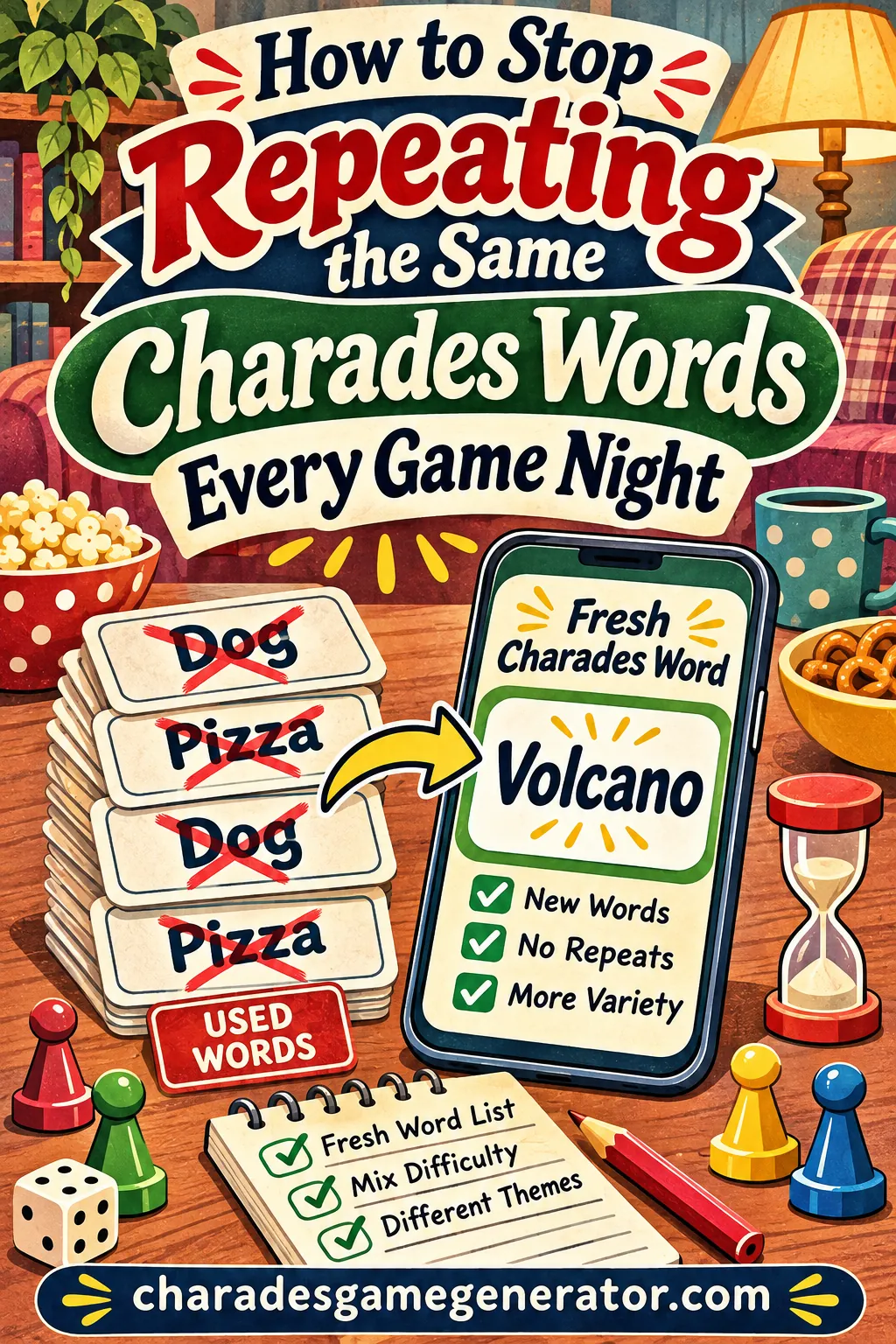
To stop charades words from repeating, draw from a deck that removes every word once it's used, switch to a new category every round, and add a few custom words nobody has seen before. That's the whole fix. The free charades game on our homepage makes the category switch and custom words a two-tap job, and the rest of this guide gives you ready lists, exact settings and a host plan so round three feels as fresh as round one.
You know the moment. Someone flaps their arms and three people yell "bird!" before the timer even starts. Someone mimes eating a slice and it's "pizza" again. It's not that your group is bad at charades. It's that they've seen these words so often the game has turned into a memory test instead of a guessing game.
The good news: repetition is a setup problem, not a people problem. Fix the setup and the laughs come back.
Why the Same Charades Words Keep Coming Back
Before you fix anything, it helps to know where the repeats come from. There are usually four culprits, and most groups have at least two of them going at once.
The brain-dump problem. When players write their own slips on the spot, everyone reaches for the first thing that pops into their head. And the first thing that pops into everyone's head is the same: dog, cat, baseball, swimming, sleeping, elephant. Ten people writing three slips each will give you thirty slips with maybe eighteen different words.
The tiny-list problem. A printed list of 50 words sounds like a lot. But a group of eight playing five rounds with 60-second turns can burn through 50 words in under an hour, especially if players skip a lot. Then you either stop or start over, and starting over means everyone already knows the answers.
The one-category problem. If every round is "animals" or every round is "movies," the words start to blur together. Even when the exact word is new, the motions aren't. Every four-legged animal gets the same crawl. Every action movie gets the same finger guns.
The recycled-deck problem. The family slip jar from last Thanksgiving still has the same slips in it. Kids remember answers far better than adults expect, and after one or two holidays, half the deck is spoiled.
Here's a quick way to diagnose your own game night:
| What you notice | Likely cause | Quick fix |
|---|---|---|
| Same five words every game | Players brain-dumping slips | Use a ready list or a generator instead of on-the-spot slips |
| Words run out halfway through | List too short for the group size | Plan about 8 to 12 words per player for the night |
| Turns feel identical even with new words | One category all night | Rotate to a new category each round |
| Kids guess before the actor moves | Recycled slip jar | Retire old slips, add a new themed batch |
| A word shows up twice in one night | Drawing with replacement | Set used words aside, never back in the pile |
Most groups only need two of these fixes to feel the difference.
Draw Once, Then Retire the Word
The single biggest fix is boring but powerful: once a word has been drawn, it's out of the deck for the rest of the night. Card players call this drawing without replacement. In plain terms, you don't put the card back. If you've ever searched for a way to get charades words no repeats, this is the rule underneath every answer.
It sounds obvious, but a lot of groups break this rule without noticing. Skipped slips get tossed back in the bowl. The host shuffles the "guessed" pile back in when the bowl gets low. Somebody reaches into the wrong pile. Within half an hour, the same word comes up again and the guessers shout it in two seconds.
Here's how to make "draw once" stick:
- Use two containers. One bowl for fresh words, one bag for used words. Label them if you have to. Used means guessed or skipped.
- Skipped words are used words. It's tempting to recycle a skip, since nobody guessed it. But the whole room saw the actor try it. If it comes back, it's half spoiled.
- Count before you start. If you have 40 words and eight players, that's five words per person. That's enough for one or two rounds, not five. Add more before you begin, not after you run dry.
- End when the deck ends. If you truly run out, call the final round. A game that ends on a high is better than a game that limps through repeats.
The little draw box above this section works the same way. Every tap pulls a word that hasn't come up yet, and it won't repeat until the whole list is used. Try it as a warm-up before you start the real game, or use it as a tiebreaker word when two teams are even.
What "no repeats" really means for a group
There are three levels of no-repeat, and it's worth deciding which one you want before guests arrive:
- No repeats in a turn. The bare minimum. The actor never gets the same word twice in one turn.
- No repeats in a night. The goal for most groups. Once a word is used, it's gone until next time.
- No repeats across nights. For a regular group that plays every week or every month. This takes a little planning, and we'll cover it below.
If you play once in a blue moon, "no repeats in a night" is plenty. If you're a weekly family game night, you'll want the across-nights plan too.
Rotate Categories Every Round
Even a perfectly managed deck gets stale if every word comes from the same pool. The second fix is to change the category each round. This does two things at once: it gives you a brand-new set of words, and it forces actors to use different kinds of motions.
Think about how differently you act these:
- An animal (whole body, posture, how it moves)
- An action (one clear verb, usually with hands)
- A place (setting the scene, showing what people do there)
- A famous type of person, like an astronaut or a chef (costume and job gestures)
- A food (eating, cooking, the shape of the thing)
Switching categories changes the rhythm of the game. A round of places feels slow and thoughtful. A round of actions feels fast and silly. That contrast is a big part of why a game stays fun.
The charades game has 18 categories to pick from, including Movies, TV Shows, Animals, Sports, Famous People, Actions, Places, Kids, Christmas, Office Party, Superheroes, Halloween and Fairy Tales. That's plenty to rotate through a long night without repeating a category, let alone a word.
Here's a sample five-round rotation that works for mixed groups:
| Round | Category | Why it goes here |
|---|---|---|
| 1 | Actions | Easy warm-up, gets everyone moving |
| 2 | Animals | Big, funny body movements, kids love it |
| 3 | Places | Slows things down, rewards creative acting |
| 4 | Sports | High energy again after a thinking round |
| 5 | Fairy Tales or Superheroes | Strong finish with story-style acting |
If you want more ideas for which categories pair well together, the list of charades categories breaks them down by group type and energy level.
The "never twice in a row" rule
If you only remember one category rule, make it this one: never play the same category two rounds in a row. Even if your group loves animals, put something else between the animal rounds. Players come back to the category with fresh eyes, and the motions don't blur together.
Build a bigger word pool before you start
The third fix is simple math. You need more words than you think.
A rough guide: plan on 8 to 12 words per player for a full game night. Fast groups who guess quickly need the high end. Groups with lots of small kids, who take longer per word, can get away with the low end.
| Group size | Rounds | Words you'll likely use | Words to have ready |
|---|---|---|---|
| 4 players | 5 rounds | 30 to 40 | 50 |
| 6 players | 5 rounds | 45 to 60 | 75 |
| 8 players | 7 rounds | 70 to 90 | 110 |
| 12 players | 5 rounds | 80 to 110 | 130 |
| 16 or more | 3 rounds | 70 to 100 | 120 |
These are estimates, not rules. Your numbers will depend on how fast your group guesses and how often actors skip. But the point stands: if you show up with a 30-word printout for a party of ten, you'll be repeating words by dessert.
The easiest way to get a big pool is to let a generator do the heavy lifting and use your own lists only as extras. A generator with many categories gives you hundreds of options without anyone writing a single slip.
Where repeats sneak in even with a big pool
A huge list doesn't guarantee freshness if the words inside it are too similar. Watch out for these near-repeats:
- Same motion, different word. Swimming, diving, snorkeling and surfing all start with the same arm stroke. After one, the rest feel like reruns.
- Same animal family. Cat, kitten, lion, tiger, cheetah. Different words, same crawl and pounce.
- Same food action. Eating a sandwich, eating a taco, eating a burger. It all looks like someone eating a sandwich.
When you build or review a list, look for clusters like these and keep just one or two from each. You'll get more variety from 60 truly different words than from 100 words that share the same five motions.
90 Fresh Charades Words Nobody Picks First
Here's a list built specifically to dodge the usual suspects. You won't find dog, cat, pizza or baseball in here. Every word was chosen because it's actable, clean for mixed company, and not the first thing people think of. Copy any of them straight into the game's custom words box.
Easy (good for kids and warm-ups)
- Brushing a horse
- Blowing out candles
- Jump rope
- Washing a car
- Building a snowman
- Flying a kite
- Popping a balloon
- Walking on ice
- Penguin waddle
- Mailbox
- Rocking chair
- Bubble bath
- Watering plants
- Hopscotch
- Yo-yo
- Lawn mower
- Picking apples
- Tying shoelaces
- Hula hoop
- Feeding ducks
- Pillow fight
- Painting a fence
- Crab walk
- Rolling dough
- Kangaroo
- Sneezing
- Swing set
- Catching fireflies
- Stacking blocks
- Tug of war
Medium (teens and adults)
- Window washer
- Parallel parking
- Bubble wrap
- Snow globe
- Escalator
- Stuck zipper
- Lighthouse keeper
- Paper airplane
- Hiccups
- Beekeeper
- Ice fishing
- Revolving door
- Hot air balloon
- Crossword puzzle
- Assembling furniture
- Lost in a corn maze
- Carrying too many grocery bags
- Untangling holiday lights
- Stepping on a toy brick
- Waiting for toast to pop
- Chasing a runaway hat
- Brain freeze
- Sunburn
- Wrapping a present
- Sleepwalking
- Ghost hunter
- Traffic cop
- Tightrope walker
- Opening a stuck jar
- Mime trapped in a box
Hard (for groups who've played a lot)
- Procrastination
- Deja vu
- Daylight saving time
- Static electricity
- Echo
- Gravity
- Time travel
- Writer's block
- Stage fright
- Photosynthesis
- Spring cleaning
- Leap year
- Jet lag
- Autocorrect
- Group photo
- Fire drill
- Monday morning
- Lost luggage
- Elevator music
- Silent library
- Power outage
- Speed bump
- Rush hour
- Fortune teller
- Walking a stubborn dog
- Dancing in the rain
- Ventriloquist
- Missing the last bus
- Locked out of the house
- Mind reader
A few notes on using this list:
- Mix levels inside a round if your group spans ages. Hand easy words to younger kids and hard ones to the adults who keep guessing everything in five seconds.
- The hard section is abstract on purpose. Words like "procrastination" and "gravity" force actors to tell a tiny story instead of copying a shape. That's exactly the kind of acting that never feels repetitive.
- Cross off as you go. If you're playing from paper, put a line through each used word so it doesn't sneak back in later.
For a ready-made pile sorted by challenge level, the charades words by difficulty page has more to pull from, and the words you can play right now list is handy when you need a batch in a hurry.
How to Set It Up in the Game
You can run a no-repeat night in the free charades game in about two minutes. Here's the exact setup for a typical living-room group of six to eight people.
Step 1: Teams. Pick 2 teams. Two teams keep everyone involved and make the score easy to follow. If you have ten or more people, go up to 3 or 4 teams.
Step 2: Category. Choose your first category from the 18. Start with Actions for a warm-up. You'll change it before each new game.
Step 3: Custom words. Tap ✏️ Add Custom Words and use + Add to drop in eight to twelve words from the fresh list above. These are your surprise words. Nobody in the room has seen them in the game before.
Step 4: Timer. Pick 60 sec. It's long enough for the harder words and short enough that nobody stands frozen in front of the group.
Step 5: Rounds. Pick 5 rounds. That's long enough for real competition without draining the category.
Step 6: Difficulty. Pick 🎲 Mixed. Mixed keeps easy and hard words coming so no stretch of the game feels the same.
Then play. The actor sees one word at a time and taps ✓ GOT IT! when their team guesses or ↷ Skip — too hard! when they're stuck. When time runs out, you'll see the Time's Up screen, then Current Scores, then Next Team's Turn.
Switching categories between games
When the game ends, tap Play Again and change the category before you start. That's your rotation. A five-round game in Actions, then a five-round game in Places, then one in Sports gives you three totally different decks in one night.
Here's a full evening plan with the settings for each game:
| Game | Teams | Category | Timer | Rounds | Difficulty | Custom words |
|---|---|---|---|---|---|---|
| 1 (warm-up) | 2 | Actions | 60 sec | 3 | 😊 Easy | 6 easy words from the list |
| 2 | 2 | Animals | 60 sec | 5 | 🎲 Mixed | None |
| 3 | 2 | Places | 90 sec | 5 | 🎲 Mixed | 8 medium words |
| 4 | 2 | Sports | 60 sec | 5 | 🎲 Mixed | None |
| 5 (finale) | 2 | Fairy Tales | 30 sec | 3 | 😤 Hard | 6 hard words |
Notice the timer changes too. A 90-second Places round gives actors time to build a scene. A 30-second finale on hard words creates fast, frantic energy to close the night. Changing the pace is another way to keep the game from feeling like the same thing over and over.
Settings for different groups
Not every group is a group of eight adults. Here's how to tweak things:
- Young kids (5 to 8). 2 teams, Kids or Animals category, 90 sec, 3 rounds, 😊 Easy. Add easy custom words like "penguin waddle" and "blowing out candles."
- Tweens and teens. 2 or 3 teams, rotate Superheroes, Sports and Actions, 60 sec, 5 rounds, 🎲 Mixed.
- Adults who play a lot. 2 teams, rotate Places, Famous People and Actions, 60 sec, 7 rounds, 😤 Hard. Load the hard section of the list as custom words.
- Big parties (12 or more). 3 or 4 teams, 30 sec turns, 3 rounds. Short turns mean more people get to act, and more words fly by without anyone getting bored.
A Host Script That Keeps Words Fresh
A lot of the repeat problem is social. Someone says "oh, do the elephant one again!" and suddenly you're replaying the same bit. A good host keeps the game moving forward. Here's a simple script you can read almost word for word.
Before the first round:
"Okay, quick house rule tonight: no repeats. Once a word's been played, it's done. Skipped words are done too. We're switching categories every game, so if you're bad at animals, just wait ten minutes."
When someone asks for a favorite word back:
"Love that one, but it's retired for tonight. It'll be back next time. Let's see what the game gives us."
When the group groans at an easy word:
"Easy points still count! Quick one, then we're on to the next."
When you switch categories:
"New category, new deck. Nobody has an advantage here. Places round, ninety seconds, go!"
When the night is winding down:
"Last game. Hard mode, thirty seconds, and I've loaded some words nobody has seen. Good luck."
That last line is a nice trick. Telling people the final round has brand-new custom words builds a little suspense and makes the end of the night feel special instead of tired.
Small host habits that help
- Keep the custom words secret. Add them before guests arrive or step into another room. If people watch you type them in, they're spoiled.
- Let actors skip freely. A word that sits on screen for 50 seconds while the actor flounders feels repetitive even if it's brand new. Skipping keeps the energy up.
- Announce the category clearly. Guessers who know it's a Places round won't waste time shouting animal names. Clear categories mean faster guesses and more words per turn.
Keep Words Fresh Across Many Game Nights
If your group plays every week or every month, "no repeats tonight" isn't enough. By the fourth game night, people start recognizing words from last time. Here's how regular groups keep things new for the long haul.
Keep a simple "played" list
After each game night, jot down the categories you played and any custom words you used. A note on your phone works fine. Next time, start with categories you didn't play last time. It takes thirty seconds and saves you from running the same Animals warm-up four weeks in a row.
Use a category calendar
Some families like to give each game night a theme. It's a fun way to guarantee variety without thinking about it:
| Week | Main category | Bonus custom words theme |
|---|---|---|
| 1 | Actions | Things you do in the morning |
| 2 | Animals | Animals doing jobs (a bear mailman, a cat chef) |
| 3 | Places | Places on vacation |
| 4 | Sports | Silly made-up sports |
| 5 | Fairy Tales | Fairy tale characters at a modern job |
| 6 | Famous People | Types of performers (magician, juggler, opera singer) |
| 7 | Superheroes | Made-up heroes with silly powers |
| 8 | Halloween or Christmas (seasonal) | Seasonal chores and traditions |
After eight weeks, you've cycled through a big chunk of the game's categories, and the bonus themes mean even the custom words feel different each time.
Let a different player write the custom words each week
This is a great one for families. Each week, one person gets to secretly add six to ten custom words. They can't play on their own words, so they become the host for those turns or sit out when one comes up. Kids especially love being the "word maker." It spreads the creative load around, and every player has a different style, so the custom words never fall into a rut.
Retire the classics on purpose
Some words are so overplayed in your group that they're basically free points. Make a "retired" list and agree as a group not to add those to custom words anymore. Common ones to retire:
- Dog, cat, bird, fish
- Pizza, hot dog, ice cream cone
- Swimming, running, sleeping
- Baseball, football, basketball
- Brushing teeth, driving a car
Retiring them isn't permanent. Bring them back as a nostalgic "classics round" once a year if you want. But taking them out of regular play makes everyone dig deeper.
Twists and Variations That Make Old Words Feel New
Sometimes you can't avoid a familiar word. It's on screen, it's "elephant" again, and everyone sighs. The trick is to change how the word is acted, not just which word it is. These twists turn a repeat into something new.
Slow motion round. Every word must be acted in slow motion. A slow-motion elephant is a totally different performance than a regular one. It's also hilarious.
Emotion round. Before each turn, the opposing team picks an emotion: nervous, sleepy, angry, overjoyed. The actor must perform every word in that mood. A nervous elephant. An overjoyed dentist. Familiar words suddenly need real acting.
Tiny space round. The actor must stay inside a small square, like a placemat or a sheet of paper on the floor. Big motions are off the table, so actors have to get creative with hands and faces.
One-hand round. Actors can only use one hand. This is surprisingly fun and gives seated or less mobile players an equal shot.
Partner round. Two actors from the same team perform each word together. Two people acting "lawn mower" — one as the mower, one pushing it — is a new experience even if everyone's seen "lawn mower" before.
Backwards round. The actor has to show the word happening in reverse. "Building a snowman" becomes melting and unstacking. The guessers' brains have to work in a whole new way.
Here's a quick table to pick a twist based on your group's mood:
| Group mood | Try this twist | Why it helps |
|---|---|---|
| Too easy, everyone guesses fast | Tiny space or one-hand | Takes away the obvious motions |
| Low energy, getting sleepy | Partner round | Gets two people up and moving |
| Same words keep coming up | Emotion round | Old words need new acting |
| Kids are getting silly | Slow motion | Channels the silliness into the game |
| Adults want a challenge | Backwards round | Forces real creative thinking |
You can run any of these in the game with no extra setup. Just announce the twist before the turn starts and play as normal.
Variations by group size and age
Repetition shows up differently depending on who's playing. Here's what to watch for with different groups.
Two to four players. Small groups burn through words fastest, since every person acts more often. Use 90 sec turns so each word gets a full performance, and plan on at least 12 words per player. Rotate categories every game, not just every night.
Family with young kids. Little ones love repeats, honestly. A four-year-old will happily act "bunny" every turn. That's fine for them. Give the kids their own easy words and keep the fresh, harder words for the older players. Everyone wins.
Teens. Teens get bored of repeats faster than anyone. Lean on 30 sec turns, 😤 Hard difficulty and a mix of Superheroes, Sports and custom words they write themselves. Let them pick the categories.
Big parties. With 12 or more people, each person acts less often, so repeats are less of a problem. The bigger issue is running out of time. Use 3 or 4 teams, 30 sec turns and 3 rounds. The fast pace means lots of different words go by.
Classrooms. Teachers playing the same game every Friday should keep a running list of categories used. Rotate through Animals, Actions, Places, Sports and Fairy Tales, and let students submit custom words as a writing warm-up.
Regular game night crew. This is the group that needs the across-nights plan most. Use the category calendar, retire the classics and let a different person write custom words each week. It keeps the game going for months.
If you're planning the whole evening, not just the charades part, the guide on how to host a game night covers snacks, seating and timing.
Troubleshooting Common Repeat Problems
Even with a good plan, a few situations come up again and again. Here's how to handle them without stopping the fun.
"We've seen this word already tonight!" Don't argue about it. Just skip it. Tap ↷ Skip — too hard! and move to the next word. Make a quick rule at the start: if anyone in the room says "repeat," the actor skips, no penalty. It takes less time than debating.
"The other team got an easy word and we got a hard one." This is about fairness, not repeats, but it comes up when players are tired of the same old words and start noticing every difference. Remind everyone that 🎲 Mixed difficulty shuffles easy and hard for both teams, and it evens out over five rounds. If it still bugs people, switch to 😊 Easy or 😤 Hard for the whole game so every word is roughly the same level.
"My kid keeps adding the same custom words." Totally normal. Kids love their favorites. Try giving them a theme instead of a blank slate. "Add three words about things at the beach" gets a lot more variety than "add three words."
"We ran out of new categories." With 18 categories, this mostly happens to groups who play every single week. Start pairing categories with twists: Animals in slow motion, Places in one-hand mode. Or use a category as a jumping-off point for custom words, like "animals at a job" or "places at midnight."
"People shout the answer before the actor even moves." That's a sign the word is overplayed. Add it to your retired list and swap in a word from the medium or hard section above. If it's happening a lot, bump the difficulty to 😤 Hard for a game or two.
"Somebody memorized the whole slip jar." Retire the jar. Seriously. Once a deck is known, it can't be saved. Start fresh with a generator or a new themed batch. If you love paper slips, the hard charades words list is a good place to rebuild from, since harder words tend to stay fresh longer.
Ready to play without the repeats
Fresh charades isn't about having a perfect list. It's about a few simple habits: draw each word once, switch categories every game, add a handful of surprise words and shake up the acting when a familiar word slips through. Do those four things and your group will be laughing at round seven the way they laughed at round one.
Open the free charades game, pick a category you haven't played in a while, add a few words from the fresh list above and see how long it takes for someone to say "wait, that's a new one."
Frequently Asked Questions
How do I stop getting the same charades words every time?
Draw each word only once per night, switch to a different category every game and add a few custom words nobody has seen. Those three habits handle most repeats. If certain words are overplayed in your group, put them on a retired list.
How many charades words do I need for one game night?
Plan on about 8 to 12 words per player for a full night. A group of six playing five rounds will usually go through 45 to 60 words, so having 75 ready is safe. Fast-guessing groups need more.
Does the charades game let me add my own words?
Yes. On the setup screen, tap ✏️ Add Custom Words and use + Add to enter your words. They mix in with the category you choose. The custom words aren't saved between visits, so keep your own list somewhere if you want to reuse them.
What should I do if a word repeats during the game?
Just skip it and keep going. Tap ↷ Skip — too hard! and the actor gets the next word. Agree before you start that anyone can call "repeat" and the actor skips with no penalty.
What are some charades words people don't usually pick?
Try words like window washer, parallel parking, bubble wrap, snow globe, stuck zipper, brain freeze, jet lag and daylight saving time. They're easy to act but rarely the first thing anyone writes on a slip. The list of 90 fresh words above has plenty more.
How do I keep charades fresh for a weekly game night?
Keep a short note of which categories you played, follow a category calendar, and let a different person secretly add custom words each week. Retire the most overplayed words and bring them back only for an occasional classics round.
Is it okay to reuse skipped words later in the night?
It's better not to. Everyone in the room watched the actor try that word, so it's partly spoiled. Treat skipped words the same as guessed words and keep them out for the rest of the night.
Which categories should I rotate through?
A good mix is Actions, Animals, Places, Sports and either Fairy Tales or Superheroes. Each one uses different kinds of motions, so turns feel different even when the group is the same. Avoid playing the same category two games in a row.