Charades With an Odd Number of Players (5, 7 or 9 People)
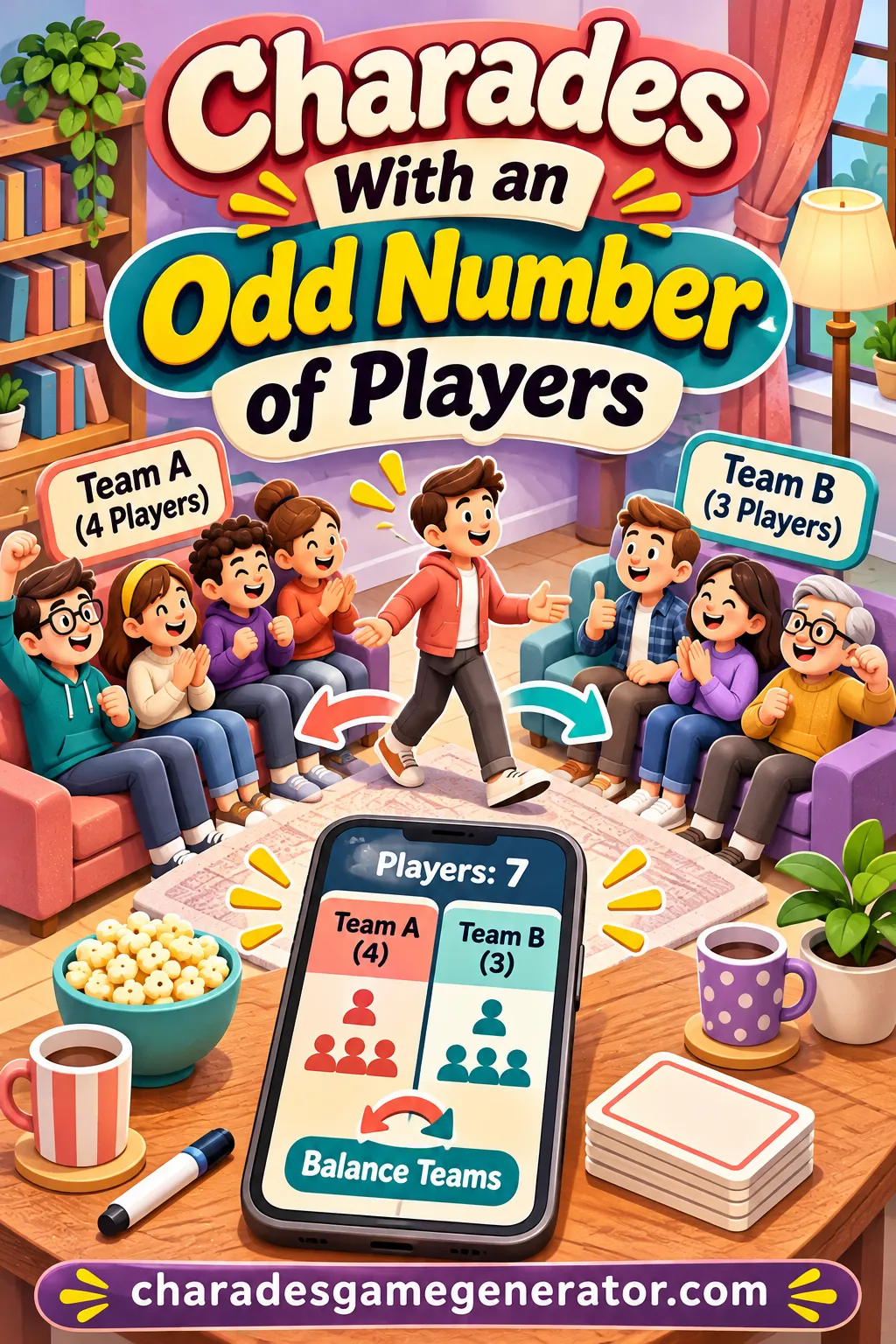
When you've got an odd number of players for charades, split into two teams that are one person apart and name a rotating "floater" who acts for the smaller team, so both teams get the same number of turns and nobody sits out. That one rule fixes almost every uneven-teams problem, from five people around a coffee table to nine crammed into a living room. Below you'll find the exact setups, scoring fixes and word lists to make it feel fair.
You can run the whole thing on the free Charades Game Generator, which gives each actor a word, runs the timer and keeps the scores for two, three or four teams, so you only have to sort out who's on which side.
Why Odd Numbers Feel Unfair (and Why They Usually Aren't)
The worry with uneven teams is simple: the team with more people seems to have an edge. It has more guessers shouting answers, and if every player gets a turn to act, it also has more turns.
The first part matters less than people think. In charades, one or two sharp guessers do most of the work. A team of four isn't much better at guessing than a team of three, and sometimes it's worse, because people talk over each other while the actor waves frantically at the one person who's close.
The second part is the real problem. If the bigger team gets four acting turns per cycle and the smaller team gets three, the bigger team has more chances to score. That's the gap you need to close, and there are three clean ways to close it:
- Equal turns per team, not per player. Each team acts the same number of times per round, no matter how many people it has. The smaller team just cycles through its actors faster.
- A rotating floater. One person switches sides or acts for the smaller team on a set schedule.
- No teams at all. Everyone plays for themselves, which works surprisingly well with five or seven people.
The game itself handles part one for you automatically. It alternates turns by team, not by person, so Team 1 and Team 2 always get the same number of turns over the number of rounds you pick. Your job is just to decide who stands up to act when a team's turn comes around.
The Floater Rule, Explained
The floater is the simplest fix for uneven teams in charades, and it's the one most groups end up using once they try it.
Here's how it works. Split your players into a bigger team and a smaller team. The smaller team is one person short, so one player from the bigger team becomes the floater. The floater stays on the bigger team for guessing, but when it's time to fill the missing acting slot on the smaller team, the floater acts for them instead.
That sounds odd at first. Why would someone act for the other team? Because it keeps the number of acting turns even, and in practice nobody minds. The floater still gets to perform, the smaller team gets a full set of actors, and each team guesses for its own actors.
The floater's three jobs
- Act for the smaller team when that team's rotation reaches the empty slot.
- Guess for their home team the rest of the time, but never guess when they're acting for the other side (that would be strange anyway).
- Hand the floater role to someone new each round, so it doesn't land on the same person all night.
Rotating the floater fairly
The floater role should move. A simple way is to give the job to whoever acted most recently on the bigger team when a new round starts. Another option is a written order: the host jots the bigger team's names on a sticky note and moves a paperclip down the list each round.
Rotation matters for two reasons. First, being the floater is a little more work, so sharing it feels fair. Second, some players are great actors and some aren't, and you don't want the smaller team permanently stuck with your weakest performer or permanently boosted by your strongest one.
Floater vs. switcher
Some groups prefer a "switcher" instead. The switcher fully changes teams every round: they guess and act for Team 1 in round one, then move their chair and play for Team 2 in round two. That works well when you only play an even number of rounds, because the switcher spends exactly half the game with each side.
| Approach | How it works | Best for | Watch out for |
|---|---|---|---|
| Floater | Stays home for guessing, acts for the short team | Any odd group, any round count | Remember who the floater is each round |
| Switcher | Fully changes teams every round | Even round counts (no 7 rounds) | Their points split across both teams |
| Equal turns only | Each team acts the same number of times; no one switches | Casual play, 5 or 7 people | Small team's actors perform more often |
| Every player for themselves | Individual scoring, everyone guesses | 5 to 7 people, competitive friends | Takes longer per round |
| Host sits out | Odd player runs the game and timer | 9+ people, kids' parties | Host doesn't get to play |
If you're not sure which to pick, start with the floater. It works for five, seven, nine or eleven people, it doesn't depend on the number of rounds, and it's easy to explain in one sentence.
Exact Setups for 5, 7 and 9 Players
Here's a ready plan for the three most common odd group sizes. Each one includes how to split the group, which settings to choose in the game, and how the floater rotates.
Charades with 5 players
Five is the trickiest odd number, because a 3-vs-2 split puts a lot of acting on the pair. You have two good options.
Option A: 3 vs. 2 with a floater. Team 1 has three players, Team 2 has two. Team 2's two players take turns acting, and once each round, the floater from Team 1 acts for Team 2 so the pair gets a breather. Over a game, everyone acts a similar number of times.
Option B: Everyone for themselves. With five people, individual play is fast and fun. One person acts, the other four race to guess, and whoever guesses first earns the point along with the actor. You can still use the game for words and the timer, and keep individual tallies on paper.
Recommended game settings for a 3-vs-2 game:
- Teams: 2
- Category: Actions or Animals (big, physical words that a two-person team can guess quickly)
- Timer: 60 sec
- Rounds: 5
- Difficulty: 🎲 Mixed
Five rounds means each team acts five times. On the two-person team, the floater covers one of those turns, so each of the pair acts twice and the floater acts once.
Charades with 7 players
Seven is the most common "one too many" number, and it splits nicely into 4 vs. 3. The floater rule shines here.
- Write all seven names on slips and pull them from a bowl to make the teams. Alternate: first name to Team 1, second to Team 2, and so on. Team 1 ends up with four players, Team 2 with three.
- Pick the first floater from Team 1.
- Each round, every team acts once. On Team 2, the three players take turns, and every fourth acting turn goes to the floater.
- When a new round starts, the floater role passes to the next Team 1 player.
Recommended game settings:
- Teams: 2
- Category: Movies, Famous People or Places for adults; Kids or Animals for younger groups
- Timer: 60 sec
- Rounds: 7
- Difficulty: 🎲 Mixed
Seven rounds gives each team seven turns. On the team of four, everyone acts at least once and one person acts twice. On the team of three, the three regulars act twice each and the floater covers the seventh turn. That's about as even as it gets.
Charades with 9 people
Nine opens up more options. You can go 5 vs. 4 with a floater, or split into three teams of three, which needs no floater at all.
Three teams of three is the cleanest fix for nine. Every team has the same size, everyone acts the same number of times, and the game supports three teams out of the box.
Recommended game settings for 3 teams of 3:
- Teams: 3
- Category: Office Party, Places or Sports (or any category that suits your crowd)
- Timer: 60 sec
- Rounds: 5 or 7
- Difficulty: 🎲 Mixed
If your group prefers two big teams, go 5 vs. 4 and use the floater on the team of four. Big teams get loud, so a 45-second feel can help: pick the 60 sec timer but ask actors to skip quickly when they're stuck.
For more on how group size shapes the game, our guide on how many people you need for charades walks through every size from two up to a crowd.
Quick reference: splits for any odd group
Not every party lands on five, seven or nine. This table covers the odd numbers you're most likely to see, from three people at a kitchen table to fifteen at a family reunion.
| Players | Best split | Game teams setting | Floater needed? | Notes |
|---|---|---|---|---|
| 3 | Everyone for themselves | 2 (use as a turn counter) or paper tally | No | One acts, two guess, rotate |
| 5 | 3 vs. 2 | 2 | Yes, on the pair | Or play individually |
| 7 | 4 vs. 3 | 2 | Yes | The classic floater game |
| 9 | 3 + 3 + 3 | 3 | No | Cleanest option |
| 11 | 4 + 4 + 3 | 3 | Yes, on the team of 3 | Or 6 vs. 5 with two teams |
| 13 | 4 + 3 + 3 + 3 | 4 | Yes, on one team of 3 | Four teams keeps turns short |
| 15 | 5 + 5 + 5 | 3 | No | Big, loud and fair |
A pattern jumps out: whenever your number divides by three, three teams solves the problem without any extra rules. Nine and fifteen are easy. Seven, eleven and thirteen need a floater no matter how you slice them.
With three people, team play doesn't really work. Take turns acting and let the other two race to guess. For very small groups, cooperative scoring also works: the actor and guessers try to beat their own best score together.
How to Set It Up in the Game
Once you've picked your split, getting the game ready takes about a minute. Here's the full walk-through for the most common case, seven players in a 4-vs-3 game with a floater.
- Open the free charades game on one phone or tablet. Pick a device with a decent screen, since it gets passed to each actor.
- Under Set Up Your Game, choose 2 teams. The game only tracks teams, not individual names, so jot the names for each side on a scrap of paper if your group tends to forget.
- Pick a category. Movies, Animals, Famous People, Places, Actions and Kids all work well for mixed groups. For a holiday gathering, Christmas or Halloween keeps the theme going.
- Add custom words if you like. Tap ✏️ Add Custom Words, type a word, then tap + Add. This is a great place for the word lists later in this article, or for inside jokes your group will love.
- Set the timer to 60 sec. It's long enough for a newer actor and short enough that the smaller team doesn't feel like it's always waiting.
- Choose 7 rounds. With seven players, seven rounds lets the floater rotate through most of the bigger team.
- Pick 🎲 Mixed difficulty. Easy words for warm-ups and harder ones for the competitive types, all in one deck.
- Start the game and hand the device to Team 1's first actor. They see the word, act it out, and tap ✓ GOT IT! when their team guesses or ↷ Skip — too hard! when they're stuck.
- On the Time's Up screen, check Current Scores, then tap Next Team's Turn and pass the device to Team 2's actor (or to the floater, if it's their slot).
- When the last round ends, tap Play Again for a rematch with shuffled teams.
Keeping track of the floater
The game counts team turns and points. It doesn't know who the floater is, so you'll need a tiny bit of paper tracking. The easiest method is an "acting order" card for each team.
On a sticky note, write the smaller team's names in order and leave the last slot as "Floater." For a 4-vs-3 game, Team 2's card reads: Sam, Priya, Jo, Floater. Then on a second note, write the bigger team's names in the order they'll take the floater role. Cross off names as you go.
That's it. Two sticky notes and the game does the rest.
Settings cheat sheet by group size
| Players | Teams | Timer | Rounds | Difficulty | Suggested category |
|---|---|---|---|---|---|
| 5 | 2 | 60 sec | 5 | 😊 Easy or 🎲 Mixed | Actions, Animals |
| 7 | 2 | 60 sec | 7 | 🎲 Mixed | Movies, Famous People, Places |
| 9 | 3 | 60 sec | 5 or 7 | 🎲 Mixed | Office Party, Sports, Places |
| 11 | 3 | 60 sec | 7 | 🎲 Mixed | Any; Kids for mixed ages |
| 13 | 4 | 30 sec or 60 sec | 5 | 😤 Hard for fast groups | Superheroes, Fairy Tales, Movies |
| 15 | 3 | 60 sec | 5 | 🎲 Mixed | Christmas, Halloween, seasonal |
With four teams, rounds take longer because each round includes four turns. Five rounds of four teams is twenty acting turns, which is plenty for one evening. If your group moves fast, the 30 sec timer keeps the energy high.
A host script for explaining the floater
The floater idea makes sense once people play one round, but explaining it to a room of chatty guests can get messy. Here's a short script you can read out loud or paraphrase.
"Okay, we've got seven people, so the teams are four and three. To keep it fair, both teams get the same number of turns. Team 2 is one person short, so each round, one person from Team 1 is the floater. When it's the floater's slot, they act for Team 2. Team 2 guesses, Team 2 gets the points. Then the floater goes right back to Team 1. Next round, someone else is the floater. Got it? Great, let's play."
That takes about twenty seconds. If someone looks confused, just say, "You'll see in one round," and start. After the floater's first turn, everyone gets it.
What to say when someone complains
- "Their team has more people!" "True, but both teams get the same number of turns. More people doesn't mean more points in charades. Sometimes it just means more shouting."
- "Why does the floater act for us?" "So your team gets the same number of actors as theirs. Their points go to you."
- "I don't want to be the floater." "No problem, we'll skip you this round. But it's kind of fun. You get to show off for both teams."
- "The floater is throwing it!" "Okay, new rule: if the floater's turn scores for your team, they also get a bonus point for their own team. Now they want you to win."
That last line is the floater bonus (more on it in the scoring options below), and it fixes the "throwing" worry right away.
Scoring Options That Keep Uneven Teams Fair
The game's built-in scoring gives one point per word guessed. For most odd-numbered groups, that's all you need, because both teams get the same number of turns. Still, some groups want extra fairness, especially when a competitive uncle is on the small team. Here are a few house rules to choose from.
Option 1: Straight team points (default)
Every word guessed earns one point for the actor's team. When the floater acts for the smaller team, those points go to the smaller team. This is the simplest choice and the one the game tracks for you.
Option 2: Floater bonus
If the floater's turn gets the smaller team at least one point, the floater earns a "good sport" point for their home team too. This rewards the floater for really trying, so they don't quietly go easy on the other side. Track bonus points on paper and add them at the end.
Option 3: Per-player average
For truly competitive groups, divide each team's final score by the number of players. A team of three that scored 15 averages 5 per player. A team of four that scored 18 averages 4.5. This is overkill for most game nights, but it settles arguments when the teams are very lopsided, like 6 vs. 5.
Option 4: Individual leaderboard
Keep team scores on the screen, but also tally individual "actor points" on paper. Each time an actor's word is guessed, they get a mark. At the end, crown both a winning team and a top actor. This works really well for five or seven people, because it gives the floater a way to win, too.
| Scoring rule | Effort | Fairness | When to use |
|---|---|---|---|
| Straight team points | None (game tracks it) | Good | Most game nights |
| Floater bonus | Low (paper tally) | Better | When the floater might coast |
| Per-player average | Medium (quick math) | Best for big gaps | Lopsided teams with keen players |
| Individual leaderboard | Low (paper tally) | Good for small groups | 5 to 7 players, friendly rivals |
If your group loves to argue about points, our guide to charades scoring has more systems you can borrow, including bonus rounds and penalty rules.
Ready Word Lists for Uneven Groups
When teams are uneven, word choice matters more than you'd think. A smaller team has fewer guessers, so very hard or obscure words punish them more. The trick is to keep the deck balanced, with plenty of words that one or two sharp guessers can get on their own.
Here are three ready lists. Type any of them into ✏️ Add Custom Words before you start, or keep them handy for the floater's turns. Every word is clean and works for mixed company.
Easy words (warm-up and young players)
These are quick, physical words that even a two-person team can guess in a few seconds.
- Brushing teeth
- Swimming
- Riding a bike
- Jumping rope
- Eating spaghetti
- Sleeping
- Crying baby
- Monkey
- Elephant
- Rabbit
- Fishing
- Driving a car
- Playing guitar
- Painting a wall
- Snowball fight
- Dancing
- Clapping
- Yawning
- Kangaroo
- Reading a book
Medium words (most game nights)
These need a bit more acting but are familiar to almost everyone.
- Changing a diaper
- Walking on ice
- Ironing a shirt
- Hiking up a mountain
- Waiting in a long line
- Mowing the lawn
- Taking a photo
- Hammering a nail
- Building a sandcastle
- Lifeguard
- Chef
- Scuba diver
- Pirate
- Robot
- Tightrope walker
- Volcano
- Earthquake
- Haunted house
- Ice skating
- Blowing up a balloon
Hard words (competitive groups)
Save these for groups who like a challenge. They're tough for small teams, so use 🎲 Mixed rather than 😤 Hard if your teams are 4 vs. 3 or 3 vs. 2.
- Stuck in an elevator
- Opening a stuck jar
- Losing your keys
- Getting a haircut
- Assembling furniture
- Missing the bus
- Learning to skateboard
- Untangling a necklace
- Running late for work
- Trying to catch a fly
- Lost luggage
- Parallel parking
- Burnt toast
- Locked out of the house
- Walking through a spider web
- Choosing a melon
- Carrying too many bags
- Wrapping a gift with no tape
- Hiding a surprise party
- First day at a new job
That's sixty words, enough for a long night even with nine or eleven players. For a bigger pool sorted by challenge level, the charades words by difficulty page has hundreds more.
Variations by Age and Crowd
The floater rule works for everyone, but different groups bend it in different ways. Here's how to adjust for kids, teens, families and adults.
Kids (ages 5 to 10)
Young kids care much more about getting a turn than about the score. With an odd number of children, skip the floater and use a grown-up as the extra player on the smaller team. The adult guesses and cheers but only acts when a child wants a helper. Set the game to 😊 Easy, the Kids or Animals category, and the 90 sec timer so nobody feels rushed.
If you have one child too many and no spare adult, try "partner acting." Two kids from the bigger team act a word together. That uses up an extra player without changing turn counts, and little ones love having a buddy on stage.
Teens and tweens
Teens usually want a real competition. Use the floater with the floater bonus, so nobody can accuse anyone of throwing a round. Mixed difficulty and the 60 sec timer keep it fast. Let the teens pick the category each round, which gives them a sense of control and cuts down on eye-rolling.
Mixed-age families
At family gatherings, an odd number is almost guaranteed. Grandparents, cousins and toddlers all arrive in different numbers. A smart setup is to make the floater a teenager or adult who can act any word well, then rotate the role between the grown-ups only. That way the smaller team is never stuck with a three-year-old acting "parallel parking."
You can also pair a young child with an adult and count them as one player. A team of "Grandma plus Leo" is one acting slot, which neatly turns seven people into six slots.
Adults and competitive friends
Grown-up groups often prefer individual scoring with five or seven people. Everyone guesses, the first correct guesser and the actor each get a point, and the game runs fast. If you want team play, the per-player average settles every argument about lopsided sides.
Very large odd groups
Once you're past eleven or thirteen people, the "one extra" barely matters. At that size, just use three or four teams and let the bigger team act one more time at the end, or name a game host who runs the device, reads out scores and calls "Next team!" For more ideas on crowd play, our charades for large groups guide covers relay formats and stage setups.
Troubleshooting Common Arguments
Odd numbers bring out a few predictable disputes. Here's how to settle each one fast and get back to playing.
"The bigger team has more guessers, so they win more." Both teams get the same number of turns, so the scoring field is level. If the gap really bothers people, switch to per-player average scoring for the next game.
"Nobody wants to act for the other team." Make the floater spot something to brag about. Use the floater bonus, or give a small prize at the end to the floater whose turn scored the most for the other team.
"The floater keeps guessing for the other team, too." Set a clear rule: the floater only guesses for their home team, and only acts for the smaller team. If someone slips, just reset the round's points by one. It happens once and then never again.
"We forgot who the floater is." That's what the sticky notes are for. If you lose track, the person who acted most recently on the bigger team is the floater for the next round.
"The small team is tired of acting." On a team of two or three, each person acts a lot. Give the smaller team two floater turns per round instead of one, or switch to the 30 sec timer so each turn is shorter.
"Somebody arrived halfway through." Lucky you, now you might have an even number. Add the newcomer to the smaller team and drop the floater. If it makes the numbers odd again, the newcomer becomes the next floater.
"Someone had to leave." Move one player across to rebalance, or name a new floater. The game keeps scores by team, so nothing on the screen has to change.
Quick tips for smoother uneven games
- Pick teams randomly. Pulling names from a bowl avoids the awkward "who's left over" moment and makes the uneven split feel like luck, not a judgment.
- Seat teams on opposite sides of the room. It's easier to see who's guessing for whom, and the floater has a clear path between groups.
- Keep skips moving. The ↷ Skip — too hard! button exists for a reason. A small team stuck on a word for a full minute will lose interest fast.
- Warm up with easy words. Use 😊 Easy for the first round so everyone, including the floater, gets a quick win.
- Call out the floater at the start of each round. A simple "This round's floater is Mia!" avoids every mix-up.
If you'd like a broader look at home rules people use, our charades house rules page has more ideas you can mix in.
Ready to Play With Any Number
Five, seven, nine or fifteen, an odd count doesn't have to stall your game night. Split the group as evenly as you can, name a floater for the smaller team, rotate the role each round, and let the game keep the turns and scores even. Open the free Charades Game Generator, pick your teams, category and timer, and start the first round in under a minute.
Frequently Asked Questions
How do you play charades with an odd number of players?
Split into two teams that are one person apart and pick a floater from the bigger team. The floater acts for the smaller team when it's short an actor, then goes back to guessing for their own team. Rotate the floater each round so the role is shared.
What's the best way to play charades with 5 players?
You can play 3 vs. 2 with a floater who covers one of the pair's turns each round, or play everyone for themselves. Individual play is quick with five people, since four guessers race to call out the answer. Keep a paper tally if you go individual.
How do you split 7 players for charades?
Make teams of four and three by drawing names from a bowl. The team of three gets a floater from the team of four for its extra acting slot. Seven rounds with a 60 sec timer is a good setting for this size.
Can you play charades with 9 people without a floater?
Yes. Split into three teams of three and set the game to 3 teams. Every team has the same number of players, so no one needs to switch sides.
Isn't the bigger team at an advantage?
Not much. Both teams act the same number of times, and in charades a couple of good guessers do most of the work, so an extra person rarely changes the result. If your group still worries, use per-player average scoring at the end.
What if nobody wants to be the floater?
Rotate the role so no one gets stuck with it for long, and add a floater bonus point for their home team when their turn scores for the other side. Most people find the floater role fun once they try it, since they get to act more often.
Does the online game track the floater?
No. The game tracks team turns, team scores and rounds, not individual players. Write the acting order on a sticky note and mark who's floating each round.
What timer is best for uneven teams?
The 60 sec timer suits most groups. If the smaller team is getting tired from acting so often, switch to 30 sec. For young kids, choose 90 sec so they have time to think.