How to Run a Charades Tournament for 16 Players (Bracket, Scoring and Final)
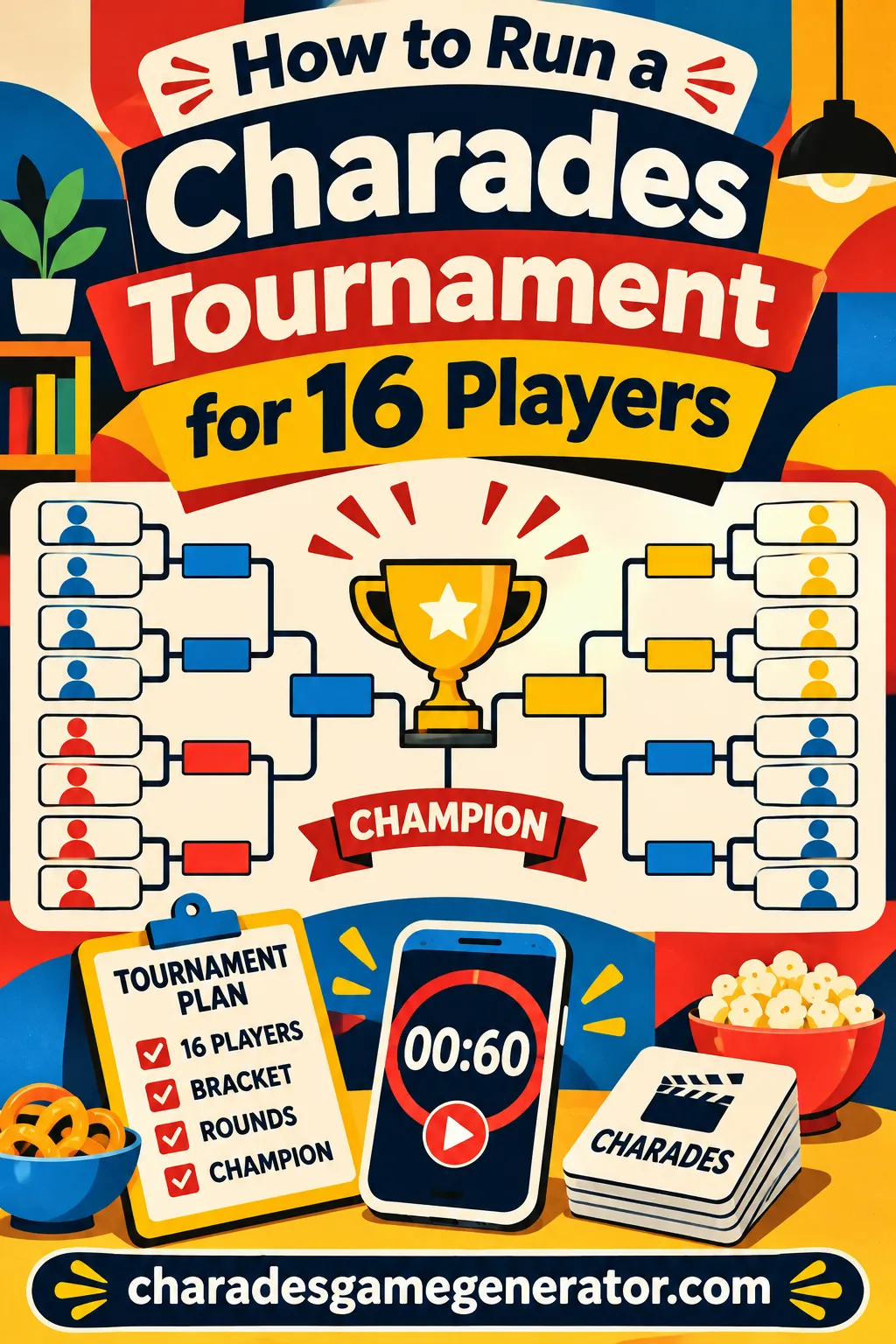
To run a charades tournament for 16 players, split everyone into four teams of four, play one timed qualifier game with all four teams, then send the top two teams to a harder head-to-head final. The free charades game handles the words, the timer and the scoreboard for every stage, so your only jobs are keeping the bracket sheet and refereeing. The whole event takes about 90 minutes to two hours and crowns a real champion instead of ending in "I think we won?"
One big game with 16 people doesn't work. Turns come around so slowly that half the room checks out, and the final score feels like luck. A tournament fixes that with stages, a clear scoring system and a final that everyone watches. Below you'll find the format, the exact game settings for each stage, a bracket sheet you can copy onto paper, host scripts, word lists for each round, a referee rulebook and versions for 8 to 32 players.
The Tournament Format at a Glance
The core format is called Qualifier plus Final. It's simple to explain, it gives every team plenty of turns, and it ends with a showdown the whole room cares about.
| Stage | Who plays | Game settings | Rough length | Result |
|---|---|---|---|---|
| Opening | Everyone | Team draw, names, rules | 10 min | Four teams of four |
| Qualifier | All 4 teams | 4 teams, 🎲 Mixed, 60 sec, 5 rounds | 30 to 35 min | Teams ranked 1 to 4 |
| Break | Everyone | Phone down | 10 min | Bracket updated |
| Third-place match | Teams ranked 3 and 4 | 2 teams, 🎲 Mixed, 60 sec, 5 rounds | 15 min | Bronze finish |
| Final | Teams ranked 1 and 2 | 2 teams, 😤 Hard, 60 sec, 7 rounds | 20 to 25 min | Champion |
| Awards | Everyone | Scores read aloud | 5 min | Bragging rights |
Why this shape works:
The qualifier keeps everyone busy. With four teams on one phone, each team acts once per round, so there's always a team acting, a team about to act and two teams heckling (quietly). Nobody waits more than about four or five minutes for their next turn.
The final raises the stakes. Switching to 😤 Hard and 7 rounds makes the championship feel different. The words are tougher, the game is longer, and a lucky streak in round one can be overcome.
The third-place match keeps the bottom half playing. Without it, eight people sit and watch for 25 minutes. With it, they get another game, and the room stays lively.
Everything fits on one phone. You never need four devices or a special app. If you do have a second phone, there's a faster version later in this guide where the final and the third-place match run at the same time in two rooms.
How to Set It Up in the Game, Stage by Stage
Here are the exact settings for each stage. Open the free online charades game on the host's phone before guests arrive and run a quick test turn so you know where every button is.
Stage 1: the qualifier
- Number of teams: 4. One for each team of four players.
- Category: pick something everyone knows. Actions, Animals, Places and Sports are all fair choices because nobody gets an edge from pop-culture knowledge. If the group is all adults who love films, Movies works too.
- ✏️ Add Custom Words (optional). Skip this for the qualifier so no team can say the host stacked the deck. If you do add words, read them out to everyone first or use the neutral list below.
- Timer: 60 sec. It's the fairest middle ground. Shorter turns reward fast readers, longer turns drag with four teams.
- Rounds: 5. Each team acts five times, so with four players per team, everyone acts at least once and one player acts twice.
- Difficulty: 🎲 Mixed. A blend of easy and tricky words spreads the scores out so you get a clear ranking.
During the game, the actor taps ✓ GOT IT! for each word their team guesses and ↷ Skip — too hard! for words they want to pass. At the end of each turn the Time's Up screen appears, then Current Scores. That's your moment to copy the numbers onto the bracket sheet. Tap Next Team's Turn and keep going.
Stage 2: the third-place match
- Number of teams: 2.
- Category: a different one from the qualifier, so the words feel fresh. Food or Kids keep it light.
- Timer: 60 sec.
- Rounds: 5.
- Difficulty: 🎲 Mixed.
Stage 3: the final
- Number of teams: 2.
- Category: let the higher-seeded team choose from a short list you announce (for example Actions, Places, Famous People or Superheroes). That's their reward for winning the qualifier.
- Timer: 60 sec. Keep the same timer as the qualifier so nobody can say the rules changed on them.
- Rounds: 7. More turns means skill wins over one lucky word.
- Difficulty: 😤 Hard. The final should feel like a final.
Settings summary
| Setting | Qualifier | Third-place match | Final |
|---|---|---|---|
| Teams | 4 | 2 | 2 |
| Category | Neutral (Actions, Animals, Places, Sports) | Fresh pick (Food, Kids) | Top seed picks from host's shortlist |
| Custom words | None, or a shared list | Optional | None |
| Timer | 60 sec | 60 sec | 60 sec |
| Rounds | 5 | 5 | 7 |
| Difficulty | 🎲 Mixed | 🎲 Mixed | 😤 Hard |
When a stage ends, tap Play Again and change the settings for the next stage. Each stage is its own fresh game, which is exactly why you keep the paper bracket sheet as the official record.
Before Kickoff: Teams, Seeding and the Bracket Sheet
Good tournaments are won or lost before the first word is drawn. A fair team draw and a clear bracket sheet stop most arguments before they start.
Drawing four fair teams
Sixteen people almost always include a few natural performers and a few who'd rather be anywhere else. If friends pick their own teams, you'll get one super team and three unhappy ones. Try one of these instead:
- Count off. Everyone stands in a line and counts one, two, three, four. All the ones are a team, and so on. Quick, random and hard to argue with.
- Captain draft. Pick four captains (the four most confident players work best). Captains pick one player at a time in snake order: 1, 2, 3, 4, then 4, 3, 2, 1. Snake order keeps it balanced.
- Pairs plus pairs. If guests arrived as couples or pairs of friends, keep pairs together but have the host combine two pairs into each team, spreading the strong pairs across teams.
- Mix the generations. At family events, make sure each team has at least one adult and one kid or teen.
Give teams two minutes to choose a name. Names make the bracket fun to read and the final more dramatic. If teams freeze, point them to the charades team names list.
The paper bracket sheet
Draw this on a sheet of paper, a whiteboard or the back of a pizza box. It's your official record, separate from the phone's scoreboard.
| Team | Qualifier R1 | R2 | R3 | R4 | R5 | Total | Seed |
|---|---|---|---|---|---|---|---|
| Team A | |||||||
| Team B | |||||||
| Team C | |||||||
| Team D |
Below it, draw the knockout part:
- Final: Seed 1 vs Seed 2
- Third place: Seed 3 vs Seed 4
- Champion: ______
Write each team's points after every round, not just the total at the end. Round-by-round numbers make tiebreakers easy and let you announce a running leaderboard during the qualifier, which keeps the energy high.
Pick your officials
You need two volunteers besides yourself, and they can still play:
- Scorekeeper: copies points from the Current Scores screen onto the bracket sheet after each turn.
- Line judge: sits with the teams that aren't acting and watches for talking, mouthing words or pointing at objects.
Rotate the line judge so it's never someone from the acting team. Officials who are on teams simply hand off the job when their own team is up.
Scoring Rules and Tiebreakers That Hold Up Under Pressure
A friendly game can live with fuzzy scoring. A tournament can't. The moment there's a trophy (even a paper one), people start reading the rules like lawyers. Settle these before the qualifier starts and read them aloud.
Basic scoring
The game's own scoreboard counts one point for each word a team guesses before the timer runs out. Skips don't add points. That's the official score for every stage, and it's simple enough that nobody needs it explained twice.
Optional scoring layers
If your group wants more strategy, add one or two of these. Don't use all of them; the bracket sheet gets messy fast.
| Scoring option | How it works | Best for |
|---|---|---|
| Standard | One point per word guessed, from the game's scoreboard | Every group, every stage |
| Skip limit | Each turn, after three skips, any further skip costs one point | Competitive adults who skip too fast |
| Placement points | Qualifier rank earns bonus points: 1st gets 3, 2nd gets 2, 3rd gets 1 | Multi-game leagues |
| Steal | If the acting team fails a word, the next team gets one guess for a bonus point | Groups that like drama |
| Clean-turn bonus | One bonus point for a turn with zero skips and zero rule breaks | Rewarding careful actors |
| Round wins | Final is decided by rounds won, not total points | Close, even teams |
Any bonus points get written on the bracket sheet by hand, since the game's scoreboard only counts guessed words. For more ideas, the charades scoring guide breaks down other point systems in detail.
Tiebreakers in order
Ties happen, especially in the qualifier between the second and third place teams. That's the line between the final and the bronze match, so decide the order now:
- Most points in the last round. The team that finished stronger advances.
- Fewest skips across the qualifier. Have the scorekeeper note skips as they happen if you plan to use this.
- Sudden-death turn. Both teams play one turn each, 30 sec timer, same category, same difficulty. Most words wins. If it's still tied, repeat.
For the final itself, skip straight to sudden death. Everyone's watching, and a sudden-death turn is the most exciting possible finish.
Running sudden death in the game
Set Teams to 2, Timer to 30 sec, Rounds to 3, and keep the same category and difficulty as the stage that tied. Play only the first round, then compare. If you want, you can keep going round by round until one team leads after both have acted. It's tense, quick and fair, since both teams get the same timer and word pool.
Host Scripts for Every Stage
You don't need to be a game-show host, but a few clear lines at the right moments make the event feel organized. Here's what to say.
Opening (before the qualifier)
"Welcome to the charades tournament. Sixteen players, four teams, one champion. Here's how it works. First, all four teams play a qualifier: five rounds, sixty seconds a turn, mixed words. The top two teams go to the final. Teams three and four play for third place. The final is seven rounds on hard words."
"Three rules. One: actors don't speak, mouth words or point at real objects in the room. Two: only the acting team guesses. If another team shouts the answer, the acting team gets the point anyway. Three: skips are free, but they waste time, so use them wisely."
"Our scorekeeper is [name]. Our line judge is [name]. Their call is final. Any questions? Then let's draw teams."
During the qualifier
After each turn: "Time! Team [name] scores [number] this turn. Scorekeeper, got it? Next up, Team [name]. Actor, come on up."
After each full round: "End of round [number]. Here's the leaderboard: [read totals from highest to lowest]."
Before round 5: "Last round of the qualifier. Right now, [team] and [team] are in the final spots, but it's close. Everything's on the line."
Announcing the bracket
"The qualifier is over. Your finalists are [Seed 1] and [Seed 2]. [Seed 1], as the top seed, you pick the category for the final from this list: [list]. Before that, [Seed 3] and [Seed 4] play for third place. Five-minute break, then we're back."
Before the final
"This is it. Seven rounds, hard words, sixty seconds a turn. [Seed 1] acts first. Everybody else, you're the audience now. Cheer all you want between turns, but total silence while someone's acting. Ready? Go."
Closing
"Your champions are [team name]. Let's hear it. Third place goes to [team name]. Thanks to our scorekeeper and line judge. Want a rematch? Same teams, same bracket, next game night."
Short, clear and repeatable. After one tournament, a confident guest can host the next one with this script.
Tournament Word Lists for Each Stage
The game's built-in categories are the main word source for every stage, so the host never sees the words in advance. These lists are for practice rounds, a shared custom deck for the qualifier, or a sudden-death tiebreaker if you want words both teams can see were fair. Every word is clean and works for mixed company. Type them into ✏️ Add Custom Words and tap + Add after each one.
Warm-up words (practice round before the qualifier)
Use these in a quick unscored round so everyone learns the buttons and the signals.
- Brushing teeth
- Riding a bike
- Taking a selfie
- Fishing
- Juggling
- Painting a wall
- Walking a dog
- Playing guitar
- Swimming
- Baking a cake
- Yawning
- Hula hoop
Qualifier words (balanced, mixed difficulty)
These are fair for every player, with a range of difficulty so scores spread out.
| Easy | Medium | Tricky |
|---|---|---|
| Kangaroo | Lighthouse keeper | Air traffic controller |
| Pizza | Changing a flat tire | Parallel parking |
| Surfing | Beekeeper | Assembling furniture |
| Dentist | Window washer | Hot air balloon |
| Volcano | Ice fishing | Lost luggage |
| Penguin | Sushi chef | Marathon runner |
| Snowman | Tightrope walker | Scuba diver |
| Robot | Snowball fight | Blowing out birthday candles |
| Firefighter | Mountain climber | Photographer at a wedding |
| Bowling | Ventriloquist | Getting stuck in an elevator |
Final words (hard, for the championship)
Use these as an optional custom deck for the final, or as a sudden-death tiebreaker set. They reward creative acting and teamwork.
- Stage fright
- Running late for a flight
- Locked out of the house
- Learning to ice skate
- Bomb squad cutting a wire
- Reading a map upside down
- Walking on hot sand
- Trying to catch a bus
- Untangling holiday lights
- Wrapping a present badly
- Losing a contact lens
- Spinning plates
- Rowing across a lake in a storm
- Hiccups during a speech
- Walking a very large dog
- Sneezing in a library
- Finding a spider in your shoe
- Sleepwalking chef
- Robot learning to dance
- Astronaut doing laundry
Sudden-death words (quick and clear)
For a 30-second tiebreaker you want words that are tough but fair, with no arguments over close answers.
- Lumberjack
- Ballerina
- Detective
- Igloo
- Waterfall
- Cactus
- Jellyfish
- Magician
- Tornado
- Skyscraper
That's 72 words in all. If you prefer to keep the qualifier fully neutral, skip custom words entirely and let the game's built-in categories do the work.
A Sample Two-Hour Tournament Schedule
Here's how a 16-player tournament plays out on a real evening, starting at 7:00 pm. Times assume about a minute and a half per turn once you count the hand-off and score copying.
| Time | What happens | Notes |
|---|---|---|
| 7:00 pm | Arrivals, snacks, rules read aloud | Hand out name tags if guests don't know each other |
| 7:10 pm | Team draw and team names | Count off or captain draft |
| 7:15 pm | Practice round, unscored | Two or three quick turns with warm-up words |
| 7:20 pm | Qualifier, rounds 1 to 5 | 20 turns in total, about 30 to 35 minutes |
| 7:55 pm | Break, bracket announced | Seeds written up where everyone can see |
| 8:05 pm | Third-place match | 10 turns, about 15 minutes |
| 8:20 pm | Final | 14 turns, about 20 to 25 minutes |
| 8:45 pm | Awards and photos | Champion picks the first game at next game night |
| 8:50 pm | Optional rematch or free play | Mixed teams, no scoring |
A few timing tips:
Start the qualifier on time. Late arrivals can join a team that's short a player, but don't hold the whole room for one guest.
Don't skip the break. Ten minutes after the qualifier lets the scorekeeper double-check totals, settles any tiebreaker, and gives everyone a chance to stretch. It also builds suspense before you announce the finalists.
Keep the hand-offs fast. The slowest part of any tournament is passing the phone. Have the next actor stand ready beside the current one, and tap Next Team's Turn the second the score is copied.
Running long? Cut the third-place match to 3 rounds, or drop it and let teams 3 and 4 act as the official line judges for the final. Running short? Play the final as best of three short games instead of one long one.
Five mistakes that sink a tournament
Letting friends stack a team. One super team turns the qualifier into a formality. Use a count-off or a snake draft every time.
Changing rules mid-event. If you switch the timer or scoring between the qualifier and the final, the team that lost will blame the change. Lock the rules before the first word.
Trusting the phone as the only record. Each stage is a separate game, so copy scores onto paper after every turn. A dead battery shouldn't erase your bracket.
Letting the same people act every turn. Rotate actors in a fixed order. A tournament where one star does all the acting isn't a team event anymore.
No job for eliminated players. People who are out tend to drift to the kitchen and get loud. Give them roles: line judge, scorekeeper, or official cheering section for the final.
The Referee Rulebook: Settling Disputes Fast
Competitive players argue. Plan for it. Most fights at a charades tournament fall into a handful of patterns, and each one has a quick, fair answer. Read the house rules out loud before the qualifier, and keep this table handy for the line judge. The charades house rules page has more rules you can borrow if your group plays often.
| Dispute | Ruling |
|---|---|
| Actor mouthed a word | Word doesn't count. Actor taps Skip and moves on |
| Actor pointed at a real object in the room | Word doesn't count unless pointing is part of a standard signal |
| Another team shouted the answer | Point goes to the acting team |
| Guess was close but not exact ("swim" for "swimming") | Counts if it's the same word in a different form |
| Guess was a synonym ("sofa" for "couch") | Doesn't count. Actor keeps acting until the exact word is said |
| Actor tapped Got It by mistake | Point stands. The game moves on and so do we |
| Timer ran out mid-guess | Guess doesn't count once the Time's Up screen shows |
| Someone took over the phone mid-turn | Turn ends immediately, score stands as is |
| Tie for a final spot | Use the tiebreaker order, ending in sudden death |
| Team claims the words were unfair | Same game, same settings for every team; no replays |
How the line judge should work
Stay neutral. The line judge should never be on the acting team. Rotate the role or pick someone from a team that's waiting.
Call it once, clearly. "That's a mouthed word, no point." Then move on. The longer a ruling takes, the bigger the argument gets.
Don't stop the clock. The game timer keeps running, and that's fine. Stopping for disputes mid-turn invites arguments about restarting.
Settle borderline guesses after the turn. If a guess is close and the actor already tapped ✓ GOT IT!, let it go. If you think a point was wrongly given, the scorekeeper can subtract it from the bracket sheet after the turn, but use this rarely.
Keeping the mood friendly
A tournament should be fun to lose. Remind everyone at the start that the prize is bragging rights and maybe a paper crown. Cheer for good acting from every team. If a team is falling far behind, the host can give a silly "best performance" shout-out after each round so everyone gets a moment in the spotlight.
Variations for 8 to 32 Players
The game supports up to four teams at once, which is the key number for planning. Here's how to scale the tournament up or down.
8 players
Play four teams of two. The qualifier is fast because each team is small, so use 7 rounds instead of 5. Partners take turns acting and guessing, which means everyone is always involved. The final stays at 2 teams, 😤 Hard, 7 rounds.
12 players
Use four teams of three. Keep the core format exactly as it is. Each player acts at least once in a 5-round qualifier, and two players on every team act twice.
20 players
Make four teams of five. Bump the qualifier to 5 rounds and rotate actors so everyone acts once. Some players won't get a second turn in the qualifier, so make sure each team's strongest actor isn't the only one who performs in the final. A simple rule: in the final, nobody acts a second time until every teammate has acted once.
24 players
This is where you need a second phone. Split into two pools of 12, each with four teams of three. Each pool runs its own qualifier at the same time in different rooms, each with its own host and scorekeeper. The winner of each pool meets in the grand final, and the two runners-up play for third place.
| Group size | Teams per pool | Players per team | Pools | Qualifier rounds | Final |
|---|---|---|---|---|---|
| 8 | 4 | 2 | 1 | 7 | Top 2, Hard, 7 rounds |
| 12 | 4 | 3 | 1 | 5 | Top 2, Hard, 7 rounds |
| 16 | 4 | 4 | 1 | 5 | Top 2, Hard, 7 rounds |
| 20 | 4 | 5 | 1 | 5 | Top 2, Hard, 7 rounds |
| 24 | 4 | 3 | 2 | 5 | Pool winners, Hard, 7 rounds |
| 32 | 4 | 4 | 2 | 5 | Pool winners, Hard, 7 rounds |
32 players
Same idea as 24, with two pools of 16 and four teams of four in each. You'll need two rooms, two phones and two hosts. If you have even more people, the charades for large groups guide covers ways to run several games at once.
The four-team bracket (if you have two phones)
Want a classic bracket instead of a final straight from the qualifier? After the qualifier, run semifinals at the same time in two spaces: Seed 1 vs Seed 4 and Seed 2 vs Seed 3, each with 2 teams, 🎲 Mixed, 60 sec and 5 rounds. Semifinal winners meet in the final; the two losing teams play for third. It's a little longer but feels more like a real sports bracket, and every team gets a knockout game.
League over several game nights
Keep the same four teams for a month of game nights. Use placement points (3, 2, 1, 0) for each night's finish and keep a running table on the fridge or in a group chat. The team with the most points at the end of the season wins. Change the qualifier category each week so no team's favorite topic decides the whole season.
Individual champion
For groups who want a single winner, rebuild the four teams for each stage. After the qualifier, every player on the winning team earns 3 points, second place 2, third place 1. Then redraw teams and play again. After three games, the player with the most points is the champion. It's slower, but it mixes everyone up and rewards players who help any team win.
Ready to run your tournament?
Draw the bracket sheet, recruit a scorekeeper and a line judge, and read the opening script. When the teams are ready, open the charades game and set it to 4 teams, 🎲 Mixed, 60 sec and 5 rounds for the qualifier. In under two hours, you'll have a champion and a room full of people asking when the rematch is.
Frequently Asked Questions
How do you run a charades tournament with a big group?
Split players into four teams, play one qualifier with all four teams on a single phone, and send the top two to a final. Teams three and four play a third-place match. A paper bracket sheet holds the official scores between stages.
How long does a 16-player charades tournament take?
Plan for about 90 minutes to two hours. The qualifier takes about 30 to 35 minutes, the third-place match about 15 and the final about 20 to 25, plus time for team draws, breaks and awards.
What settings should I use for the final?
Use 2 teams, 😤 Hard difficulty, a 60 sec timer and 7 rounds. The extra rounds reduce luck, and hard words make the championship feel different from the qualifier. Let the top seed choose the category from a shortlist you give them.
How do you break a tie in charades?
Check the most points in the last round first, then fewest skips. If it's still tied, play sudden death: each team gets one 30 sec turn with the same category and difficulty, and the most words wins.
Do I need more than one phone?
No. The core format runs on one phone because the game handles up to four teams at once. A second phone only helps if you want semifinals at the same time or you're running two pools for 24 or more players.
Can kids play in a charades tournament?
Yes. Use the Kids category or easy topics like Animals, set difficulty to 😊 Easy for younger players, and give them a 90 sec timer. Mix ages on every team so no team is all kids or all adults.
What prizes work for a charades tournament?
Keep them small and fun. A paper crown, a homemade trophy, first pick of snacks or choosing the game at the next game night all work well. The bragging rights matter more than the prize.
How do you keep the losing teams engaged?
Run a third-place match so the bottom half of the bracket keeps playing. Between turns, hand out silly awards like "best performance" or "most creative skip." In the final, invite the eliminated teams to serve as line judges.