Who Goes First in Charades? Fair Turn Order Without Arguments
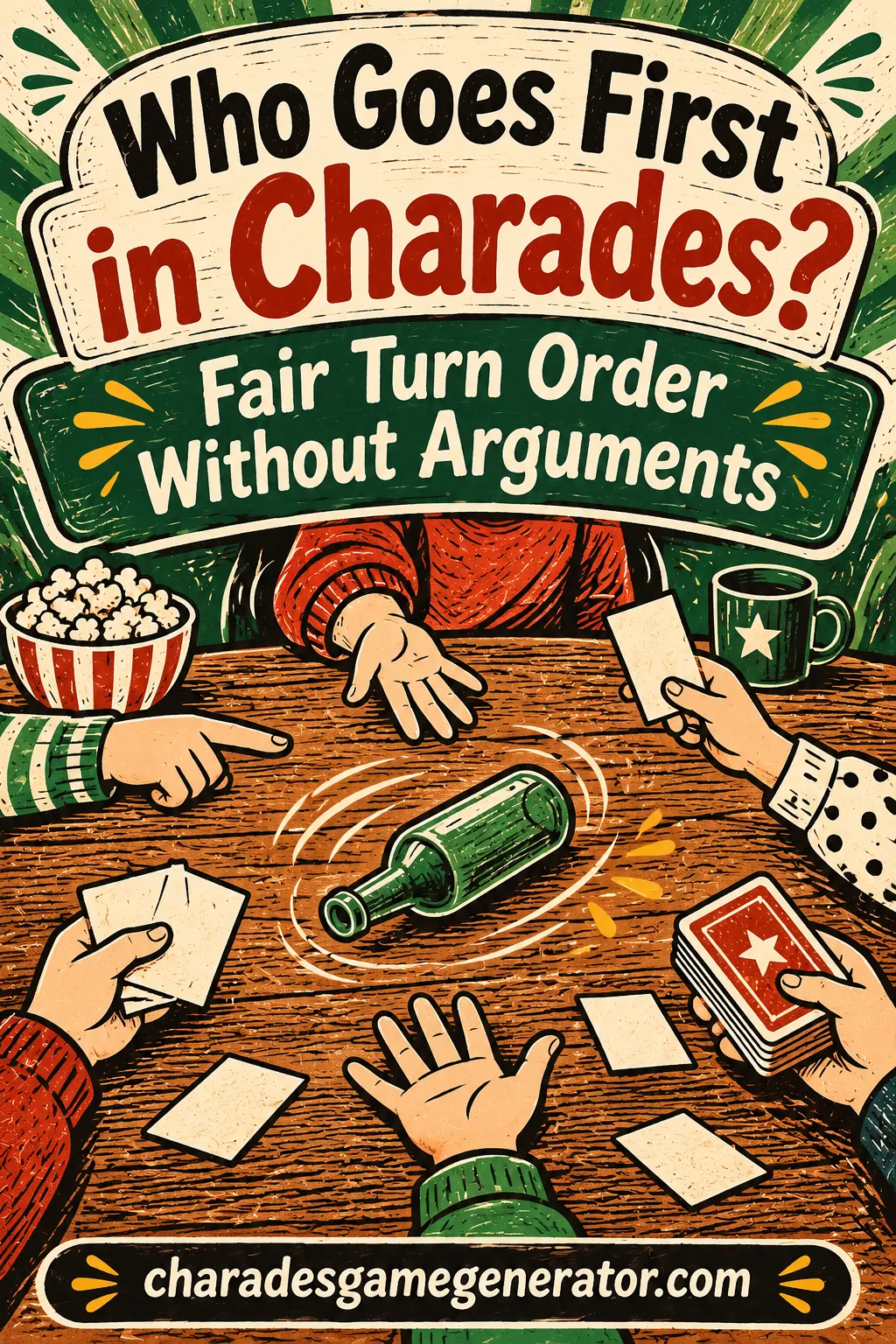
The fairest way to decide who goes first in charades is to draw names at random and then keep drawing without putting anyone back until every player has acted once. That one rule ends both classic problems: nobody gets stuck going first because they hesitated, and the same confident three people can't take every turn. Pair it with a free charades game that deals the words, runs the clock and passes the turn between teams, and nobody has to argue about anything except whether "flapping arms" really meant "chicken."
Below you'll find a ready-to-use rotation system, a dozen ways to pick the very first actor, exact settings for setting up the game, scripts the host can read out loud, and fixes for the arguments that come up most often.
The Short Answer: A Draw-Without-Repeats Rotation
Most charades guides tell you to "take turns," and then leave you to figure out what that means when eight people are staring at the floor. Here's a method that works for any group size.
Step 1: Write every player's name on a slip of paper. Use one slip per person, folded the same way. If you'd rather skip paper, number everyone off and use a phone's random number feature, or have each person pick a playing card.
Step 2: Sort the slips into team piles. If you're playing in teams, keep one pile per team. Team A's names go in one bowl, Team B's in another.
Step 3: Draw one name from the active team's pile. That person acts. Their slip goes face down on the table, not back in the bowl.
Step 4: Keep drawing until the bowl is empty. Every person on the team acts once before anyone acts twice.
Step 5: Refill and reshuffle. When a team's bowl is empty, toss all its slips back in and start a fresh cycle.
That's it. It's random, so nobody can claim the host played favorites. It's no-repeat, so the quiet cousin and the theater kid get exactly the same number of turns. And it's quick, because drawing a slip takes two seconds.
The free charades game takes care of the other half of fairness: it picks the words, so nobody can accuse a teammate of handing out easy ones, and it moves play to the next team automatically when time runs out.
Why "just take turns" breaks down
"Just take turns" sounds fine until you watch it play out. A few things tend to happen:
- The volunteer trap. The first person to say "I'll go" ends up acting first every round, because the group gets used to it.
- The circle drift. Going around the circle works until someone gets up for snacks, someone sits down in a new spot, and suddenly nobody remembers who's next.
- The shy skip. Quiet players say "skip me" once, and the group quietly stops asking.
- The hog. A confident player jumps up the second a turn opens. Ten minutes later, they've acted five times and their teammate hasn't acted at all.
A random draw without repeats fixes all four, because the order isn't decided by who speaks up, where people sit, or how bold they feel.
How to Pick the Very First Actor
Before the rotation starts, someone has to break the ice. If your group dreads going first, these methods take the decision out of everyone's hands. Pick one and announce it before anyone has time to protest.
| Method | How it works | Best for | Time needed |
|---|---|---|---|
| Name draw | First slip out of the bowl goes first | Any group | 10 seconds |
| Next birthday | Person whose birthday is coming up soonest | Families, coworkers | 30 seconds |
| Youngest player | Youngest at the table starts | Family game night | 5 seconds |
| Rock, paper, scissors | Losers drop out until one remains | Up to 8 people | 1 minute |
| Card draw | Highest card acts first | Groups with a deck handy | 30 seconds |
| Pointing game | Everyone points at someone on "three," most votes goes | Silly friend groups | 15 seconds |
| Longest hair | Person with the longest hair starts | Kids parties | 15 seconds |
| Last to touch nose | Host says "noses!" and the last hand up goes first | High-energy groups | 5 seconds |
| Farthest traveler | Whoever came the longest distance | Reunions, parties | 1 minute |
| Host volunteers | The host acts first to show how it's done | Nervous or new groups | Instant |
Which method is fairest?
The name draw is the most neutral, because it doesn't depend on age, looks or luck at a hand game. If you want the start to feel playful, "last to touch nose" gets a laugh and takes five seconds, though it does tend to land on whoever's distracted.
For new or nervous groups, the strongest option is often the host going first. It isn't random, but it's kind. When the host acts a simple word and gets guessed in fifteen seconds, everyone sees that acting first isn't scary. Then the name draw takes over for turn two.
Why going first feels so hard
Going first means acting before anyone has seen the hand signals, before the room has warmed up, and before there's any laughter to hide behind. That's the real reason people dodge it. You can shrink the problem in three ways:
- Give the first actor an easy word. Set the difficulty to Easy for round one, or use the warm-up words in the box above this section.
- Let the first actor pick a partner. A two-person act takes the spotlight off one person.
- Make round one a practice round. Points don't count. Say so out loud.
Once the first turn is over, the second actor has a model to copy, and the dread fades fast.
Fair Rotation Systems for Every Group Size
The draw-without-repeats method works everywhere, but group size changes the details. Here's how to adjust it.
Two to four players
With so few people, teams don't make much sense. Play as one group: one person acts, everyone else guesses, and whoever guesses correctly earns a point. Rotation is simple because there are so few names. Still, use a draw for the first cycle so the eager player doesn't always lead.
If it's just two of you, you'll alternate every turn, so the only real question is who starts. Flip a coin, and whoever loses the toss gets to pick the category instead.
Five to ten players
This is the sweet spot for two teams. Split into Team A and Team B, give each team its own name bowl, and alternate teams every turn. Inside each team, the draw decides who acts.
A typical cycle with eight players looks like this:
| Turn | Team | Who acts | Bowl left after draw |
|---|---|---|---|
| 1 | A | Name drawn from A's bowl | 3 names |
| 2 | B | Name drawn from B's bowl | 3 names |
| 3 | A | Next name from A | 2 names |
| 4 | B | Next name from B | 2 names |
| 5 | A | Next name from A | 1 name |
| 6 | B | Next name from B | 1 name |
| 7 | A | Last name in A | Empty, refill |
| 8 | B | Last name in B | Empty, refill |
After turn eight, every player has acted exactly once. Refill both bowls and start again.
Eleven to twenty players
Split into three or four teams. The game supports 2, 3 or 4 teams, and with more teams, people wait less between turns because each team plays more often. With four teams of five, each person acts once every twenty turns, which is a long wait. To keep everyone involved, consider shorter timers (30 or 60 seconds) and a rule that the whole team guesses together.
Twenty-plus players
Big groups need structure. You can run several small games at once, each with its own phone or tablet and its own name bowls, or run a single big game where only a handful of people act. In that second case, the draw still decides who acts, but you'll likely not reach everyone. Tell the group up front: "We'll draw names, and if yours doesn't come up, you're on the guessing squad." Our guide to charades for large groups has room layouts and team ideas for parties this size.
How to Set It Up in the Game
Here's exactly how to pair the name draw with the game, step by step. Open the free charades game with a timer and teams on any phone, tablet or laptop. There's no app to download and no signup.
Step 1: Set the number of teams. Under Set Up Your Game, choose 2, 3 or 4 teams to match the bowls you've made.
Step 2: Pick a category. There are 18 to choose from, including Movies, Animals, Actions, Kids, Places, Sports and Halloween. For a first game with a nervous group, Actions or Animals is a safe pick because the words are physical and easy to show.
Step 3: Add custom words if you want. Tap ✏️ Add Custom Words, type a word, and hit + Add. This is optional, but it's handy for warm-up words you know everyone can act.
Step 4: Choose a timer. Pick 30 sec, 60 sec, 90 sec or 2 min. Sixty seconds suits most groups.
Step 5: Set the rounds. Choose 3, 5, 7 or 10 rounds. More on matching rounds to players below.
Step 6: Pick a difficulty. 😊 Easy, 🎲 Mixed or 😤 Hard. For turn one, Easy takes the pressure off.
Step 7: Draw a name and hand over the phone. The actor sees the word, acts it out, and taps ✓ GOT IT! when their team guesses, or ↷ Skip — too hard! to move on. When time runs out, the Time's Up screen shows up, then Current Scores, then Next Team's Turn.
Step 8: Draw the next name from the next team's bowl. The game passes the turn between teams. Your name bowls decide who on that team holds the phone.
One honest note: the game rotates turns between teams, but it doesn't keep a list of player names. That's what the bowls (or a simple numbered list) are for. The two together give you full fairness: random words from the game, random actors from the bowls.
Match rounds to your rotation
If you want every person to act the same number of times, set the rounds to fit your team size. Each round, every team plays one turn, so the number of rounds equals the number of turns each team gets.
| Players per team | Rounds to choose | Acts per person |
|---|---|---|
| 3 | 3 | Once each |
| 5 | 5 | Once each |
| 5 | 10 | Twice each |
| 7 | 7 | Once each |
| 10 | 10 | Once each |
| 4 | 3, then 5 with Play Again | Twice each, across two games |
| 6 | 3, played twice | Once each, across two games |
When team sizes don't match an option exactly, play a few rounds, hit Play Again, and keep drawing from the same bowls. The bowls remember who's acted even when the game resets.
Recommended setups
Here are four ready-to-go settings for common situations.
Nervous first-time group (6 people): 2 teams, Actions, 60 sec, 3 rounds, Easy. Host acts first, then the name draw takes over.
Family night (8 people, mixed ages): 2 teams, Animals or Kids, 90 sec, 5 rounds, Easy. Youngest player goes first. Pair little kids with an older helper.
Friends who know the game (10 people): 2 teams, Movies or Famous People, 60 sec, 5 rounds, Mixed. Name draw from the start.
Big party (16 people): 4 teams, Places or Sports, 30 sec, 5 rounds, Mixed. Name draw, and the whole team guesses at once.
Host Scripts That Head Off Arguments
The easiest way to avoid a turn-order argument is to announce the system before anyone asks. People rarely fight a rule that was explained calmly at the start. Here are short scripts you can read word for word or tweak to fit your style.
Opening script
"Okay, quick rules before we start. Everyone's name goes in a bowl for their team. When it's your team's turn, I draw a name, and that person acts. Your name doesn't go back in until everybody on your team has had a turn. So nobody goes twice before everyone goes once. The game picks the words, so no one can rig them. Sound good? Great. I'll go first to show how it works."
When someone asks to skip their turn
"No problem, you can pass this time. Your slip goes back in the bowl, and I'll draw someone else. You'll come up again later, and if you want, you can act with a partner."
When someone tries to grab an extra turn
"Love the energy! The bowl says it's Sam's turn, though. You're up again after everyone on your team goes once."
When a team is short a player
"Team B has one less person, so one of you will act twice this cycle. Let's draw for it so it's fair."
When the game wraps up
"That's the final round. Everybody acted the same number of times, so nobody can say they didn't get a chance. Who wants a rematch?"
Scripts look a little formal on paper, but out loud they're quick, and they put the host in charge of the rules instead of the loudest player. If you'd like a full set of written rules to share before game night, the charades house rules page covers everything from hand signals to scoring disputes.
Turn Hogs and Shy Players: Keeping It Even
Every group has one or two players who light up when it's time to act. That's great energy, and you don't want to squash it. You just want everyone else to get a turn too.
Why hogging happens
Hogging is rarely selfish. Usually it's one of these:
- Silence feels awkward. When nobody steps up, the confident player fills the gap to keep things moving.
- They think they're helping. "I'll go so we don't lose time" is a kind impulse.
- They're having a blast. Some people just love performing.
The draw-without-repeats rule fixes all three without singling anyone out. The bowl decides, not the host, so nobody feels scolded.
Give the eager players a job
Confident actors are useful. Put that energy to work between their turns:
- Timekeeper. They watch the clock and give a ten-second warning with a hand signal.
- Scorekeeper. They read out the totals when the Current Scores screen shows up.
- Name drawer. They pull the next slip out of the bowl with a big dramatic flourish.
- Coach. Before a shy teammate's turn, they quietly show the hand signals again.
People who feel useful don't mind waiting.
The "one guess at a time" rule
Some groups have the opposite problem: one person shouts every answer, and nobody else gets a chance to guess. If that's happening, add a rule that each guesser gets one guess and then has to let someone else try before guessing again. Or rotate a "lead guesser" using the same name bowl. It sounds strict, but in practice it gets the quieter guessers talking.
Helping shy players take their turn
The flip side of hogging is hiding. Some people would happily guess all night and never act. Turn order matters for them too, because "we'll get to you later" usually means never.
Here are gentle ways to include quieter players while still keeping the rotation fair.
Keep their slip in the bowl. Don't remove a shy person's name just because they look nervous. When their name comes up, offer choices instead of a yes or no.
Offer a partner act. Two people act the same word together. This works especially well for words like "rowing a boat," "dancing" or "carrying a couch."
Let them steer the difficulty. If they'd like an easier word, they can tap ↷ Skip — too hard! until something simple shows up. That's what the button is for.
Allow a "pass once" token. Each player gets one pass for the whole game. They can use it, but their name still goes back in, so they'll get another chance.
Celebrate every attempt. Clap for the actor whether or not the team guesses it. The applause matters more than the point.
For a full set of confidence-building ideas, see the guide to charades for shy people.
A warm-up word list for first turns
The first actor of the night, and anyone who's nervous, does best with a word that has one obvious motion. Type a handful of these into ✏️ Add Custom Words before you start, and set the difficulty to Easy for round one.
Super easy (one clear action): Swimming, jumping rope, brushing hair, clapping, yawning, sleeping, waving goodbye, eating spaghetti, typing, driving a car, rowing a boat, hammering a nail, digging a hole, flying a kite, walking a dog, crying, laughing, shivering, stirring a pot, juggling
Easy animals (everyone knows the move): Elephant, monkey, snake, frog, bird, fish, cat, dog, rabbit, crab, chicken, horse, gorilla, duck, turtle
Easy objects (shape it in the air): Ball, ladder, guitar, phone, umbrella, book, scissors, toothbrush, camera, balloon, kite, hat, door, window, clock
That's fifty warm-up words, enough for a full first cycle in almost any group. Once everyone's acted once, switch the difficulty to 🎲 Mixed and let the game take over.
Troubleshooting the Most Common Turn-Order Arguments
Even with a bowl and a clear rule, small disputes pop up. Here's a quick reference for settling them in seconds.
| Argument | What's really going on | Quick fix |
|---|---|---|
| "We went first last game too!" | Starting first feels like a disadvantage | Teams alternate who starts each new game. Write it on a sticky note. |
| "She already went twice!" | Someone's slip got put back by mistake | Check the face-down pile. If her slip is there twice, set one aside next cycle. |
| "I wasn't here when you drew names" | A late arrival | Add their slip to the smaller team's bowl right away. They act in the current cycle. |
| "Our team has more people, so we get fewer turns each" | Uneven teams | Move one player, or let the smaller team's members act twice by draw. |
| "He got all the easy words" | Bad luck, not favoritism | Point out that the game deals the words. Switch to 🎲 Mixed for balance. |
| "We lost time because of the handoff" | Slow phone passing | Draw the next name before the Time's Up screen ends so the actor is ready. |
| "Can I go now? I've got a great idea" | Eager player | Smile and point at the bowl. "The bowl decides." |
| "Why does the last team get the final turn?" | Ending feels lopsided | Play full rounds so every team gets the same number of turns. |
Does going first or last give an advantage?
In a team game where every team gets the same number of turns, there's no built-in advantage to going first. The game deals each team a fresh word each time, so the only real difference is that the first team plays before the room warms up, and the last team knows the score they need to beat.
If your group worries about it, alternate which team starts each new game. When you hit Play Again, the team that went second last time goes first. That's easy to remember and hard to argue with.
What about tie games?
Ties tend to restart the turn-order fight, because now the question is who acts the deciding turn. Settle it ahead of time. Two fair tiebreakers:
- Sudden death pair. Each team draws one name from its bowl. Both act a word with a 30-second timer. If one team scores and the other doesn't, they win. If both score or neither does, draw again.
- Bonus round. Hit Play Again with 3 rounds and 30 sec, Hard difficulty. Highest score wins. The name draw still picks the actors.
For more scoring formats, including handicaps for mixed-age teams, see the guide to charades scoring.
Fair Teams Come Before Fair Turns
A perfect rotation won't help much if the teams are lopsided. Splitting teams fairly takes a minute and saves a lot of grumbling.
Ways to split teams quickly
- Count off. Go around the room saying "one, two, one, two." All the ones are a team, all the twos are another.
- Card colors. Hand out red and black playing cards face down. Red is one team, black is the other.
- Birthday months. January through June against July through December. It's random and usually close to even.
- Mix the households. At family gatherings, split up couples and siblings so no team is stacked with people who read each other's minds.
- Balance the ages. For mixed groups, make sure each team has a mix of kids and grown-ups. A team of only six-year-olds against a team of only parents isn't much fun for anyone.
Once teams are set, each team picks a name. That's a nice ice-breaker in itself, and if you need ideas, the charades team names list has plenty of silly, clean options.
Uneven teams
If you have an odd number of players, one team will have an extra person. You have three fair options:
- Rotating extra. The bigger team's members act once each per cycle, and the smaller team draws one name to act a second time in that cycle.
- Floating player. One person switches teams every round and acts for whichever team they're on when their name comes up.
- Permanent host. The odd person out runs the bowls, watches the clock and acts only during warm-ups or tiebreakers. This works well when someone would rather not act much anyway.
Variations by Age and Setting
The core idea stays the same everywhere: draw at random, no repeats until everyone's gone. But how you run it shifts a bit depending on who's playing.
Young kids (ages 4 to 7)
Little kids care a lot about fairness, and they'll notice if a sibling acts twice. Make the rotation visible:
- Use a picture or sticker next to each child's name, so non-readers can recognize their slip.
- After a child acts, they put their slip in a "done" basket themselves. Kids love that moment.
- Choose the Kids category, 90 sec, 3 rounds, Easy.
- Let a grown-up whisper the word to a child who can't read it yet.
Older kids and tweens (ages 8 to 12)
This age group loves rules and loves enforcing them. Hand a kid the job of "bowl keeper," and they'll make sure nobody cheats. Try Animals, Sports or Superheroes at 60 sec with 🎲 Mixed difficulty.
Teens
Teens are the most likely to dodge acting entirely. The draw helps because it's impersonal, and a partner act option helps more. Keep rounds short so the game never drags.
Grown-ups
Adults can handle Hard words and 30-second timers, which keeps the rotation moving quickly. At bigger parties, the name draw also helps people who don't know each other well, since nobody has to guess who's comfortable going next.
Classrooms
Teachers already have a version of this: popsicle sticks with student names in a cup. Use the same cup for charades. Pull a stick, the student acts, and the stick goes into a second cup until the first one's empty. The class sees the system is fair, and you don't have to remember who's acted.
Family reunions and holiday gatherings
These groups have the widest age range and the most competitive cousins. Use the "youngest goes first" opener to make the little ones feel special, then switch to the bowl. Mix generations on every team.
Ready to play?
You've got the system: name slips, team bowls, draw without repeats, refill when empty. You've got openers for the first turn, scripts for the host, and fixes for every argument. All that's left is the words and the clock.
Open the free charades game, pick your teams, category, timer, rounds and difficulty, and draw the first name. Nobody has to volunteer, nobody gets left out, and the only thing left to argue about is whether that really looked like a kangaroo.
Frequently Asked Questions
Who goes first in charades?
There's no official rule, so pick a method everyone agrees to before you start. The fairest is drawing a name at random from a bowl. If your group is nervous, the host can go first to show how it's done, then the random draw takes over.
How do you choose the next actor fairly in charades?
Put every player's name on a slip, sort the slips into one bowl per team, and draw one when it's that team's turn. Don't return a slip until everyone on that team has acted. Then refill the bowl and start a new cycle.
Does the charades game keep track of which player acts?
The game rotates turns between teams and shows Next Team's Turn after each round, but it doesn't store player names. Use name slips or a simple numbered list to track who acts within each team. The game handles the words, the timer and the scores.
How do I stop one person from taking every turn?
Use a draw without repeats so nobody can act twice before everyone has acted once. Give eager players jobs like timekeeper, scorekeeper or name drawer between their turns. Most people are happy to wait when they have something to do.
What if someone doesn't want to act?
Offer a partner act, an easier word or a single pass. Keep their name in the bowl so they get another chance later instead of being quietly left out. Clapping for every attempt makes the next turn easier.
Is it an advantage to go first in charades?
Not when every team gets the same number of turns. The first team plays before the room warms up, and the last team knows the score to beat, so it tends to even out. Alternate which team starts each new game if your group worries about it.
How many rounds should we play so everyone gets a turn?
Match the rounds to your team size. With five players per team, choose 5 rounds and everyone acts once; choose 10 and everyone acts twice. If team sizes don't line up with the 3, 5, 7 or 10 options, use Play Again and keep drawing from the same bowls.
What's a good tiebreaker that's fair?
Each team draws one name and acts a single word on a 30-second timer, sudden-death style. Or play a quick bonus game with 3 rounds on Hard. Either way, the name draw still decides who acts, so nobody argues about who gets the clutch turn.