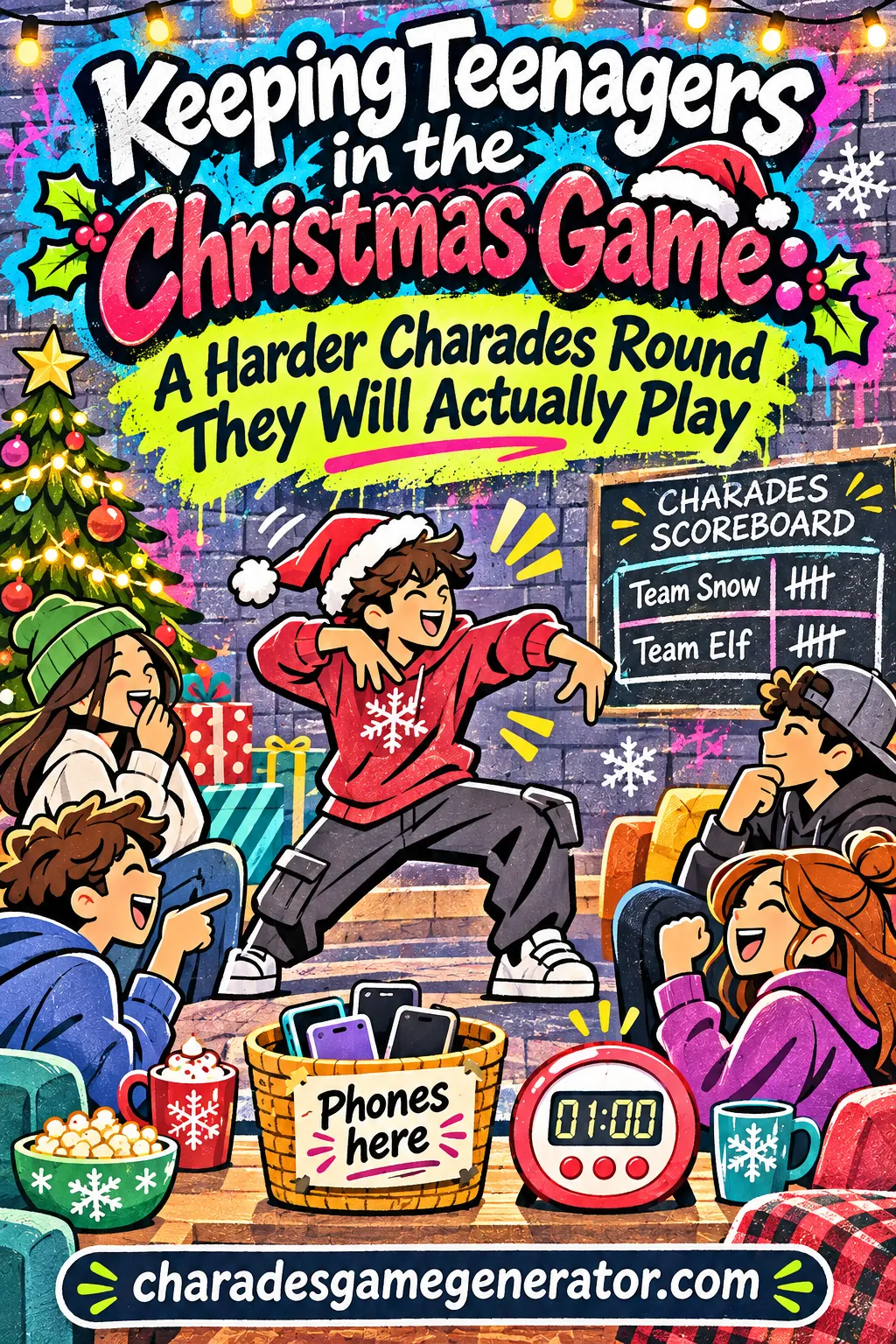
Keeping Teenagers in the Christmas Game: A Harder Charades Round They Will Actually Play
The fastest way to keep teenagers in a family Christmas game is to make it harder, faster and competitive: run a teens-vs-adults charades round on the Hard setting with a short 30-second timer, and let the teens write some of the words. Teens don't skip family games because they hate their family. They skip games that feel built for a seven-year-old. The free Christmas charades generator opens on the setup screen with the Mixed Bag category ready, so you can set Hard mode, pick two teams and start in about a minute, with nothing to download.
This guide is for parents, grandparents, aunts and uncles who want the 13-to-18 crowd to put their phones down for half an hour on Christmas Eve or Christmas night. You'll get the exact settings, a teens-vs-adults format, harder Christmas word lists, scripts for inviting a reluctant teen, an evening plan, fixes for the usual problems and ideas for different family sizes.
Why Teens Check Out of Family Christmas Games (and What Brings Them Back)
Picture the living room after Christmas dinner. Someone pulls out a game, reads a card that says "Snowman," and a nine-year-old cousin waves their arms in a circle. The adults cheer. The fifteen-year-old on the couch looks at their phone and quietly decides they're not part of this.
That moment is fixable. Most of what pushes teens away from family games comes down to a handful of things you can change before anyone sits down.
| What turns teens off | What brings them back |
|---|---|
| Words so easy they're insulting | Hard mode words that take real thinking |
| Slow turns with long waits in between | Short 30-second turns that keep the room moving |
| Being lumped in with little kids | Their own team, playing against the adults |
| Adults correcting how they play | Clear rules set once, then nobody nags |
| Feeling put on the spot to act first | Going second, after an adult has looked silly first |
| No real stakes | A visible score and a small family prize |
| The game drags on forever | A fixed number of rounds with a clear end |
| Grown-ups picking every word | Teens adding their own custom words to the deck |
Competition is the hook
Teenagers love beating adults. That's not a flaw, it's a feature you can use. When the game is "teens vs parents" instead of "the whole family plays together," it stops feeling like a chore and starts feeling like a challenge with bragging rights. The generator keeps score for each team after every turn and shows the totals on screen, so there's no arguing about who's ahead.
Difficulty is respect
Easy words tell a teen "this game is for the little ones." Hard words tell them "we think you can handle this." On the Hard setting, the generator pulls only from its toughest word lists, so instead of "Reindeer" a teen might get "Twelve Days of Christmas," "Advent Calendar" or "Winter Solstice." Those take creativity, and pulling one off feels good.
Speed keeps phones in pockets
A two-minute turn is a long time to sit and watch someone else act if you're sixteen. A 30-second turn is over before anyone gets bored. The timer ring counts down on screen and turns red in the last 10 seconds, which adds just enough pressure to make the room lean in.
Ownership changes everything
When teens get to add their own words, the game becomes partly theirs. Inside jokes, a cousin's famous Christmas fail from last year, the dog stealing the ham: these are the words that get the biggest laughs, and teens are usually the ones who remember them best.
How to Do It With the Free Tool
Open the Mixed Bag charades game on any phone, tablet or laptop. The link drops you on Set Up Your Game with the 🎲 Mixed Bag category already picked. There's no signup and no app. You'll see three cards: teams, category and game settings.
Exact settings for a teens-vs-adults round
| Setting | What to choose | Why it works for teens |
|---|---|---|
| How Many Teams? | 2 Teams | Teens on one side, adults on the other |
| Team names | Let the teens name both teams | Instant buy-in, and usually funnier names |
| Pick a Category | 🎲 Mixed Bag (already selected) or 🎄 Christmas | Mixed Bag pulls from every category for variety |
| Add Custom Words (optional) | 8 to 15 words the teens write | Gives them ownership of the deck |
| Timer per Turn | 30 sec for a speed round, 60 sec for Hard words | Short turns keep energy high |
| Rounds | 5 Rounds | Long enough for a comeback, short enough to finish |
| Difficulty | 😤 Hard | Pulls only from the hardest word lists |
The game starts on 3 Teams, 60 sec, 5 Rounds and Mixed by default, so you'll change the team count and the difficulty at minimum.
Mixed Bag or Christmas?
Both work. Here's how to choose.
- 🎲 Mixed Bag on Hard draws from the hardest words across every category: tricky animals, famous landmarks, extreme sports, classic films, historical figures and a handful of Christmas words. It's the most varied and the best pick when your teens find holiday words a bit corny.
- 🎄 Christmas on Hard keeps every word holiday themed: Nativity Scene, Three Wise Men, Winter Solstice, Boxing Day, Advent Calendar, Wassailing, Yule Log, Christmas Crackers, Figgy Pudding and Partridge in a Pear Tree, among others. It's a smaller list, so add custom words if you plan to play more than a few rounds.
A good compromise: start on Mixed Bag Hard and add 10 or so Christmas custom words from the lists further down. Custom words go into the deck whatever difficulty you choose, so they'll show up alongside the hard words.
Step by step
- Open the game. Tap the link above. You'll land on the setup screen with Mixed Bag chosen.
- Choose 2 Teams. Hand the phone to a teen and let them type both team names. Each team needs a different name, or the game will ask you to fix it.
- Add custom words. Tap ✏️ Add Custom Words (optional), type a word and press Enter or tap + Add. Tap the × on any tag to remove it. The teens can add their own words here while the adults look away.
- Pick your settings. Under ⏱️ Timer per Turn tap 30 sec (or 60 sec if this is your group's first hard game). Under 🔄 Rounds tap 5 Rounds. Under 💪 Difficulty tap 😤 Hard.
- Tap 🎭 Start Playing! The pass screen shows which team is up, the round number and both scores.
- Pass the phone to the actor. Only the actor looks. They tap ▶ We're Ready!, a 3-2-1 countdown runs and the first word appears.
- Act fast. Tap ✓ GOT IT! when the team guesses, or ↷ Skip — too hard! to move on. Skips don't cost points.
- Check the turn summary. When time runs out, the screen lists every word the actor saw, marked guessed or skipped, plus the current scores. Read the skipped ones aloud for a laugh, then tap Next Team's Turn →.
- Finish strong. After the last round, the game names the winner (or a tie) and shows final scores. Tap 🔄 Play Again! for a rematch.
One thing to know: the timer can't be paused mid-turn, so make sure the actor is ready before they tap the start button.
The Teens-vs-Adults Format, Round by Round
Splitting by age is the simplest way to make teens care. It also solves a quiet problem: when teens and parents are on the same team, the parent tends to guess everything first and the teen stops trying. On separate teams, each side has to carry itself.
Setting up the teams
- Teens: everyone roughly 12 or older who isn't a parent. Older cousins in their early twenties can join the teens if numbers are short.
- Adults: parents, grandparents, aunts and uncles.
- Younger kids: give them a job. They can be the official "skip judge," hold the phone between turns or sit on whichever team is smaller. More on that below.
If the teen team has only two players and the adult team has six, that's fine. A small team guesses with fewer voices but often moves faster. If it feels lopsided after round one, move one adult over as a "free agent" who can only guess, not act.
How rounds actually work
In the generator, a round means every team gets one turn. With 2 teams and 5 rounds, that's 10 turns total, 5 per side. Inside each team, rotate the actor so a different person acts each turn. The game doesn't track who acted, so agree on an order before you start (youngest to oldest is easy to remember).
How long it takes
Here's a realistic time estimate, including passing the phone, the countdown and a little laughing at the turn summary.
| Timer | Rounds | Turns (2 teams) | Approximate total time |
|---|---|---|---|
| 30 sec | 3 | 6 | 8 to 10 minutes |
| 30 sec | 5 | 10 | 12 to 15 minutes |
| 30 sec | 7 | 14 | 18 to 22 minutes |
| 60 sec | 5 | 10 | 18 to 22 minutes |
| 60 sec | 7 | 14 | 25 to 30 minutes |
| 90 sec | 5 | 10 | 25 to 30 minutes |
For teens, shorter is better. Aim for 15 to 20 minutes for the first game. If they ask for a rematch, that's your win.
Adding stakes without spending anything
The generator handles the score. You supply the stakes. A few ideas that cost nothing:
- The losing team clears the dessert plates.
- The winners pick the next game, or the next family movie (keep that one for later in the evening).
- The winners get first choice of leftover cookies.
- The losing team has to wear the paper crowns or the reindeer headbands for the next hour.
- The winning team's names go on a "Family Charades Champions" note stuck to the fridge until next Christmas.
Optional house rules teens like
These are all agreed out loud before you start. The generator doesn't enforce them, but they add a bit of edge.
- No sounds, ever. Strict silent charades makes hard words even harder. Teens tend to enjoy the purity of it.
- Steal rule. If the acting team hasn't guessed a word in the last 5 seconds of the turn, the other team gets one shout to steal it. If they're right, write a tally mark on paper and add it to their total at the end.
- Hand signals only for the first word. Players can show the number of words and which word they're on, then they have to act the meaning. Agree on the standard signals before the first turn so nobody argues mid-round.
- The last round counts double. Keep a paper tally for the final round and double it before you announce the winner. This keeps the trailing team hopeful.
Harder Christmas Prompts Teens Will Respect
If you want more holiday flavor than the built-in Hard list, add some of these as custom words. They're grouped by how hard they are to act, so you can mix tiers or give the toughest ones to the team that's ahead.
Tier 1: Warm-up (good for the first round)
These are still more interesting than "Santa," but anyone can get them in 30 seconds.
| Word | Acting idea |
|---|---|
| Snowball fight | Pack, throw, duck, laugh |
| Ice skating | Glide, wobble, wave your arms |
| Wrapping paper cut | Cut paper, wince, suck your finger |
| Sledding crash | Sit, push off, tumble sideways |
| Hot cocoa too hot | Sip, flinch, fan your tongue |
| Stocking stuffed too full | Pull hard, things fall out everywhere |
Tier 2: Real thinking (rounds 2 to 4)
These need a plan before you start acting, which is where the fun is.
| Word | Acting idea |
|---|---|
| Untangling the lights | Pull a long strand, find a knot, groan, keep going |
| Regifting a present | Peel off an old tag, write a new one, hand it over |
| Assembling a toy at midnight | Squint at instructions, turn them upside down, yawn |
| Burning the cookies | Open the oven, wave away smoke, hide the tray |
| Shoveling the driveway | Scoop, toss, rub your aching back |
| Hiding presents in the closet | Tiptoe, stack boxes high, lean on the door to shut it |
| Ugly sweater contest | Put on a sweater, strike a pose, wait for applause |
| Caroling in the cold | Sing, shiver, stamp your feet |
Tier 3: Hard mode (late rounds or tiebreakers)
These are abstract or multi-step. Expect a few skips. That's okay.
| Word | Why it's tough |
|---|---|
| Christmas spirit | It's a feeling, not an object |
| Winter Solstice | Show the shortest day: sun barely rises, then sets |
| Twelve Days of Christmas | Needs counting plus a gift idea |
| Advent calendar | Opening small doors day by day |
| The night before Christmas | Everyone asleep, one person creeping |
| Wassailing | Going door to door singing, an old tradition |
| Snowed in for the holidays | Snow piling up, a door that won't open, a shrug |
| Partridge in a pear tree | Bird, then tree, then pear |
| Season of giving | Several people handing things to each other |
| Peace on earth | Big gestures for the whole world, then calm |
Family words: the teens' secret weapon
The best custom words come from your own family. Have the teens add 5 to 10 of these without the adults seeing. A few patterns that work well:
- Famous family moments: "Grandpa's turkey fire," "The year the tree fell over," "Mom's lost car keys."
- Family habits: "Dad's long holiday toast," "Grandma's cheek pinch," "Uncle asleep on the couch."
- Pet chaos: "The cat in the tree," "The dog eating wrapping paper."
- Running jokes: whatever your family laughs about every year.
Keep it kind. Nobody should be the butt of a joke they wouldn't laugh at themselves. A quick rule: if the person being acted out is in the room and would smile, it's in. If they'd wince, it's out.
For more ideas, our list of hard charades words is full of tough prompts, and charades for teens has words aimed squarely at this age group.
How to Invite a Teen Without It Feeling Forced
How you ask matters almost as much as the game. "Come on, everybody's playing!" from across the room is the fastest way to get a no. Here's what tends to work better.
Ask early, ask privately
Mention it in the afternoon, one on one, before there's an audience. A teen who's had time to think about it is more likely to say yes than one who's put on the spot in front of twelve relatives.
Script: "Hey, after dinner we're doing charades, teens against adults. Hard words only, 30-second turns. Want to captain your team?"
That's short, it frames it as a competition, and it hands them a role.
Give them a job, not just a seat
Teens are far more likely to join if they're running something. Options:
- Captain: picks the acting order for their team.
- Deck builder: adds the custom words before the game starts.
- Game host: holds the setup screen, picks the settings and explains the rules to the room.
- Judge: decides if a guess counts when it's close (for example, "Christmas tree" vs "Christmas trees").
Script for a reluctant teen: "You don't have to act if you don't want to. Can you just set up the game and keep it moving? Nobody else knows how to do the settings."
Often a teen who starts as host is acting by round three.
Let them say no without a fight
Some teens truly don't want to play, and pushing hard makes next year worse. Offer once, maybe twice, then let it go.
Script: "No worries. If you change your mind, the teen team could really use you. They're losing badly to Grandma."
Then let the laughter do the work. A teen on the couch who hears their cousins beating the adults often drifts over on their own.
Don't make it about the phone
"Put your phone down and come play" makes the game a punishment. Skip any mention of screens. If the game is good, phones go down by themselves. And since the generator runs on a phone, a teen can even be the one holding it.
Lead with the silliest adult
Teens worry about looking foolish. Let the most outgoing adult act first, and make sure they really commit. Once a parent has crawled across the rug acting out "Burning the cookies," a teen's dignity concerns mostly disappear.
A 45-Minute Christmas Evening Plan
Here's a full plan you can follow on Christmas Eve or Christmas night. It assumes dinner's done and people are full but not ready for bed.
| Time | What happens | Who runs it |
|---|---|---|
| Afternoon | Quietly invite the teens and ask one to captain | A parent |
| 0:00 | Teens add custom words on the setup screen while adults step out | Teen deck builder |
| 0:05 | Explain the rules in one minute: silent, 30-sec turns, skips are free | Teen host |
| 0:07 | Warm-up round: 3 Rounds, 30 sec, 🎄 Christmas on 😊 Easy, just for practice | Everyone |
| 0:15 | Main game: Mixed Bag, 😤 Hard, 30 sec, 5 Rounds | Everyone |
| 0:30 | Snack break; read out the funniest skipped words | Anyone |
| 0:35 | Rematch or tiebreaker: 🎄 Christmas, 😤 Hard, 60 sec, 3 Rounds | Teams pick |
| 0:45 | Announce champions and hand out the prize | Losing team captain |
Why a warm-up on Easy?
The warm-up isn't for the teens. It's for the adults and younger kids who haven't played in a while. A few easy turns get everyone comfortable with the pass-the-phone flow and the buttons, so the main game runs without pauses. Tell the teens it's practice and doesn't count. They'll tolerate three easy rounds if they know Hard is coming.
Changing settings between games
When a game ends, tap 🔄 Play Again! to go back to setup. Your teams, team names, category, settings and custom words stay as you left them, so you only change what you need. Tap the × on any custom word you want to drop before the rematch.
Variations by Family Size and Ages
Not every family has two teens and four adults. Here's how to adjust.
Just one teen
One teen against a room of adults is a tough spot. Better options:
- Teen plus a "draft pick." The teen picks any one adult to join their side. Teens usually pick the funniest relative, and it's flattering for the adult.
- Teen as permanent host and judge. They run the phone, rule on close guesses and act in the final tiebreaker round only.
- Two-player style. If it's just a parent and a teen, both act and both guess, then compare totals. See our guide to playing with two players for that setup.
Teens plus younger kids
Little ones want to play too, and Hard mode will frustrate them. Try these:
- Kids on the adult team. It evens out the score, since adults on Hard words plus kids who can't act them yet tends to balance against a strong teen team.
- Kid helper rule. A younger child can act alongside any adult. They do the big moves, the adult adds detail.
- Separate kids' round first. Run one quick game on 👶 Kids or 🎄 Christmas with 😊 Easy, then send the little ones off to play while the teens and adults go Hard.
Big families (10 or more)
- Use 3 or 4 Teams: teens, parents, grandparents, and maybe "in-laws" or "cousins under 12."
- Drop to 3 Rounds so each team still gets to act several times without the game running past an hour.
- Keep the 30 sec timer. With four teams, longer turns mean a long wait between your team's turns.
- Pick team names that make it a rivalry. The charades team names list has plenty of ideas.
Older teens (16 to 19)
These players often want the most challenge. Give them:
- Hard on Mixed Bag, with custom words written by the adults that are deliberately tough.
- The silent rule, strictly enforced. No sounds, no mouthing.
- Speed bonus: 30-second turns, and if a team guesses 5 or more in one turn, they get a paper tally bonus point.
Younger teens (12 to 14)
- Start on 🎲 Mixed difficulty rather than Hard. It blends easy, medium and hard words, which keeps it challenging but not discouraging.
- Use 60 sec turns.
- Let them pick a few custom words that are funny rather than difficult.
Comparison of setups
| Family setup | Teams | Category | Difficulty | Timer | Rounds |
|---|---|---|---|---|---|
| 2 to 3 teens, 3 to 4 adults | 2 | Mixed Bag | Hard | 30 sec | 5 |
| 1 teen, several adults | 2 (teen plus draft pick) | Christmas | Mixed | 60 sec | 5 |
| Teens plus little kids | 2 (kids join adults) | Christmas | Mixed | 60 sec | 5 |
| 10+ people | 3 or 4 | Mixed Bag | Hard | 30 sec | 3 |
| Younger teens (12 to 14) | 2 | Christmas | Mixed | 60 sec | 5 |
| Older teens (16 to 19) | 2 | Mixed Bag | Hard | 30 sec | 7 |
Troubleshooting: When the Game Starts to Slip
Even with good setup, a few things tend to go wrong. Here's how to catch them early.
| Problem | Likely cause | Quick fix |
|---|---|---|
| Teens keep skipping every word | Hard words feel impossible at 30 sec | Switch to 60 sec, or drop to Mixed difficulty |
| One adult guesses everything | Strong guesser dominating | Add a "three guesses per turn" limit for that person |
| A teen won't act | Nerves or embarrassment | Let them host or judge this game, act in the next |
| Words they've never heard of | Mixed Bag Hard includes older titles and names | Skip freely; skips cost nothing |
| Teens and adults arguing over close guesses | No agreed rule | Name a judge before the game; their call is final |
| The game drags | Too many rounds or too many teams | Cut to 3 Rounds and 2 Teams |
| Teens drift back to phones mid-game | Long waits between turns | Use 30 sec turns and keep the next actor ready |
| Little kids feel left out | Words too hard | Give them a helper role or a separate easy round |
| Same words keep appearing | Small word pool with many rounds | Add more custom words, or use Mixed Bag for a bigger list |
A note on the words
The Mixed Bag Hard list includes some classic film titles, older TV shows and historical names that teens may not know, and some that adults won't either. That's part of the challenge, but it shouldn't stall the game. Tell everyone up front: if you don't know it, skip it. Nobody loses a point, and the turn summary at the end makes those skipped words a fun talking point.
If your family wants the full holiday experience, Christmas charades ideas has 100 holiday words you can type into the custom words box.
Make It a Tradition
The best sign the game worked is when a teen asks about it the following December. A few ways to make that happen:
- Keep the champions note. Write the winning team's names on a card and tuck it in with the ornaments. Bring it out next year.
- Let last year's losers build the deck. They get to add the custom words for the rematch.
- Save the best family words. Keep a note on your phone of the custom words that got the biggest laughs. Next year, add them again and watch everyone remember.
- Let teens run it next year. Hand the whole thing over: settings, teams, words, prizes. A teen who's in charge of the family game is a teen who's going to show up.
Ready to try it? Open the free Mixed Bag charades game, pick 2 Teams, set 😤 Hard and 30 sec, and let the teens name both teams. Ten minutes in, you'll know if you've found your new Christmas tradition.
Frequently Asked Questions
What are good Christmas games for teenagers and family to play together?
Games with real competition and a bit of challenge work best: charades on a hard setting, teams of teens against adults, short timed turns and a small prize for the winners. Avoid games built mainly for young children. Charades works well because it needs no supplies and everyone can play from the couch.
How do I get my teenager to play family games at Christmas?
Ask privately and early, give them a role like captain or host, and make it a competition against the adults. Let them add their own custom words. If they say no, accept it once and let the fun in the room do the convincing.
What timer setting should I use for teens?
Start with 30 sec for speed and energy. If the hard words are leading to lots of skips, move up to 60 sec. The generator also has 90 sec and 2 min options, but those are usually too slow for teens.
Is the Hard setting too difficult?
It can be at first, especially with a 30-second timer. Skips don't cost points, so it's okay to pass on words you don't know. If your group is struggling after two rounds, switch to Mixed difficulty, which blends easy, medium and hard words.
Can we add our own Christmas words?
Yes. Tap ✏️ Add Custom Words (optional) on the setup screen, type a word and press Enter or tap + Add. Your words mix into the deck at any difficulty level. Family jokes and holiday memories make the best custom words.
How many people do you need for a teens-vs-adults game?
Two per team is the minimum for it to feel like a team game, so four people total. It works well with 6 to 12 players. For larger groups, use 3 or 4 teams and fewer rounds.
What if we have only one teenager?
Let them draft one adult to join their team, or have them host and judge the game. You can also have the teen act in the final round only. The goal is to make them feel like part of the game, not outnumbered.
Do we need to download anything?
No. The generator runs in any web browser on a phone, tablet or laptop. There's no signup and nothing to install. One phone is enough for the whole room since players pass it to each actor.