A Calm Christmas Eve Game for Kids Who Won't Settle Down
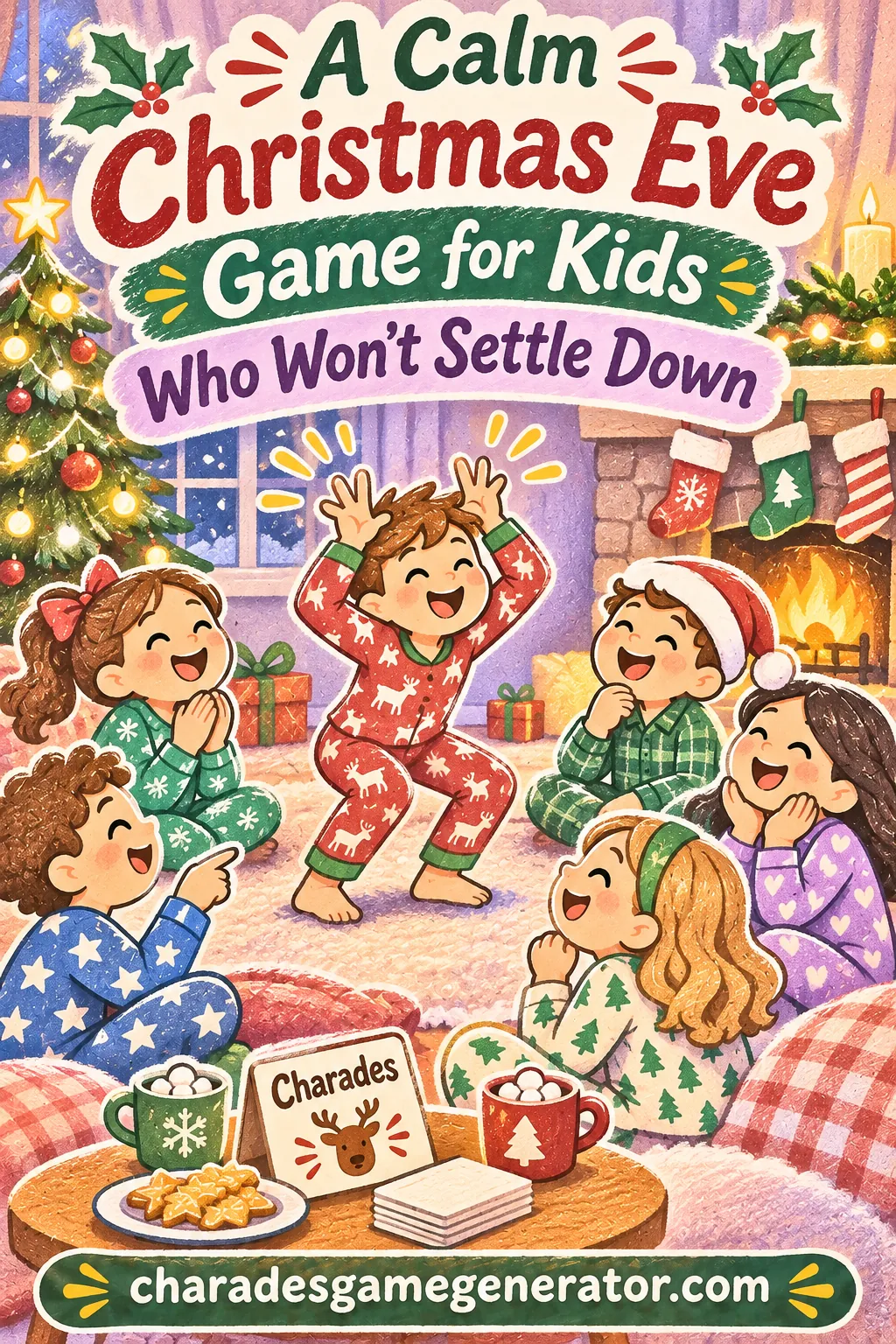
When kids are bouncing off the walls on Christmas Eve, switch to a silent charades game with slow, sleepy holiday words, whispered guesses and a timer that ends on a calm note instead of a sprint. It turns all that excited energy into something quiet and focused, then hands it off to bedtime. You can run it in the free charades game on any phone or tablet with no app and no signup, using the Christmas category and a few gentle custom words.
Below you'll find the whole wind-down plan: exact settings, a calm-down script, 70 quiet Christmas words sorted by age, rules that keep the volume low, and what to do when one kid just won't slow down.
Why Christmas Eve Turns Kids Into Pinballs
You're not imagining it. Christmas Eve really is the hardest night of the year to get kids to sleep. A few things pile up at once.
- Anticipation. Presents are under the tree and the big morning is hours away. Kids feel it in their whole body.
- Sugar and late dinners. Holiday treats and later-than-usual meals throw off the normal rhythm.
- Broken routines. Relatives, travel, special services and late events all push bedtime around.
- Overstimulation. Twinkling lights, music, wrapping paper and cousins add up to a lot of input.
- Fear of missing out. Kids worry that if they fall asleep, something exciting will happen without them.
Telling an excited kid to "calm down" rarely works, because they can't flip a switch. What does work is giving that energy somewhere to go, then slowly turning it down. That's the whole idea behind this game. It starts with a little movement, shrinks the movement round by round, and ends in a hush.
Why charades works as a wind-down
Charades has a built-in quiet rule: the actor can't talk. That's already half the battle. On top of that, it asks kids to focus on one thing, watch carefully, and take turns. All three of those skills are calming. When you choose slow, cozy words and add a whisper rule for guessing, regular charades becomes something closer to a bedtime ritual.
It also gives kids what they actually want on Christmas Eve: attention, a little excitement and a feeling that the night is special. You're not taking the magic away. You're shaping it.
The Wind-Down Plan at a Glance
This is a 20 to 25 minute routine. Start it about half an hour before you want lights out, after baths and pajamas if you can.
| Stage | Time | What happens | Energy level |
|---|---|---|---|
| 1. Wiggle round | 5 minutes | Kids act bigger holiday words, standing up | Medium |
| 2. Slow-motion round | 5 minutes | Same game, but every move is slow | Lower |
| 3. Seated round | 5 minutes | Kids act from the couch or floor, hands and face only | Low |
| 4. Sleepy round | 5 minutes | Bedtime and night words, whispered guesses | Very low |
| 5. Last word | 2 minutes | One final word acted by a parent, then lights down | Calm |
The trick is that the energy drops in steps. Jumping straight from a sugar high to "go to bed" feels like a cliff. Stepping down a staircase feels like part of the game.
Set the room before you start
The room does a lot of the work. Before you call the kids in:
- Dim the big lights and leave on the tree lights or a lamp.
- Turn off the TV and any music with a strong beat. Soft instrumental music is fine, or none at all.
- Clear a small space on the floor or rug for acting.
- Put pillows and blankets out so kids can get cozy between turns.
- Lower the phone or tablet's brightness and volume.
The lower the lights, the more natural it feels to talk softly. Kids match the room.
How to Set It Up in the Game
Open the free charades game with a timer and use these settings in Set Up Your Game.
| Setting | What to choose | Why |
|---|---|---|
| Teams | 2 (even for siblings vs. parents) | Simple and easy to follow at night |
| Category | Christmas | Holiday words kids already know |
| Add Custom Words | Add 15 to 25 quiet words from the lists below | Steers the game toward cozy, slow actions |
| Timer | 60 sec for the first rounds; 30 sec for the last one | Longer turns feel unhurried; the short final round ends things gently |
| Rounds | 3 for little kids, 5 for older kids | Short enough to finish before bedtime |
| Difficulty | 😊 Easy | Nobody gets frustrated before bed |
Some notes on these picks.
Timer. The game offers 30 sec, 60 sec, 90 sec or 2 min. For a calm game, 60 seconds is the sweet spot. It's long enough that nobody rushes, but short enough that waiting kids stay interested. If you want a slower pace, choose 90 sec. If your plan is to finish fast, set the last game to 30 sec so it ends with a quick, quiet sprint and then it's over.
Category. The Christmas category gives kids familiar holiday words. If you have toddlers or preschoolers, the Kids category works too, since those words are very simple. Either way, add your own quiet words so the game leans calm.
Custom words. Tap ✏️ Add Custom Words, type a word and tap + Add. Do this before you gather the kids, so there's no waiting while you type. Fifteen to twenty-five words is plenty.
Difficulty. Easy is best on Christmas Eve. A tired, excited kid who can't guess anything will get upset fast. Keep wins coming.
What kids see when it's their turn
Hand the phone to the actor. They see a word, act it out silently, and tap ✓ GOT IT! when someone guesses. If the word is too tricky, they tap ↷ Skip — too hard! and a new word appears. When time runs out, the Time's Up screen shows, then Current Scores, then Next Team's Turn. Younger kids may need a grown-up to read the word and tap the buttons. That's fine. Whisper the word in their ear like a secret, which kids love.
When the game is done, you can tap Play Again for one more short game, or simply say, "That was the last round," and head for bed.
The ten-minute version for late nights
Some Christmas Eves run late. Maybe you got home from a relative's house at nine, or the kids already had a long day of travel. You don't need the full routine. Here's a shorter version that still gets the job done.
- Skip the wiggle round. Kids who are already tired don't need to burn energy. Start seated, on pillows, with lights low.
- Set the game to 2 teams, Christmas, 60 sec, 3 rounds, 😊 Easy. No custom words needed if you're short on time, though a handful of sleepy words from the list below helps.
- Use the whisper rule from the very first turn. Say it once, softly, and model it yourself.
- Act every word in slow motion. No need to explain it as a separate stage. Just say, "Tonight we act like sleepy snowmen."
- End with the last word. A parent acts "closing your eyes," the kids guess, and everyone heads to bed.
This quick version works well for kids who are tired but still too excited to sleep, which describes a lot of children at ten o'clock on Christmas Eve. It gives them a few minutes of focused, happy attention, and that alone often takes the edge off. If they're yawning by the second round, it's fine to stop there and call it a night. You can always play the full version some other evening in December, when bedtime isn't quite so loaded.
70 Quiet Christmas Words for a Calm Game
These lists are built for "Add Custom Words." They lean toward slow, gentle, cozy actions rather than running, jumping or loud scenes. Pick from the section that matches your kids, and save the rest for another night.
Wiggle round words (stage 1, standing)
These still have some movement, which helps burn off the last bit of energy. Use them only in the first round.
- Building a snowman
- Ice skating
- Shoveling snow
- Sledding down a hill
- Decorating the tree
- Hanging lights
- Throwing a snowball (gently)
- Reindeer
- Elf
- Toy soldier
- Jingle bells
- Ballerina
- Putting on a coat and boots
- Carrying a big present
Slow and seated words (stages 2 and 3)
These work at slow-motion speed and can be acted from a pillow on the floor.
- Wrapping a present
- Tying a bow
- Hanging a stocking
- Snowflake
- Lighting a candle
- Shaking a snow globe
- Writing a wish list
- Licking a candy cane
- Opening a tiny present
- Stirring cookie dough
- Rolling out cookie dough
- Frosting a cookie
- Building a gingerbread house
- Warming hands by the fire
- Knitting a scarf
- Ringing a small bell
- Penguin waddling
- Polar bear
- Owl in the snow
- Pinecone
- Star on top of the tree
- Angel
- Wreath on the door
- Mittens
Sleepy round words (stage 4, whispered guesses)
These are the slowest and quietest. Every one of them points toward bedtime.
- Brushing teeth
- Putting on pajamas
- Reading a bedtime story
- Yawning
- Fluffing a pillow
- Tucking in a teddy bear
- Turning off the lamp
- Counting stars
- Peeking out the window
- Leaving cookies out
- Sleeping reindeer
- Moon
- Shooting star
- Rocking a baby
- Saying goodnight
- Blowing out a candle
- Pulling up the blanket
- Hugging a stuffed animal
- Closing the curtains
- Snow falling at night
- Sleigh bells far away
- Owl hooting softly
- Dreaming
- Making a wish
- Tiptoeing down the hall
- Sleepy kitten
- Listening for sleigh bells
- Night-light
- Snoring (silently)
- Closing your eyes
- Goodnight hug
- Quiet house
For a bigger pool of holiday words to use on other nights, see these Christmas charades ideas, and if your kids love snow scenes, the winter charades list has more snowy, cozy words you can mix in.
Words to leave out tonight
Some Christmas words are fun but too exciting for bedtime. Skip these on Christmas Eve and save them for a daytime game.
- Opening all the presents
- Racing down the stairs
- Snowball fight
- Sleigh crash
- Dancing at a party
- Jumping on the bed
- Anything with a big noise, like a marching drum or a firecracker
If one of these comes up from the Christmas category, it's fine to tap Skip. You can even make it a rule: "If it makes you want to jump, skip it."
Quiet Rules That Keep the Volume Down
Normal charades gets loud because everyone shouts guesses at once. Change two or three rules and the whole game gets softer. Explain these before the first round in a low voice.
| Rule | How it works | Why it helps |
|---|---|---|
| Whisper guesses | Guessers whisper their answers | Lowers the volume of the whole room |
| One hand up | Guessers raise a hand and wait to be pointed at | Stops kids talking over each other |
| Slow-motion acting | Actors move like they're underwater | Calms bodies down |
| Stay on the rug | Acting happens in one small space | Prevents running around |
| Silent cheers | Celebrate with "jazz hands," not yelling | Keeps the joy without the noise |
| Pillow sit | Everyone not acting sits on a pillow | Gives kids a cozy home base |
| Finger on lips | Anyone can put a finger to their lips to ask for quiet | Gives kids a way to help each other |
You don't need all seven. Start with whisper guesses and silent cheers. Add slow-motion acting in round two, and the pillow sit by round three.
Silent cheers kids love
Kids still want to celebrate a good guess. Give them quiet ways to do it.
- Jazz hands. Wiggle fingers in the air.
- Snow sprinkle. Flutter fingers down like falling snow.
- Thumbs up wave. Two thumbs up, swaying side to side.
- Silent clap. Clap with hands not quite touching.
- Sparkle eyes. Open eyes wide and smile without a sound.
Let the actor pick the cheer they want after a correct guess. It gives them a little reward and keeps it calm.
Acting tips for the trickiest quiet words
Slow, gentle words can be harder to guess than big, loud ones, because there's less motion to read. Share a few of these ideas with kids before the seated round so nobody gets stuck.
Snowflake. Start with your hands high above your head and flutter your fingers as you lower them very slowly. Turn your hands as they fall, like a flake twirling. For extra help, shiver a little at the end.
Hanging a stocking. Tiptoe forward, hold up something long and floppy with both hands, and hook it on an invisible mantel. Then step back and admire it with a happy little nod.
Shaking a snow globe. Hold a small round shape in both hands, shake it once, then hold very still and follow the falling snow with your eyes. This one is a lovely calming action, because the whole point is to watch and wait.
Leaving cookies out. Carry a plate carefully, set it down, add a pretend carrot for the reindeer, then look around and tiptoe away. Kids usually guess it by the tiptoeing.
Counting stars. Lie back on the pillow, point up at the ceiling and tap the air, moving your lips silently as if counting. Nobody is allowed to say the numbers out loud.
Sleeping reindeer. Make antlers with your fingers on top of your head, then slowly fold down onto the pillow and close your eyes. A tiny ear twitch is a nice touch.
Making a wish. Close your eyes, squeeze your hands together under your chin, then open your eyes and smile up at the sky.
A good general tip for quiet words: use your face. Sleepy eyes, a slow smile or a surprised look often gives the team the clue that small hand movements can't.
The Calm-Down Script for Parents
Your voice sets the pace. If you talk fast and loud, kids will too. If you speak slowly and softly, they'll follow. Here's a script you can use, stage by stage.
Inviting them in
"Okay, elves, I have a special Christmas Eve game. It's called Silent Charades. It only works if we're really quiet, like the house is sleeping. Grab a pillow and come sit by the tree."
Calling it something special, and linking it to the magic of the night, makes kids want to join. The pillow gives them a place to land.
Starting the wiggle round
"First round, you can stand up and move. But no sounds at all. If you guess, raise your hand and whisper."
Let them be a bit silly in this round. That's the point. You're letting the steam out.
Shifting to slow motion
"Round two is the slow-motion round. Pretend you're moving through snow that's up to your knees. Everything is slow, slow, slow."
Show them first. Act out "wrapping a present" at half speed. Kids find slow motion funny, so they lean into it, and their bodies slow down without them noticing.
Moving to the seated round
"Now everybody sits on their pillow. You can only act with your hands and your face. Let's see who's the best quiet actor."
Turning it into a challenge helps. Kids who were bouncing now try to show off how still they can be.
The sleepy round
"This is the last round. It's the sleepy round. All the words are about bedtime and nighttime. Whisper your guesses as quietly as you can."
Lower your voice even more here. By now the lights are low, the words are about yawning and pillows, and kids are often yawning for real.
The last word
"I get the very last word. Watch closely."
Act out something like "Closing your eyes" or "Goodnight hug" yourself. When they guess, say: "That's right. And that's what we're doing next." Then head straight to bed. No extra round, no negotiation.
When One Kid Just Won't Slow Down
Even a good plan meets a kid who's running on pure holiday excitement. These are the most common hiccups and what to do about them.
| Problem | What it looks like | Quick fix |
|---|---|---|
| Too wound up to start | Kid is running laps around the tree | Let them act the first word, standing, with a big movement word like "shoveling snow" |
| Shouting guesses | Answers come out at full volume | Pause, whisper "Elves only whisper," and wait for silence before going on |
| Sibling fights over turns | "It's my turn!" "No, mine!" | Use the game's Next Team's Turn screen as the referee. Whatever it says goes |
| Upset about losing | Tears after the other team scores | Stop showing scores in the last round, or put the upset kid on the parent team |
| Silly acting gets wild | Rolling, tackling, jumping | Bring back the rug rule and switch to the seated round early |
| Can't guess anything | Younger child gets frustrated | Let them whisper guesses to a grown-up first, who helps them say it |
| Too sleepy to act | Kid is drooping on the pillow | Great sign. Let them be a guesser only and move toward bed |
| "One more game!" | Begging when it's time to stop | Use the last-word ritual and say it was decided before you started |
The reset trick
If the room gets loud, don't raise your voice over it. Do the opposite. Freeze like a statue, put a finger to your lips, and wait. Kids notice the silence and freeze too. Then whisper, "Snow is falling. Everybody be a snowflake," and flutter your fingers down. Within a few seconds the room settles. You can use this reset as many times as you need.
When to call it early
Sometimes kids are simply too tired or too wired to play well. If tears are coming or nobody can follow the rules, skip ahead to the last word. A short, calm game beats a long, cranky one. The goal isn't to finish all five stages. The goal is a peaceful bedtime.
Variations for Different Ages and Families
Every family's Christmas Eve looks different. Adjust the game to fit who's in the room.
Toddlers and preschoolers (ages 2 to 5)
Very young kids don't need teams or scores. Pick the Kids category, 😊 Easy difficulty and a 90 sec timer. Read each word to them, then act it out together. Let them guess anything, and celebrate every guess. Use simple words like "snowflake," "teddy bear," "yawning" and "moon." Keep the whole game to about ten minutes. For more ideas that fit this age, there's a guide to charades for preschoolers with tips on keeping little ones engaged without tears.
Early elementary (ages 6 to 8)
This age loves rules, so explain the quiet rules clearly and let them enforce them. Use two teams (kids vs. grown-ups is a favorite), the Christmas category plus custom words, a 60 sec timer and 3 rounds. They can usually read and act the words on their own. The charades rules for kids page has a simple version of the rules you can read aloud.
Older kids (ages 9 to 12)
Older kids may say charades is too young for them. Hand them the job of game master: they set up the game, add the custom words and decide who goes next. Try 🎲 Mixed difficulty and 5 rounds. They'll enjoy the slow-motion round more than they'll admit.
Mixed ages and cousins
When toddlers and preteens play together, put an older kid on each team with a younger one. The older child can whisper the word to the little one and act it with them. Older kids feel like helpers, and little ones get to join in.
Just one child
You don't need a crowd. Play one child vs. one parent, or one child with two parents as a team against "the elves" (an imaginary team whose points you make up as you go, always just a little lower). Two teams in the game works fine. One child can act for you, then you act for them.
Families with a quiet religious tradition
Many families attend a service or read a special story on Christmas Eve. You can add calm words that fit your tradition, like "star in the sky," "shepherd," "angel," "lighting a candle" or "singing softly." The game becomes a gentle way to retell the story you share.
Calm ways to keep score
Points can fire kids up, which is the opposite of what you want before bed. Here are softer options, from most competitive to least.
- Normal scoring for early rounds only. Let the game track points in the wiggle round, then stop announcing scores after that.
- Shared family score. Add both teams' points together at the end and celebrate one big family number. Everyone wins.
- Star stickers. Each correct guess earns a sticker on the back of a hand. Kids love collecting them and nobody "loses."
- Snowflake count. Drop a cotton ball into a bowl for every correct guess. At the end, count the "snowflakes" together in whispers.
- No score at all. For toddlers or very tired kids, just play for the fun of acting and guessing.
The shared family score is a favorite on Christmas Eve, because it ends the night on a team feeling instead of a winner and a loser.
After the Game: The Bedtime Handoff
How the game ends matters as much as how it starts. Make the move to bed feel like the next part of the game, not the end of the fun.
Keep the lights low. Don't flip on bright hallway lights. Walk to bedrooms by the glow of the tree or a night-light.
Keep whispering. Stay in your game voice all the way to bed. It tells kids the quiet time is still going.
Use a "tiptoe parade." Everyone tiptoes to their room in a line, acting like reindeer who don't want to wake anyone. It's silent, slow and fun.
End with one more quiet ritual. A short story, a prayer, a song hummed very softly, or a list of three things they loved about today. Keep it brief.
Say the magic line. Something like, "The faster you fall asleep, the faster morning comes." Kids have heard it before, but on Christmas Eve it lands.
A ritual worth keeping
Families who try this often keep it year after year. Kids start to look forward to "Silent Charades" as part of Christmas Eve. If you want to make it a tradition, write down your family's favorite quiet words and keep them with the stockings. The game doesn't save custom word lists, so a paper list or a note on your phone means you can add them again quickly next year.
Your Christmas Eve checklist
- Choose 15 to 25 quiet words from the lists above.
- Open the charades game and set it up before the kids gather: Christmas category, 2 teams, 60 sec timer, 3 to 5 rounds, 😊 Easy.
- Add your quiet words with ✏️ Add Custom Words.
- Dim the lights, put out pillows and lower the phone's brightness.
- Run the four rounds: wiggle, slow motion, seated, sleepy.
- Finish with the last word, then tiptoe to bed.
Merry Christmas, and may your house be quiet before midnight.
Frequently Asked Questions
What are good Christmas Eve games for kids that won't get them more wound up?
Silent charades is one of the best, because the actor can't talk and you can choose slow, cozy words. Add whisper guesses and a slow-motion round, and the game calms kids down instead of revving them up. Keep it to about 20 minutes and end right before bed.
How do I calm kids down before bed on Christmas Eve?
Give their energy a place to go first, then turn it down in steps. Start with a movement round, switch to slow motion, then seated acting, then sleepy bedtime words. Dim the lights and speak softly the whole time, since kids tend to match the room.
What timer setting should I use for a calm game?
Sixty seconds works well for most kids because nobody feels rushed. Use 90 seconds for toddlers and preschoolers. Some parents like to set the final game to 30 seconds so it ends quickly and clearly.
Is there a Christmas category in the charades game?
Yes. The game includes a Christmas category among its 18 options. You can also add your own quiet holiday words with ✏️ Add Custom Words so the game leans toward slow, bedtime-friendly actions.
How long should a Christmas Eve game last?
Plan for 20 to 25 minutes, starting about half an hour before you want lights out. If kids are getting cranky or very sleepy, skip straight to the last word and head to bed. A short, peaceful game is the goal.
Can toddlers play charades?
Yes, with help. Read the word to them, act it out together, and accept any guess with a big silent cheer. Choose very simple words like "snowflake," "moon" and "teddy bear," and keep the game to about ten minutes.
What if siblings fight over whose turn it is?
Let the game be the referee. The Next Team's Turn screen tells everyone who goes next, so there's nothing to argue about. You can also put feuding siblings on the same team with a parent so they're working together.
Can we play if it's just one child and one parent?
Absolutely. Set up two teams and take turns acting for each other. Some families add a pretend team of elves whose score always ends just a little lower, which kids find very funny.