Classroom Charades: A Teacher's Guide to Educational Charades
Charades Is a Secret Teaching Superpower
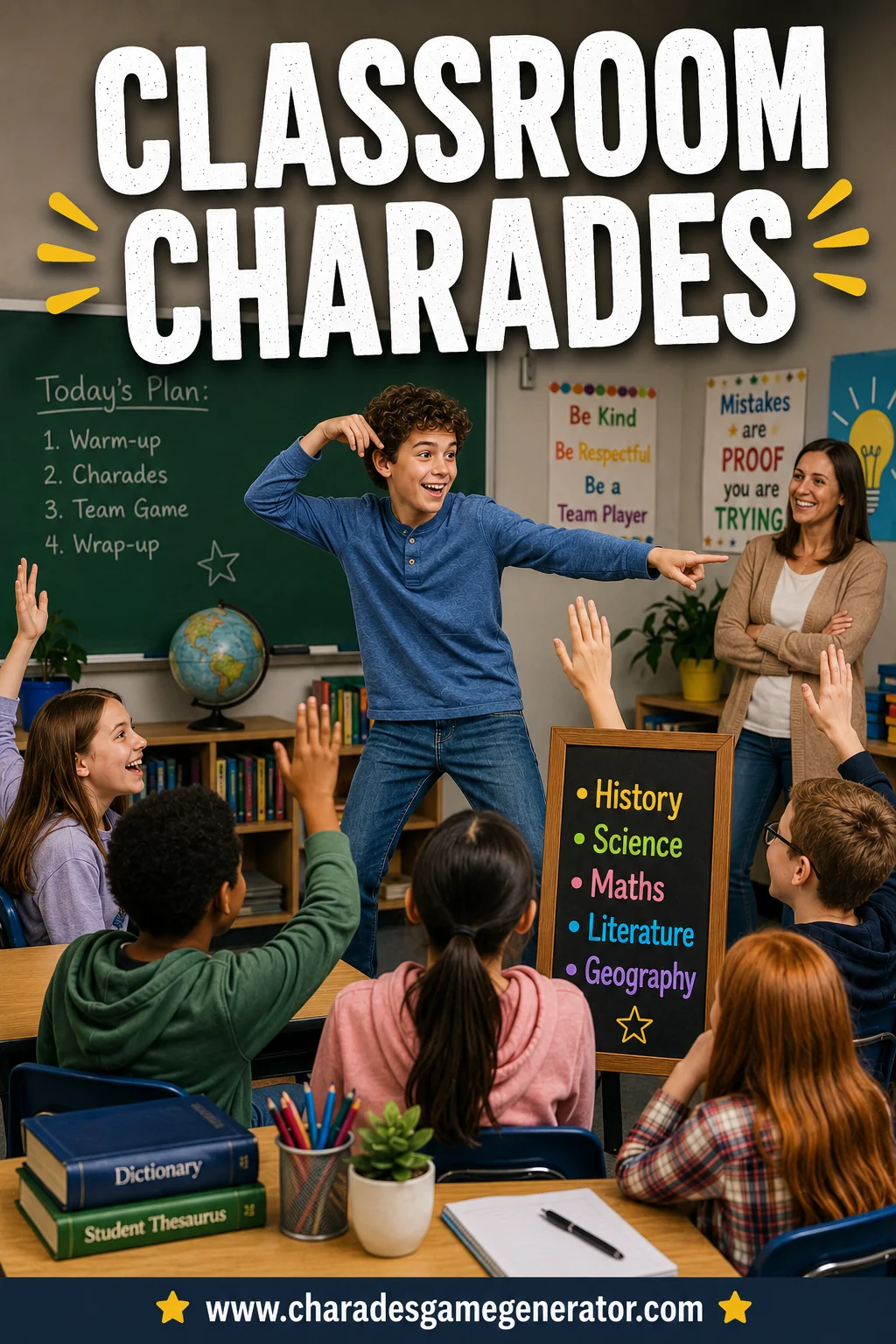
Ask any teacher for a no-prep, high-energy activity that works for any subject and any age, and charades belongs at the top of the list. It turns review into play, gets wiggly students moving, and helps kinesthetic learners absorb material they'd snooze through on a worksheet. Best of all — it's completely free and needs nothing but a list of words.
This guide shows teachers exactly how to run educational charades: subject-by-subject word lists, classroom-friendly rules, management tips for big groups, and the learning benefits that make it lesson-time well spent.
Why Charades Works in the Classroom
- Engages every learner — especially kinesthetic and visual students.
- Reinforces vocabulary through active recall, not passive reading.
- Builds confidence as quieter students perform in a low-stakes, fun way.
- Burns off energy productively (a teacher's secret weapon before lunch).
- Zero cost, zero prep — just a word list and a timer.
- Works across subjects — from spelling to science to history.
Classroom Charades Rules (Teacher Version)
A few tweaks make charades run smoothly with 20+ students:
- Split into 2–4 teams by table or row to keep it organized.
- One actor at a time comes to the front and draws a word (from you or the smartboard).
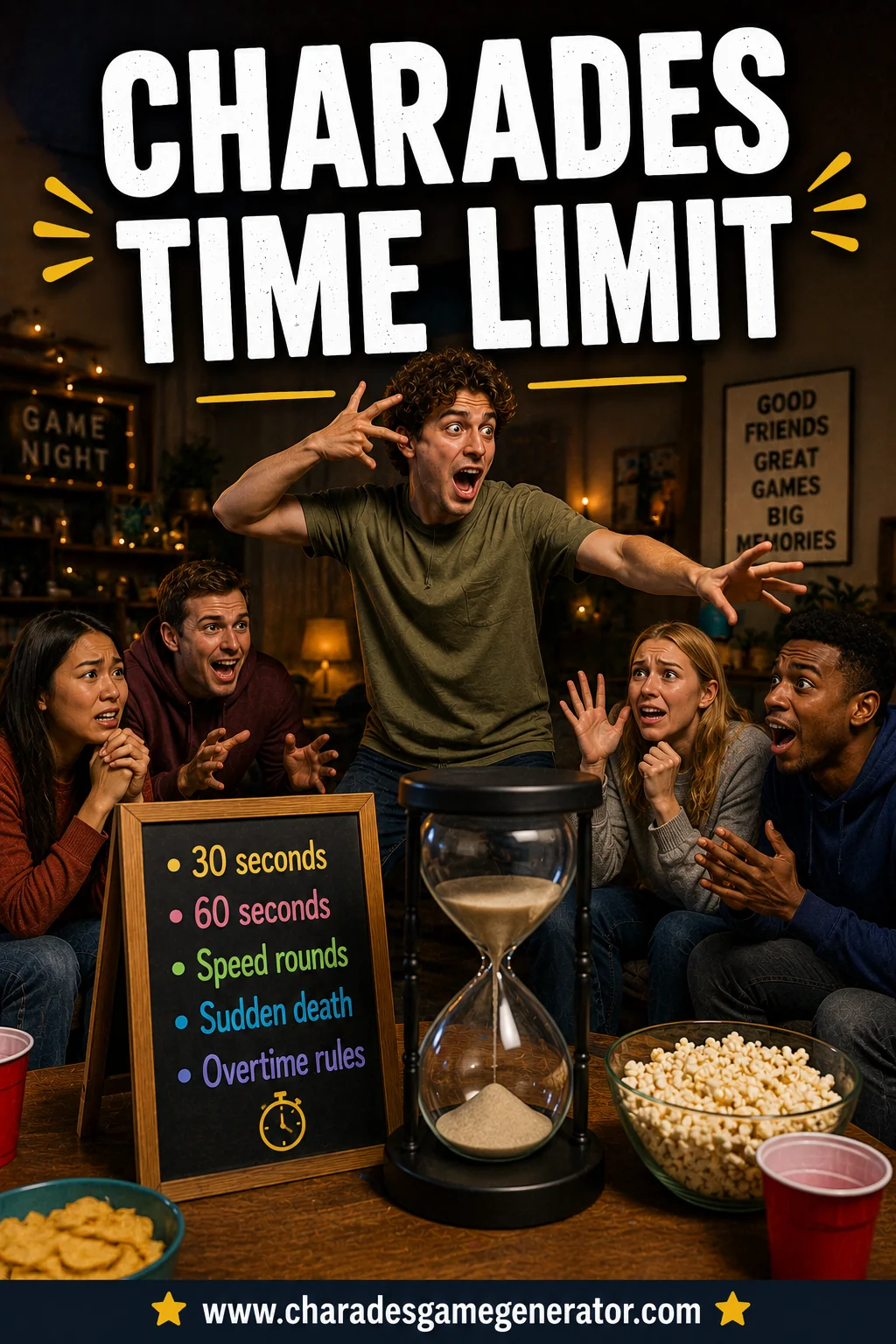
- Their team gets 60 seconds to guess; no calling out from other teams.
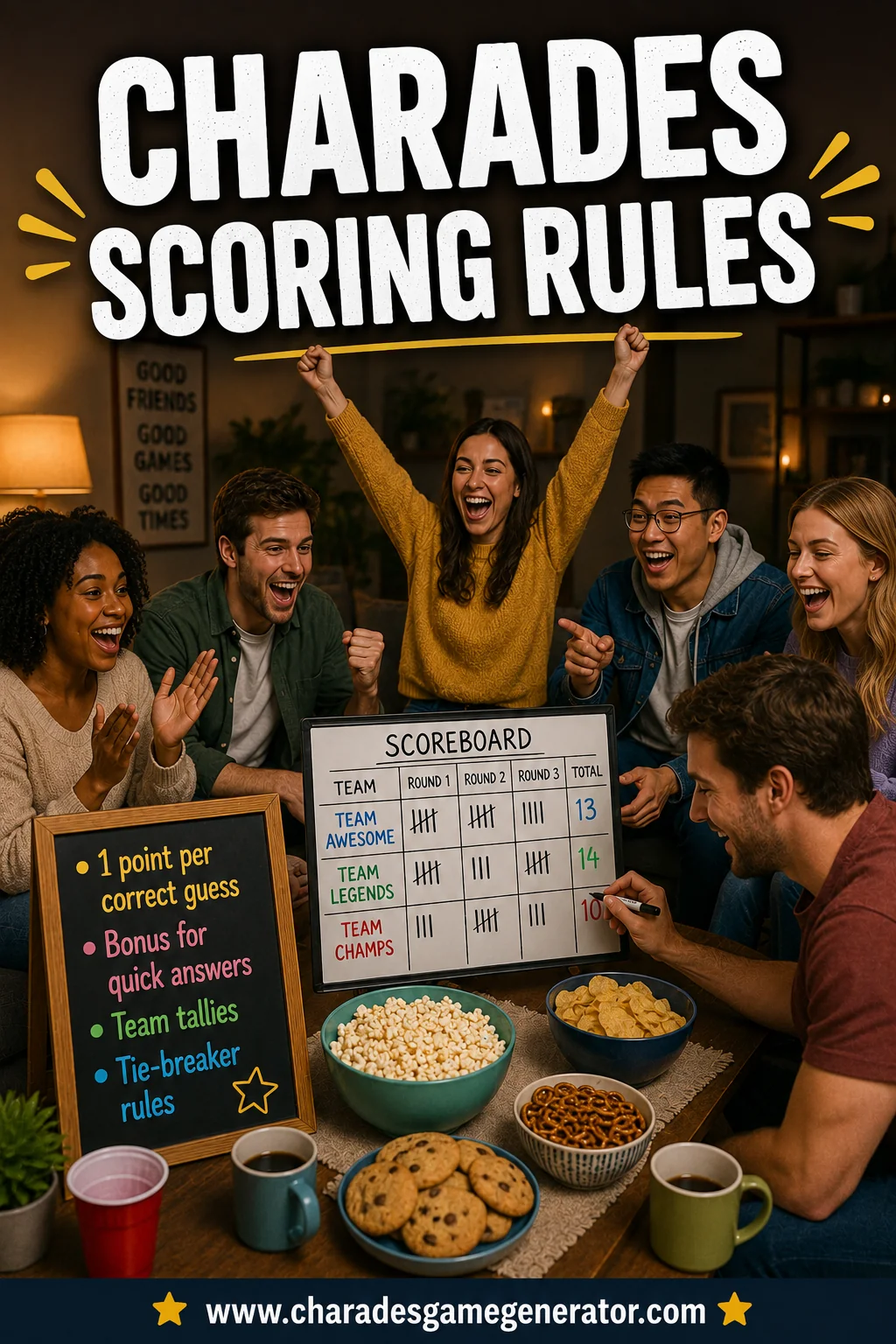
- A point per correct guess. Track on the board.
- Rotate actors so every student gets a turn over the lesson.
- Keep a "quiet hand" rule — guesses only from the acting team to avoid chaos.
Educational Charades Word Lists by Subject
📖 Vocabulary & Language Arts
Run · Whisper · Enormous · Furious · Tiptoe · Exhausted · Celebrate · Shiver · Ancient · Curious · Gigantic · Sprint · Sob · Giggle · Examine
🔬 Science
Photosynthesis · Volcano · Gravity · Evaporation · Earthquake · A growing seed · The water cycle · Magnetism · A butterfly's life cycle · Orbit · Erosion · A chemical reaction · Hibernation · Electricity · A solar eclipse
🌍 History & Social Studies
Building the pyramids · A knight in armor · The first moon landing · Rowing a Viking ship · Signing a treaty · A pioneer wagon · An ancient pharaoh · The Boston Tea Party · A medieval blacksmith · Exploring by ship
🧮 Math (Concepts in Action)
Counting on fingers · A triangle · Adding · Subtracting · Measuring · A clock showing time · Sharing equally (division) · A see-saw (balancing equations) · Symmetry · A growing pattern
📚 Book Characters
Harry Potter · Matilda · The Cat in the Hat · Charlotte (the spider) · Willy Wonka · Pippi Longstocking · The Gruffalo · Greg from Diary of a Wimpy Kid · Peter Rabbit · The BFG
🎭 How to Use Charades for Each Subject
| Subject | How to Use It |
|---|---|
| Vocabulary | Students act out new words to cement meaning through movement |
| Science | Act out processes (water cycle, photosynthesis) to visualize abstract ideas |
| History | Mime events or figures to bring the past to life |
| Spelling/ESL | Act the word, then the class spells it for bonus points |
| Reading | Act out characters or plot moments from the class novel |
| Vocabulary review | Use it as a fun, no-stress test before a quiz |
Pro tip: Pair charades with a quick write-down — after each word is guessed, students jot the term and a one-line definition. Movement plus writing locks in learning.
Classroom Management Tips
Charades can get loud — here's how to keep it productive:
- Set a noise signal (a raised hand) that means "freeze and quiet."
- Only the acting team guesses — other teams stay silent or lose a point.
- Time-box it to 15–20 minutes so it stays a treat, not a free-for-all.
- Use a visible timer (the smartboard works great) so students self-regulate.
- Reward good sportsmanship, not just correct guesses, to keep the tone positive.
Charades for ESL & Language Learning
Charades is gold for English-language learners:
- Vocabulary retention soars when words are tied to movement.
- No writing pressure — students show understanding through action.
- Builds speaking confidence as guessers call out words aloud.
- Works for any level — nouns and actions for beginners, idioms and phrases for advanced.
Try an "idiom round" for advanced ESL: act out "it's raining cats and dogs" or "break a leg."
Tips for the Best Classroom Charades
- Tie it to your lesson — use this week's vocabulary or topic.
- Keep teams small so students get frequent turns.
- Use a visible timer to keep energy and order.
- Let students suggest words for a bonus engagement boost.
- Use a generator by category so words are instant and lesson-relevant.
Frequently Asked Questions
How do you use charades in the classroom?
Split students into teams, have one act out a curriculum word (vocabulary, science term, historical event), and their team guesses within a time limit. It reinforces learning through movement.
What subjects work for educational charades?
All of them — vocabulary, science processes, history events, math concepts, and book characters all work brilliantly as charades.
Is charades good for ESL students?
Excellent — it builds vocabulary retention and speaking confidence without writing pressure, and works for every proficiency level.
How do you manage a noisy charades class?
Set a "freeze" hand signal, allow only the acting team to guess, time-box it to 15–20 minutes, and use a visible timer so students self-regulate.
What grade levels can play classroom charades?
All of them — from kindergarten (animals, actions) to high school (idioms, historical events, complex vocabulary). Just match words to the level.
How long should a classroom charades activity last?
About 15–20 minutes is ideal — long enough to engage everyone, short enough to stay a focused, fun lesson booster.
🔗 More Charades Guides You'll Love
Ready to Energize Your Classroom?
You've got subject word lists, teacher-tested rules, and management tips — now turn review time into the lesson students look forward to. Make it effortless:
👉 Open the free Charades Generator — generate words by category right on the smartboard, with a timer and scoring. No app, no signup. 🍎
Which subject will you turn into a charades game first? Try it this week!