Silent vs Sound Charades: Which Rules Are Right?
The Great Charades Debate
Every charades game eventually sparks the same argument: "Wait — is making sounds allowed?!" It's the most common rules dispute in the game, and both sides have a point. Traditional charades is strictly silent — no talking, no humming, no sound effects. But plenty of casual groups relax the rule, especially with kids. So who's right?
This guide settles the silent vs sound charades debate — the official rule, the pros and cons of each approach, and exactly when to relax it so everyone has fun. Let's clear the air (silently).
The Official Rule: Charades Is Silent
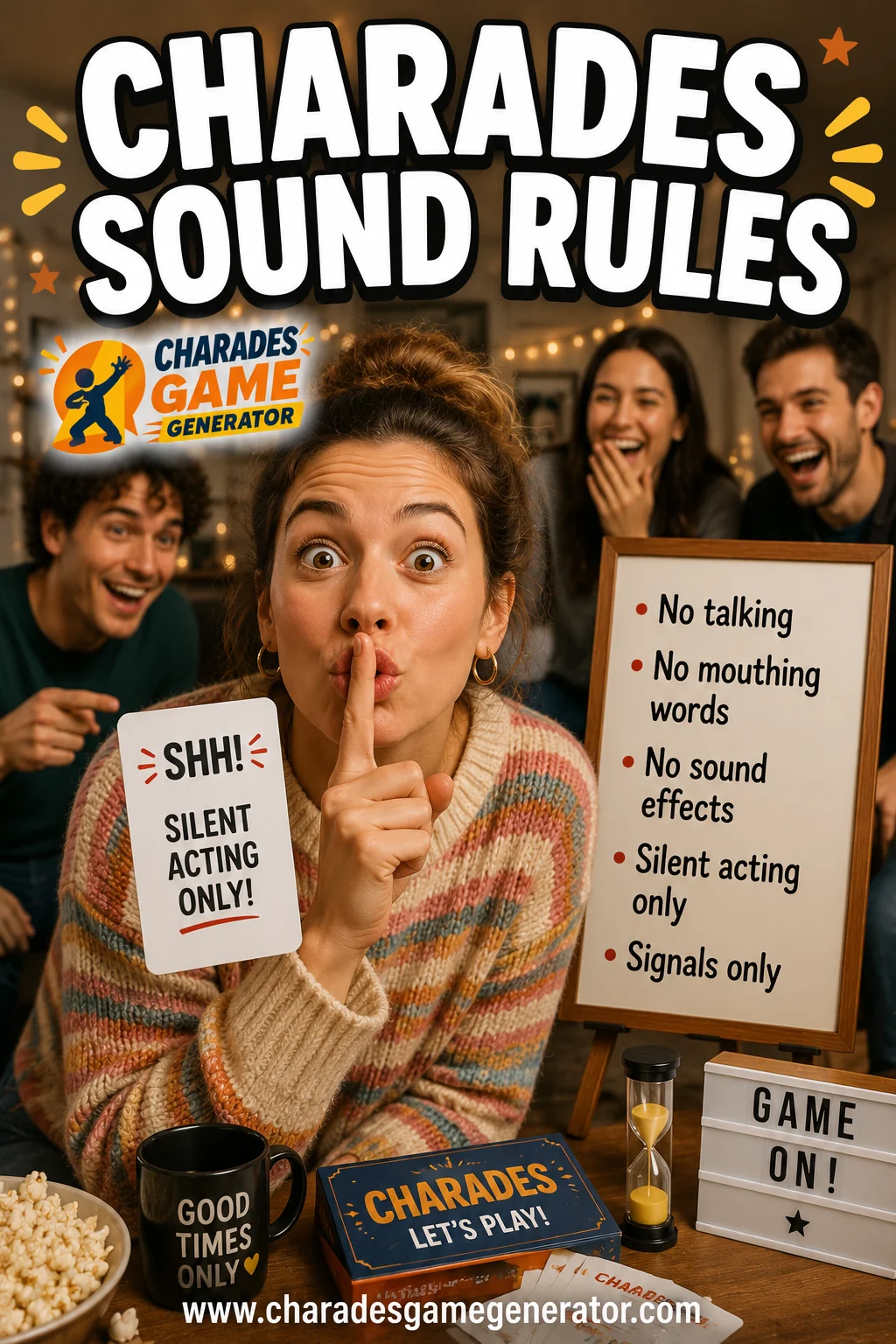
By the book, traditional charades is completely silent. The actor may not:
- ❌ Talk or mouth words
- ❌ Make any sounds (no humming a song, no animal noises)
- ❌ Use sound effects
- ✅ Only gestures, miming, and the official hand signals are allowed
The silence is the point — conveying a word with your body alone is the challenge that makes charades, well, charades.
Why the Silent Rule Is Worth Keeping
- It's the real challenge. Anyone can hum a song; miming it silently takes skill.
- It's funnier. The struggle to convey "thunderstorm" without sound is comedy gold.
- It levels the field. Sound effects can give an unfair advantage to the loud and confident.
- It's the tradition. Purists and competitive groups expect it.
When to Relax the Sound Rule
The silent rule isn't always the most fun. Consider allowing sounds when:
- Playing with young kids. Under-7s find strict silence frustrating — a "woof" or "vroom" keeps them confident and engaged.
- It's a casual, low-stakes game. Sometimes maximum laughter beats strict rules.
- You're doing a themed kids' round. Animals, dinosaurs, and vehicles are way more fun with sounds.
- You want a faster, easier game for a mixed or tired crowd.
Pro tip: Decide before the game whether sounds are allowed — and stick to it. The argument only happens when the rule wasn't agreed up front.
Silent vs Sound: Pros and Cons
| Silent (Traditional) | Sound Allowed (Relaxed) | |
|---|---|---|
| Challenge | High — pure miming | Lower — easier clues |
| Best for | Adults, competitive groups | Young kids, casual play |
| Funny factor | The silent struggle | The silly noises |
| Fairness | Levels the field | Favors the bold |
| Tradition | The "real" way | A house variation |
Neither is "wrong" — it's about matching the rule to your crowd.
What Counts as "Making a Sound"?
If you're playing strict, here's what's not allowed:
- ❌ Humming or singing a tune (for songs)
- ❌ Animal noises (woof, meow, moo)
- ❌ Sound effects (vroom, boom, splash)
- ❌ Mouthing or whispering the word
- ❌ Tapping out a rhythm audibly
And what is always allowed, even in strict play:
- ✅ Pointing at teammates to encourage close guesses
- ✅ Nodding or shaking your head
- ✅ The official hand signals (sounds-like, syllables, etc.)
Other Common Charades Rule Disputes
Sound isn't the only argument. Settle these up front too:
- Pointing at objects: Not allowed — you can't point at a real clock to clue "time."
- Spelling in the air: Not allowed — no writing letters.
- Mouthing words: Not allowed in strict play.
- Lip-syncing: A gray area — some groups allow silent mouthing for songs.
See our full rules guide to settle every dispute.
Tips for Setting the Right Rules
- Agree on the sound rule before you start — no mid-game arguments.
- Go silent for adults and competition; relax it for young kids.
- Match the rule to the round — animals with sounds, then a silent round.
- Keep the always-allowed signals (pointing, nodding) in every version.
- Use a generator so the only thing to decide is the rules, not the words.
Frequently Asked Questions
Can you make sounds in charades?
Traditionally, no — charades is completely silent, with no talking, humming, or sound effects. Only gestures and hand signals are allowed.
Is talking allowed in charades?
No. The actor can't talk, mouth words, or make any sound. Guessers, of course, shout their guesses out loud.
Should kids be allowed to make sounds in charades?
Yes — for under-7s, allowing sounds (a "woof" or "vroom") keeps them confident and engaged. Strict silence is too frustrating at that age.
Is humming allowed for song charades?
No — humming the tune is against the rules. For songs, you act out the title words silently, which is exactly what makes it challenging.
What happens if you accidentally make a sound?
House rules vary — some groups just continue, others give the other team a chance or charge a penalty. Agree on this before the game.
Can you point at things in charades?
You can point at teammates to encourage close guesses, but not at real objects in the room to give clues. Everything must be mimed.
🔗 More Charades Guides You'll Love
The Verdict
Strict silence is the official rule and the best challenge for adults and competitive groups — but relaxing it for kids and casual play is totally fine. The only real rule? Agree before you start. Then play:
👉 Open the free Charades Generator — 1000+ words, a timer, and team scoring, however you play. No app, no signup. 🤫
Settle the debate at your table: silent purists or sound-effect rebels? Decide, then let the games begin!