What to Do After Thanksgiving Dinner When Everyone Is on Their Phones
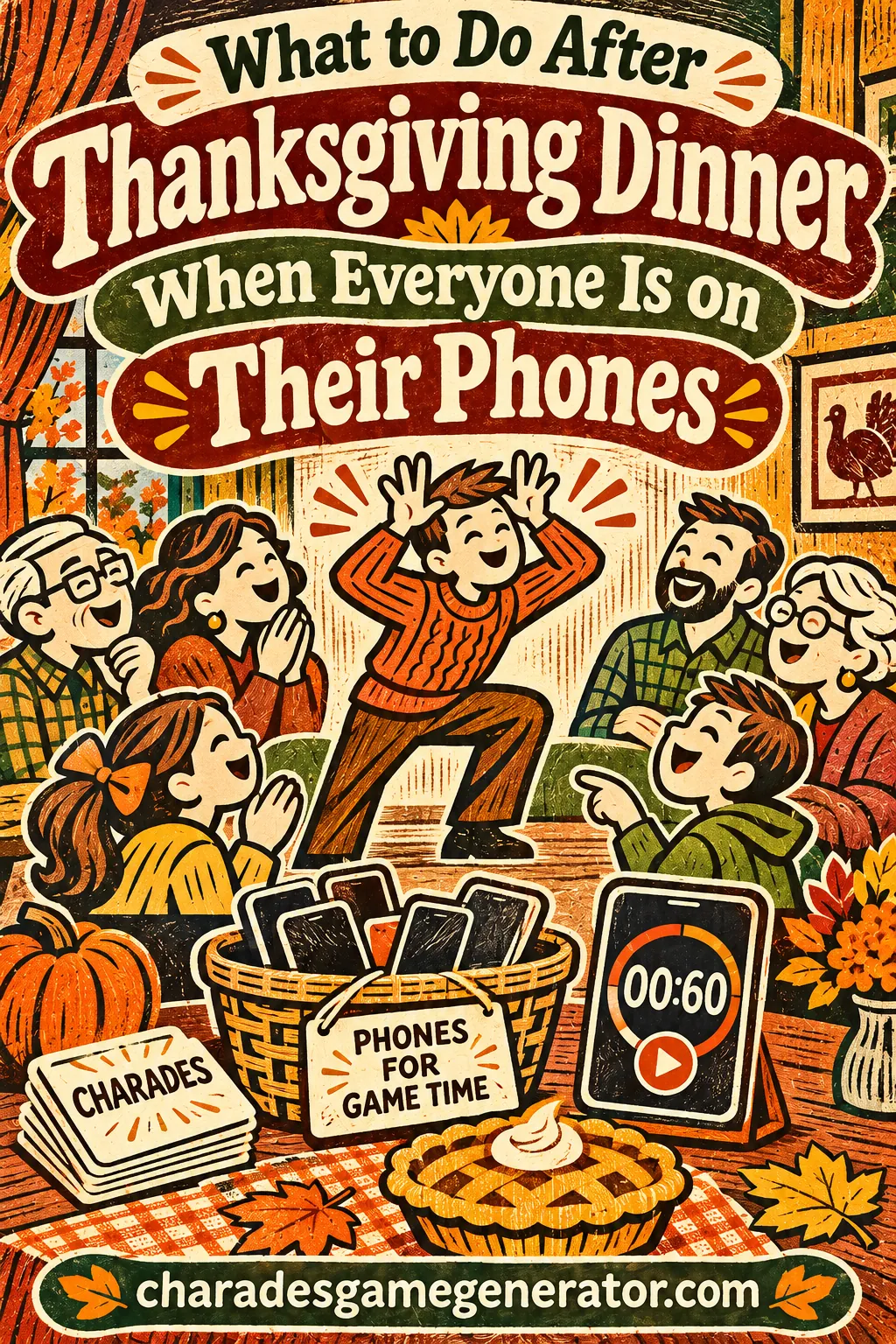
The fastest fix for the after-dinner phone slump is a 20-minute charades round with mixed-age teams, a timer everyone can see, and a stack of Thanksgiving words that make Grandpa and the eight-year-old laugh at the same thing. You don't need cards, a board or any setup beyond one phone. The free charades game on our homepage gives you teams, a timer, rounds and scores in your browser, so the only screen in the room becomes the one that brings everybody together.
This guide gives you the whole plan: the exact settings, a host script you can read out loud, 90 ready Thanksgiving words sorted by difficulty, scoring options, and fixes for the arguments that usually start around the third round.
Why Everyone Grabs Their Phones After the Meal
The phone slump isn't really about phones. It's about a gap. Dinner had a clear job: pass the dishes, eat, talk. Once plates are cleared, nobody has a job anymore, and the easiest thing to do with your hands is pick up the device in your pocket.
A few things make that gap worse on Thanksgiving in particular:
- Everyone is full and sleepy. Big activities feel like too much work, so people drift toward the couch.
- The ages are spread wide. A six-year-old, three teenagers and four grandparents don't have an obvious shared activity.
- The football game is on. Half the room cares, half doesn't, and someone always starts the "who's going to win" argument.
- Cousins don't know each other well. Relatives who see each other once a year default to screens because small talk is awkward.
Charades fixes each of these. It's low effort (you can play it sitting down), it works for every age, it gives people a job, and it mixes up the cliques at the table. Best of all, nobody has to read rules out loud or set up pieces. You can start inside five minutes.
What makes a good after-dinner game
Before you pick any activity, check it against this short list. Charades passes all of it, which is why it's the backbone of this plan.
| Need | Why it matters after a big meal | How charades handles it |
|---|---|---|
| Starts in under 5 minutes | Energy drops fast once plates are cleared | One phone, no pieces, rules fit in two sentences |
| Works sitting down | Nobody wants to run around on a full stomach | Most words can be acted from a chair |
| Every age can play | Kids, teens and grandparents in one room | Easy and Hard words, mixed teams |
| Short turns | Short attention spans and full bellies | 60-second timer keeps it moving |
| Clear end point | Pie is coming, and people want to know when | Set rounds, then a winner |
| Low stakes | Holidays already carry enough tension | Points are silly, losing is funny |
The 20-minute plan at a glance
Here's the shape of the night before we get into details. You can run this exactly as written.
- Minute 0 to 3: The call. Stand up, clap once, and announce the game (script below).
- Minute 3 to 5: Teams. Split the room into two or three mixed-age teams.
- Minute 5 to 7: Settings. Set up the game on one phone or tablet.
- Minute 7 to 20: Play. Three rounds, 60 seconds per turn.
- Minute 20: Crown the winners. Hand out the first slice of pie as the prize.
Twenty minutes is the sweet spot. It's long enough for everyone to get at least one turn in a group of up to about twelve, and short enough that nobody feels trapped. If people beg for more, play another round of three. Leaving them wanting more is how you get a family tradition instead of a one-time thing.
The magic of a hard stop
Say the end time out loud before you start. "We're playing until pie" or "We're playing three rounds, then dessert" tells the reluctant teen and the tired uncle that this isn't an all-night commitment. People join things they know will end. It also gives you a natural break before the food comes out again, which is when a second game often happens on its own.
How to Set It Up in the Game
Open the free charades game on whichever phone or tablet has the biggest screen and the most battery. Then use these settings in the Set Up Your Game screen.
| Setting | What to choose | Why |
|---|---|---|
| Teams | 2 for up to 10 people, 3 for 11 to 15, 4 for 16 or more | Keeps waits between turns short |
| Category | Actions for mixed ages, Kids if most players are under 10, Animals as a warm-up | Words everyone can act without pop culture knowledge |
| Add Custom Words | Paste in 20 to 30 words from the Thanksgiving lists below | Gives the game a holiday feel |
| Timer | 60 sec | Long enough for kids, short enough for teens |
| Rounds | 3 | Fits the 20-minute window |
| Difficulty | 🎲 Mixed | Everyone gets a mix of easy and tricky words |
A few notes on these choices.
Category. The game has 18 categories, including Movies, TV Shows, Famous People and Sports. Those are great with a crowd that shares references, but on Thanksgiving your guessers range from a first-grader to a grandparent. Actions and Animals are the safest picks because nobody needs to know a show to guess "brushing teeth" or "kangaroo." If your family loves movies and the kids are teens, Movies works well too.
Custom words. Tap ✏️ Add Custom Words, type a word, and tap + Add. Do this before people gather, while the coffee is brewing. Twenty to thirty words is plenty for one night. You'll find 90 ready ones in the next section.
Timer. If you've got lots of little ones, pick 90 sec. If it's mostly teens and adults who play a lot, 30 sec turns it into a fast, loud speed round.
Difficulty. Mixed is the right default for family groups. If a round feels too easy for the adults, switch to 😤 Hard for the next game. If the kids are struggling, switch to 😊 Easy.
How a turn works on screen
Hand the phone to the first actor. They see a word, act it out silently, and tap ✓ GOT IT! when their team guesses it. If the word is too hard, they tap ↷ Skip — too hard! and get a new one. When the timer runs out, the Time's Up screen appears, followed by Current Scores. The actor passes the phone to the next team and taps Next Team's Turn. When the rounds are done, you can tap Play Again to go another round with the same setup.
That's the whole interface. Nobody has to keep score on paper, and nobody has to watch a kitchen timer.
90 Thanksgiving Charades Words Ready to Add
These lists are written for "Add Custom Words." Pick 20 to 30 per game, mixing easy and harder ones, and save the rest for next year. Every word here is clean, family-friendly and free of brand names.
Easy words (great for kids 5 to 9)
These are concrete, physical and familiar. Little kids can act them without help, and older players can guess them in seconds, which keeps energy high.
- Turkey
- Pumpkin
- Pie
- Corn on the cob
- Leaves falling
- Scarecrow
- Football
- Apple picking
- Hugging Grandma
- Eating
- Sleeping
- Napkin
- Fork
- Spoon
- Oven
- Hat
- Squirrel
- Rain boots
- Jumping in leaves
- Rolling pin
- Whipped cream
- Baking cookies
- Waving hello
- Buttering bread
- Peeling a banana
- Owl
- Deer
- Wind blowing
- Raking
- Blowing on hot soup
Medium words (ages 10 and up, plus adults)
These need a little more acting, often two steps or a short scene.
- Carving the turkey
- Mashed potatoes
- Pumpkin pie
- Setting the table
- Washing dishes
- Gobbling turkey
- Parade balloon
- Marching band
- Wishbone
- Stretchy pants
- Food coma
- Second helping
- Leftovers
- Rolling out dough
- Basting the turkey
- Hayride
- Corn maze
- Picking a pumpkin
- Pilgrim
- Sailing ship
- Passing the gravy
- Saying grace
- Touch football
- Traffic jam
- Airport security
- Packing a suitcase
- Taking a family photo
- Folding chairs
- Kids table
- Nap on the couch
Hard words (teens and adults)
These are phrases, feelings or situations. They're the ones that get the biggest laughs, because the acting gets creative.
- Burning the rolls
- Forgetting to thaw the turkey
- The smoke alarm going off
- Sneaking a taste before dinner
- Fighting over the last roll
- Cranberry sauce from a can
- Too full for dessert
- Eating dessert anyway
- Unbuttoning your pants
- Giving thanks
- Long-distance video call
- Squeezing in one more chair
- Grandma's secret recipe
- Wrong turn on a road trip
- Black Friday shopping line
- Pumpkin carving
- Pulling a wishbone and losing
- Holding the dog back from the table
- Stuck washing every pot
- Falling asleep during the game
- Mom counting heads
- Building a pie crust lattice
- Parade on TV
- Cleaning up after the meal
- Thanksgiving traffic
- Hiding the last slice of pie
- First snow of the season
- Gathering firewood
- Telling an old family story
- Saying what you're thankful for
Want more? The Thanksgiving charades word list has extra holiday words you can mix in, including a few that lean a little more grown-up for a table of adults.
The Host Script: Getting People Off Their Phones Without Nagging
The hardest part of the night is the first 60 seconds. If you ask "Does anyone want to play a game?" you'll get a chorus of "Maybe later." Don't ask. Announce. Here's a script you can borrow word for word.
The opening call
"Okay, everybody, pie is in 20 minutes. Until then, it's family charades, and the winning team gets the first slices. Phones go face-down on the counter for 20 minutes. I'm making teams right now."
Notice what this does. It sets a time limit, offers a prize everybody wants, gives a simple phone rule with an end point, and skips the vote. You're not asking permission. You're inviting people to something that's already happening.
For the teen who won't look up
Teens often hang back because charades can feel babyish or embarrassing. Give them a role with status instead of pushing.
"I need you to run the phone for your team. You're the captain. You decide who acts next."
Being in charge of the device is a pretty good bridge for someone who didn't want to put theirs down. Most teens are acting by round two once they see the adults being ridiculous.
For the relative glued to the football game
Don't fight the game. Work around it.
"We'll play during halftime. Fifteen minutes, then you're back on the couch."
Halftime or a long commercial break is a natural window, and it ends the "who's going to win" debate because everyone is suddenly focused on something else. If they still want to watch, give them a seat facing the TV and make them the official guesser for their team. They can glance at the screen and still shout answers.
For the grandparent who says "I'll just watch"
Respect it, then offer a small job.
"Great. You're the judge. If there's an argument about whether a guess counts, you decide."
Most grandparents who say they'll watch end up shouting guesses within two turns. Being the judge keeps them in the circle and gives them a way to join without standing up.
Your mid-game check-in
Halfway through, read the room. If people are laughing, say "One more round?" If energy is dipping, say "Last round, double points!" Double points in the final round keeps the losing team interested, because they still have a shot at winning.
How to Build Mixed-Age Teams That Actually Work
Bad teams are the number one reason family charades falls flat. If all the adults end up on one team and all the kids on the other, the adults win by a mile and the kids quit. Mix it up on purpose.
The simple sorting method
Line everyone up by age, youngest to oldest. Then count off "1, 2, 1, 2" (or "1, 2, 3" for three teams). This puts kids, teens and adults on every team automatically, and it takes about 30 seconds. It also splits up couples and close siblings, which cuts down on private jokes that leave others out.
Team size guide
| Group size | Number of teams | Players per team | Turns per person in 3 rounds |
|---|---|---|---|
| 4 to 6 | 2 | 2 to 3 | About 1 to 2 |
| 7 to 10 | 2 | 4 to 5 | About 1 |
| 11 to 15 | 3 | 4 to 5 | About 1 |
| 16 to 20 | 4 | 4 to 5 | About 1 |
| 20 or more | 4 | 5 or more | Play two games or add rounds |
Each round gives each team one turn, so with three rounds your team gets three turns. In a team of five, not everyone acts in a single game. That's fine. Say up front that whoever didn't act gets to go first in the next game.
Pairing little kids
Kids under six can act with a partner, usually an older cousin or a parent. The older partner can quietly read the word to them and help with the acting, but they can't talk to the guessers. Little ones love being in the spotlight with backup.
Giving teams names
Team names make it feel like a real competition, and they're a quick icebreaker for cousins who don't know each other well. Let each team pick a name in 30 seconds. Thanksgiving names like "The Drumsticks," "Team Gravy," "The Leftovers" or "Pie Crusts" are always a hit. If you need more ideas, there's a full list of charades team names you can scroll through.
Scoring options for family groups
The game keeps score for you: one point per word your team gets during its turn. That's the simplest system, and it's usually the right one. But some families like a little extra twist, especially if one team runs away with it.
| Scoring style | How it works | Best for |
|---|---|---|
| Standard | One point per word guessed in time (shown on Current Scores) | Most families |
| Double final round | Tell everyone the last round's points count twice; add the bonus by hand | Keeping the losing team hopeful |
| Kid bonus | One extra point when a kid under 10 acts and their team guesses | Encouraging little ones |
| Skip penalty | Subtract one point for each skip (tracked by hand) | Competitive teens and adults |
| No score | Just play for laughs; no winners announced | Very young or very sensitive groups |
Keep any hand-tracked extras simple. A scrap of paper and a pen are all you need. Assign one person, maybe the grandparent judge, to keep track. For more ideas, the guide to charades scoring walks through fairer systems for uneven teams.
Prizes that don't cost anything
The prize matters less than the bragging rights, but a small reward helps.
- First slice of pie (or first pick of pie flavor)
- Choosing the next game
- Getting out of dish duty
- Picking the music for cleanup
- Getting the last wishbone pull
- The "Golden Drumstick" (any random object you crown as the trophy)
Getting out of dish duty is a strong motivator for every age. Use it wisely.
A crash course for players who've never done this
Plenty of relatives haven't played charades in years, or ever. Give them a 30-second crash course before round one. You can read this out loud:
- No talking, no mouthing words, no sounds. Your hands and face do all the work.
- Hold up fingers for how many words. Three fingers means three words.
- Tap your arm to show which word you're on. Two taps means the second word.
- Point to your team when they're close. Big nods help.
- If you're stuck, skip. You'll get another word right away.
That's enough to play. If anyone wants to get fancy, there are more charades hand signals like "sounds like" and "small word," but beginners don't need them for round one.
Words that trip people up
Some Thanksgiving words are harder than they look. Here's how to act a few of the tricky ones from the lists above.
Pilgrim. Draw a tall hat with a buckle in the air, then walk stiffly and hold up a big book. Pointing to the hat and then miming "long ago" by waving a hand backward over your shoulder helps.
Food coma. Pat your belly, puff out your cheeks, then slump back in your chair with your eyes rolling shut. Add a slow head drop for comedy.
Parade balloon. Grip invisible ropes with both hands and lean back while looking way up. Move in slow steps like you're fighting the wind.
Forgetting to thaw the turkey. Pull something out of the freezer, knock on it like it's a rock, then look at your watch and slap your forehead.
Stretchy pants. Pretend to unbutton, then pull out an imaginary waistband way too far and let it snap back. This one never fails to get a laugh.
Fixing the Arguments Before They Start
Holiday games can get heated, especially with competitive siblings. Most fights come from a handful of situations. Settle the rule before the first turn and you'll avoid nearly all of them.
| The argument | What happens | House rule that fixes it |
|---|---|---|
| "That's close enough!" | The guess was "pie" but the word was "pumpkin pie" | The actor decides. If they tap ✓ GOT IT!, it counts |
| "You mouthed it!" | The actor's lips moved | First time is a warning. Second time, the word is skipped |
| "They shouted it first!" | The other team blurted the answer | Only the acting team guesses. Others stay silent or lose a point |
| "That word was impossible!" | A team got stuck on a hard word | Unlimited skips; no penalty unless you agreed on one |
| "Their team has all the adults!" | Uneven teams | Re-sort by the age line-up method before round two |
| "Grandpa took forever!" | A slow actor runs the clock | That's the timer's job. Time's Up is final, no argument |
| "Can we redo that?" | Someone missed a turn or the phone glitched | One redo per game, decided by the judge |
The one-sentence rule that ends most fights
Before round one, say: "The actor and the timer are always right." That covers close guesses, time disputes and the urge to argue about a word. The actor taps GOT IT or doesn't, and when the timer ends, it ends. Simple rules feel fair because nobody gets to bend them. If your family needs a longer rulebook, a set of written charades house rules can settle almost anything.
When the football argument comes back
If the room splits over the game on TV, use it. Give the sports fans a "Sports Round" where everyone acts sports actions: touchdown dance, kicking a field goal, referee whistle, quarterback sneak, cheerleader jump, tailgate grill. The fans finally get to show off what they know, and everyone else gets to watch them flail around. You can also switch the category to Sports for one quick game.
When a kid melts down after losing
Full bellies, late nights and lots of relatives mean meltdowns happen. Try these quick fixes.
- Give the kid the next turn, with an easy word they choose from the list.
- Switch to team cheering, where the room claps for every correct guess no matter who scores.
- Make them the timekeeper for a round so they get a break from performing.
- End on a win. If a little one is tired, let their team get the last turn.
Variations for Different Crowds
No two Thanksgivings look the same. Some years you have 25 people packed in, some years it's four of you and a dog. Here's how to adjust the game.
Small gathering (3 to 5 people)
Use two teams, even if one is just two people. Set the timer to 30 sec and play 5 rounds so everyone acts several times. With a tiny group, the fast pace keeps it exciting. If you have only three people, one person acts for the other two and you rotate, keeping your own tally of who guessed the most.
Big crowd (16 or more)
Use four teams and a 60-second timer. More rounds would run well past 20 minutes with this many people, so stick with 3 rounds and play a second game later. Put the phone holder at the front of the room so everyone can see the actor. For big groups, one firm rule helps: only the acting team guesses.
Mostly little kids
Choose the Kids category, 😊 Easy difficulty and a 90 sec timer. Add the easy Thanksgiving words from the list. Pair the youngest kids with an older helper. Let everyone shout guesses (no team rules) and skip the score. Kids under seven care more about acting than winning.
Mostly adults and teens
Choose 😤 Hard difficulty and a 30 sec timer, and add the hard Thanksgiving words. Try Movies or Famous People as the category if everyone shares references. Turn on the skip penalty. This version gets loud and competitive in the best way.
Grandparents and anyone who prefers to sit
Most of these words can be acted from a chair. Carving the turkey, mashed potatoes, wishbone, stretchy pants, napping, eating dessert anyway: all of these work with just hands, arms and face. Tell the room that standing is optional and that seated acting is a fair way to play. Don't add rules about who has to stand.
Two households on a video call
If some relatives are joining from another state, put your laptop where they can see the actor and use a phone to run the game. The remote group can act too: they hold the phone off camera, read the word and perform for the camera. Keep the timer at 90 sec since video lag slows guessing.
A Second Game to Play After Pie
If charades goes well, people often want another game once dessert is done. Here are a few twists you can run on the same game with no extra setup.
Slow-motion round. Every actor has to perform in slow motion. It's especially funny with action words like "touch football" or "passing the gravy."
Thankful charades. Each player acts out something they're thankful for, without drawing a word. The team guesses. It's a sweet way to wrap up the night and gets people talking without forcing a round-the-table speech.
Pass the scene. One player starts acting a word, and every 15 seconds the next teammate takes over the same word. The team guesses as it goes. This is great for shy relatives because nobody performs alone for long.
Leftover round. Tap Play Again, and this time add only the words people remember skipping in the first game. Everyone has seen these words fail, which makes the second try even funnier.
Kids vs. grown-ups rematch. After a mixed game, do one quick rematch with kids on one side and adults on the other. Let the kids act the easy words from the list and give the adults the hard ones. The kids usually win, and they never forget it.
Make it a family tradition
The best after-dinner games become something people expect every year. A few small habits make that happen.
- Keep the same time slot. "Charades before pie" becomes something the kids remind you about.
- Keep a running winner list. Write each year's winning team in a notebook that lives with the holiday dishes.
- Bring back the trophy. A painted pinecone or an old gravy boat as the "Golden Drumstick" gets passed down each year.
- Write new words together. Ask each family member to bring two new words for the custom list next year.
- Save your best words yourself. The game doesn't save custom lists, so keep your favorites in a notes app or on paper so you can add them again next November.
When the game starts to feel like part of the day, the phone problem mostly solves itself. People put their screens down because they don't want to miss the part everyone talks about later.
Ready for Thursday?
Here's your quick checklist:
- Pick 20 to 30 words from the lists above.
- Before guests arrive, open the charades game with a timer and scores and add your words with ✏️ Add Custom Words.
- Decide on teams, timer, rounds and difficulty using the settings table.
- Choose a prize. Getting out of dish duty works every time.
- Memorize the opening call: "Pie in 20 minutes. Until then, it's charades."
That's it. Twenty minutes, one phone, and a room full of people laughing at an uncle pretending to be a parade balloon. Happy Thanksgiving.
Frequently Asked Questions
What are good games after Thanksgiving dinner for all ages?
Charades is the easiest pick because it needs no pieces, works sitting down and lets kids and adults play on the same team. Other good options include a thankful round where people act out what they're grateful for, and a slow-motion charades round after dessert. All of these can start in five minutes.
How do I get my family off their phones after dinner?
Don't ask if people want to play. Announce a short game with a clear end time and a prize, like "Charades until pie, winners get the first slices." Ask everyone to put phones face-down for 20 minutes, and give reluctant teens a job like running the game on the shared device.
Is there a Thanksgiving category in the charades game?
There isn't a Thanksgiving category among the 18, but you can add your own holiday words with ✏️ Add Custom Words before you start. Pair them with the Actions, Animals or Kids category so everyone gets familiar, easy-to-act words alongside your holiday ones.
How long should an after-dinner charades game last?
About 20 minutes is ideal. Three rounds with a 60-second timer fits that window for most family groups. If everyone wants more, tap Play Again and run another short game rather than one long one.
How many people do you need to play charades on Thanksgiving?
You can play with as few as three people, but four or more lets you split into two real teams. The game supports 2, 3 or 4 teams, so even gatherings of 20 or more can play with four teams of five.
How do you make charades fair when teams have different ages?
Line everyone up youngest to oldest and count off by team, which spreads kids, teens and adults evenly. Use 🎲 Mixed difficulty, and consider giving a bonus point when a young child acts and their team guesses the word.
Can grandparents play charades sitting down?
Yes. Most Thanksgiving words, like carving the turkey, wishbone or food coma, can be acted with just hands, arms and face from a chair. Tell everyone that seated acting is a normal part of the game so nobody feels singled out.
What if someone gets upset about losing?
Keep the stakes small and silly, like a pie slice or a paper trophy. Give an upset child the next turn with an easy word, or let them be timekeeper for a round. You can also skip scores entirely for very young groups and just play for laughs.