Charades Game Ideas: Themes, Twists and House Rules
The charades game ideas that actually change a party are format changes, not longer word lists: swap the timer, swap the teams, or swap what counts as a turn, and the same deck of words feels like a new game. Reverse charades, where the whole team acts and one person guesses, will get more laughs out of a tired group in five minutes than another fifty suggestions ever will.
This is a guide to the variants, themes and house rules worth stealing. Every one of them has been used at real parties, none of them need equipment, and most take one sentence to explain before you start.
What Is Charades Before You Change It
Quick baseline, since half of these ideas are deviations from it. Here is what is charades in its standard form: a player draws a word or phrase, acts it out silently against a timer, and their team guesses. No speaking, no mouthing, no pointing at objects in the room, no writing letters in the air. Points go to the team that guesses in time. That is the entire ruleset, which is why it survives being bent in so many directions.
Everything below assumes that base and then breaks one piece of it on purpose.
Format Twists That Change the Whole Game
Reverse charades. One person guesses and the entire rest of the team acts the word out at the same time. It is chaos, it is the single funniest variant, and it rescues a group where one confident performer has been hogging every turn.
Running charades. Word slips are spread on a table across the room. The actor runs over, grabs a slip, runs back, acts it, and once the team guesses correctly, runs for the next one. Teams race on total words cleared in a fixed window. Great for kids and for anyone who has eaten too much.
Charades relay. Player one sees the word and acts it to player two in silence, who acts what they think it was to player three, and so on. The last player guesses out loud. Half the fun is watching a "kangaroo" arrive as "angry mailman."
One-word charades. The actor may say exactly one word before acting, chosen carefully. It sounds like it ruins the game and instead it creates a strategy layer, since picking the right single word is genuinely hard.
Freeze frame. The actor has ten seconds to build one still pose and then must hold it, motionless, for the rest of the turn. Guessers have to read a statue. Brutal, quick, and a good tiebreaker.
Blind charades. The guesser closes their eyes while the actor performs, then opens them for a five-second replay. It forces the actor to plan a single clear beat instead of flailing.
Timer and Scoring Twists
Sudden death. Thirty-second turns, no exceptions. The pace change alone lifts a flat room.
Bank the clock. Each team gets a shared five-minute pool for the whole game instead of a per-turn limit. Burning ninety seconds on one impossible word means somebody later gets fifteen. Teams start playing the clock, which adds real tactics.
Escalating points. Easy words are worth one, medium two, hard three, and the actor picks the tier blind from three separate bowls. Risk-taking gets rewarded and the hard bowl finally gets used.
Steal rounds. If the acting team runs out of time, the other team gets one guess. It keeps everyone watching instead of checking their phones during the other side's turn.
No score at all. For a mixed-age or mixed-confidence group, drop scoring entirely and play for the turns themselves. Competitive scoring is what makes shy players dread their go.
Themed Decks and Charades Game Topics
Themes are the cheapest upgrade available. Announcing the category before the round narrows the guessing field so turns actually finish, and it lets the actor spend their time on detail rather than on establishing what universe they are in.
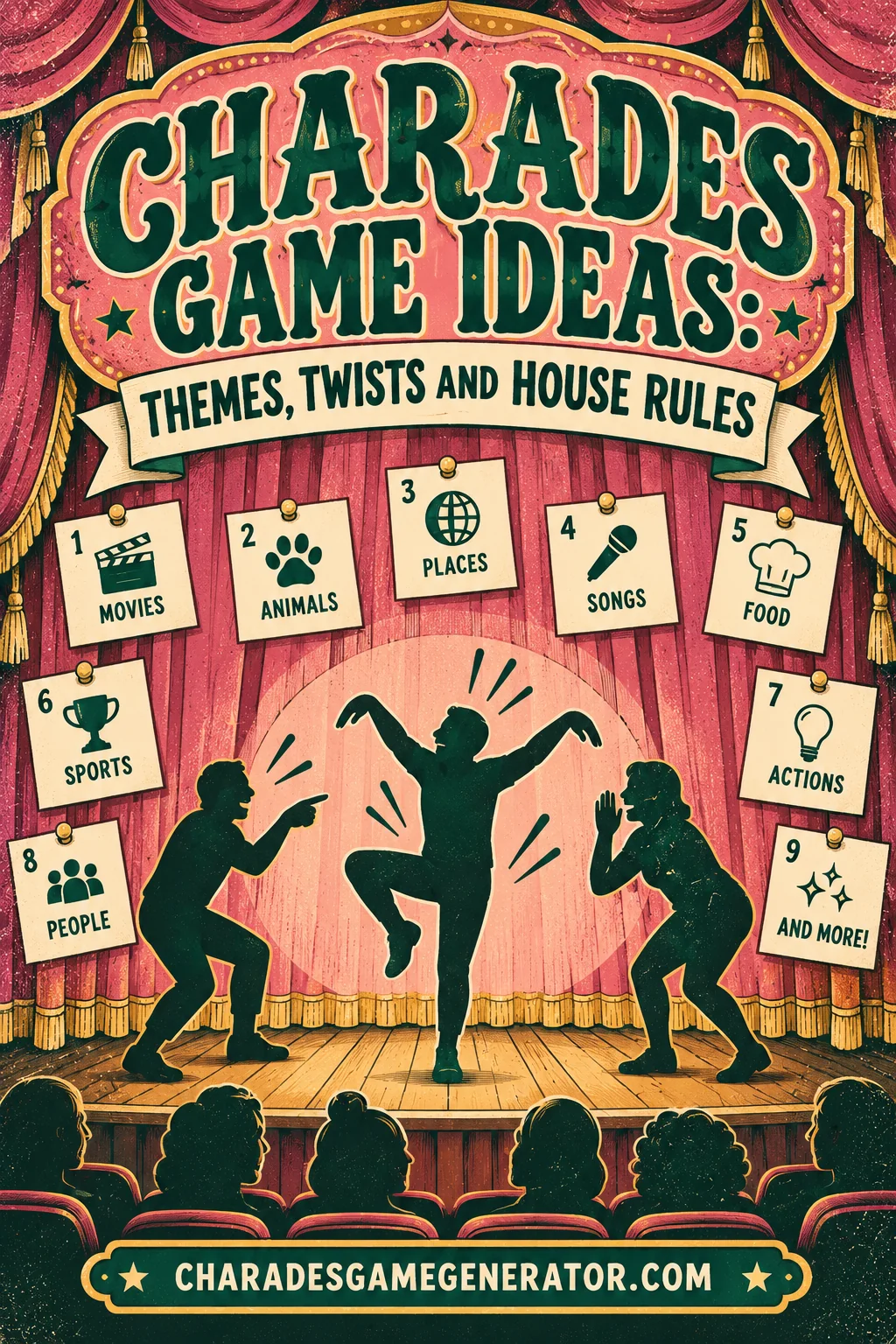
Reliable charades game topics: things that happen at an airport, chores nobody wants to do, kitchen disasters, animals at the zoo, jobs from a hundred years ago, bad first dates, things in a supermarket, school subjects, weather, sports moments, things you do on a Monday morning, and famous fictional characters.
Deeper themes work too if the group shares the reference: songs from one decade, everything in a single movie, holiday rituals, or the inside jokes of one family. A deck of inside jokes is the most reliable way to make a group of six people cry laughing, and it is completely worthless to anyone else, which is exactly the point.
Seasonal decks run themselves. A Thanksgiving deck writes itself from the table: carving the turkey, the parade on TV, falling asleep after dinner, going back for seconds. Halloween, Christmas and summer-vacation decks work the same way. Mine the occasion for objects and rituals rather than reaching for abstract ideas.
Funny Charades Ideas That Reliably Land
The comedy in this game comes from specificity and from physical commitment, not from clever words. The funny charades ideas below are all built to force one or the other.
Try these prompts: a cat knocking a glass off a table, trying to fold a fitted sheet, a person who has just walked into a glass door, someone pretending to enjoy a bad gift, a toddler refusing to put shoes on, parallel parking with an audience, a very slow dog on a very short walk, eating something far too hot, waking up from a nap in public, taking a group photo where nobody is ready, arguing with a self-checkout machine, and getting a shopping cart with one bad wheel.
Two house rules multiply the laughs. First, ban the shrug — an actor who breaks character to shrug helplessly kills the bit, so require them to keep acting until the timer stops. Second, give the room permission to be big. Half-hearted miming is the actual enemy of charades. A player who commits fully to being a jellyfish is funnier than any word on any slip.
House Rules Worth Adopting
One free pass per player per game. Prevents the miserable minute where somebody drew an unactable abstraction and everyone watches them suffer.
The actor writes nothing. No air-letters, no counting out spellings letter by letter. Word-count and syllable gestures stay legal, letters do not.
Shuffle teams every round. Fixed teams calcify. Reshuffling keeps the game social rather than tribal and stops one team from feeling like the losing team all night.
Youngest first. Attention is highest at the start of a session. Put the kids on early and let the adults take the later, longer rounds.
Anyone can call a re-draw on an offensive or confusing slip, no discussion. Faster than debating it.
No phones during someone else's turn. The single rule that most improves a game night, and the hardest to enforce.
Format Comparison
| Variant | Group size | Energy level | Best moment to use it |
|---|---|---|---|
| Standard | 4 to 12 | Medium | Opening rounds |
| Reverse charades | 6 to 20 | High | When the room goes quiet |
| Running charades | 6 to 16 | Very high | Kids, or after a big meal |
| Charades relay | 8 to 16 | Medium | Mid-game, for a change of shape |
| Freeze frame | 3 to 10 | Low | Tiebreaker or late night |
| One-word charades | 4 to 10 | Medium | Experienced groups |
Playing Charades Online
Charades online needs three fixes and then it works fine. Frame yourself from the waist up so your hands stay in shot, because a webcam crops exactly the part of you that does the acting. Appoint one timekeeper who calls the countdown out loud, since separate devices drift and arguments follow. And ask guessers to type into the chat rather than shout, because video lag turns simultaneous voices into noise.
For a charades game online, the actor can read their word privately and turn their phone face down, or keep a generator open in a window nobody else can see. A charades word generator deals a fresh word instantly, which matters more remotely than in person — the dead air while someone invents a word feels twice as long over video.
Reverse charades is the standout variant for a video call, oddly enough. A grid of six people all acting the same word at once is genuinely funny in a way that in-person reverse charades is not, because the gallery view lines them all up like a chorus.
Building a Session, Not Just a Round
A good charades night has a shape. Open with easy words and standard rules for two rounds so everyone gets a turn while stakes are low. Introduce one twist in the middle, usually reverse or running charades, right at the point where attention normally dips. Save one themed round for the end, ideally something specific to the people in the room. Then stop while the group still wants more, which is roughly twenty minutes before you think you should.
The most common mistake is playing one format for ninety minutes. The word list is not what wears out. The rhythm is.
Ideas for Specific Groups
Young children. Drop the silence rule. It is a great constraint for adults and needless cruelty for a six-year-old who just wants to bark. Use animals and everyday actions almost exclusively, keep turns to thirty seconds, and let two kids act together if one is nervous. Running charades is the best variant here by a wide margin because it burns energy while it entertains.
Teenagers. Let them write the deck. Ownership matters more than word quality at that age, and a deck full of their own references will get more out of them than anything you could write. Reverse charades works especially well because it removes the fear of performing alone in front of peers.
Office and team events. Avoid anything that depends on shared personal history, which strands new hires and anyone outside the main clique. Universal experiences carry the game instead: printers, commuting, meetings that should have been emails. Team play with reshuffled sides each round beats fixed departmental teams, which turn competitive in a way nobody enjoys afterward.
Multi-generational family gatherings. Themed rounds solve this better than anything. A deck about breakfast, chores or the weather works for a nine-year-old and an eighty-year-old equally, where a generic deck strands one of them. Let anyone who cannot stand comfortably act while seated, and mean it rather than offering it politely.
Very small groups. With three or four people, drop teams entirely. One person acts, everyone else guesses, and whoever gets it takes the next turn. It moves faster than team play and nobody sits out a single round.
Signals to Settle Before You Start
Groups argue about shorthand, not about words. Agree on the basics in two minutes and the arguments disappear. Fingers held up for the number of words, then for which word is coming. Fingers on the forearm for syllables. An earlobe tug for "sounds like." Hands pulled apart for a longer form of the word, pushed together for a shorter one. A finger on the nose to confirm a guesser is on the right track.
Also settle the close-guess rule in advance. Most groups accept any answer that clearly shows the guesser has the right idea, even if the wording is off. Whatever your group prefers, decide it before the first disputed turn instead of in the middle of one.
Frequently Asked Questions
What are good charades ideas for a very large group? Split into teams of four to six and run them as parallel games with one shared timer, or play reverse charades where the whole team acts at once. Both formats keep everyone doing something instead of watching twenty other people take turns.
How long should each turn last? Sixty to ninety seconds for standard play, thirty for a fast round. If most turns are ending on a timeout rather than a correct guess, your words are too hard for the group, not your clock too short.
Do you need cards or props to play? No. Paper slips and a phone timer cover everything. Props are actually against the spirit of the game since pointing at real objects is already banned, and a group that starts grabbing things tends to stop acting.
How do you include someone who refuses to act? Give them a permanent job: timekeeper, scorekeeper, or the person who writes the slips. Plenty of people enjoy a game night without ever standing up, and pressuring a reluctant player is the fastest way to end the evening early.