Charades Meaning: Where the Word Comes From and How the Game Works
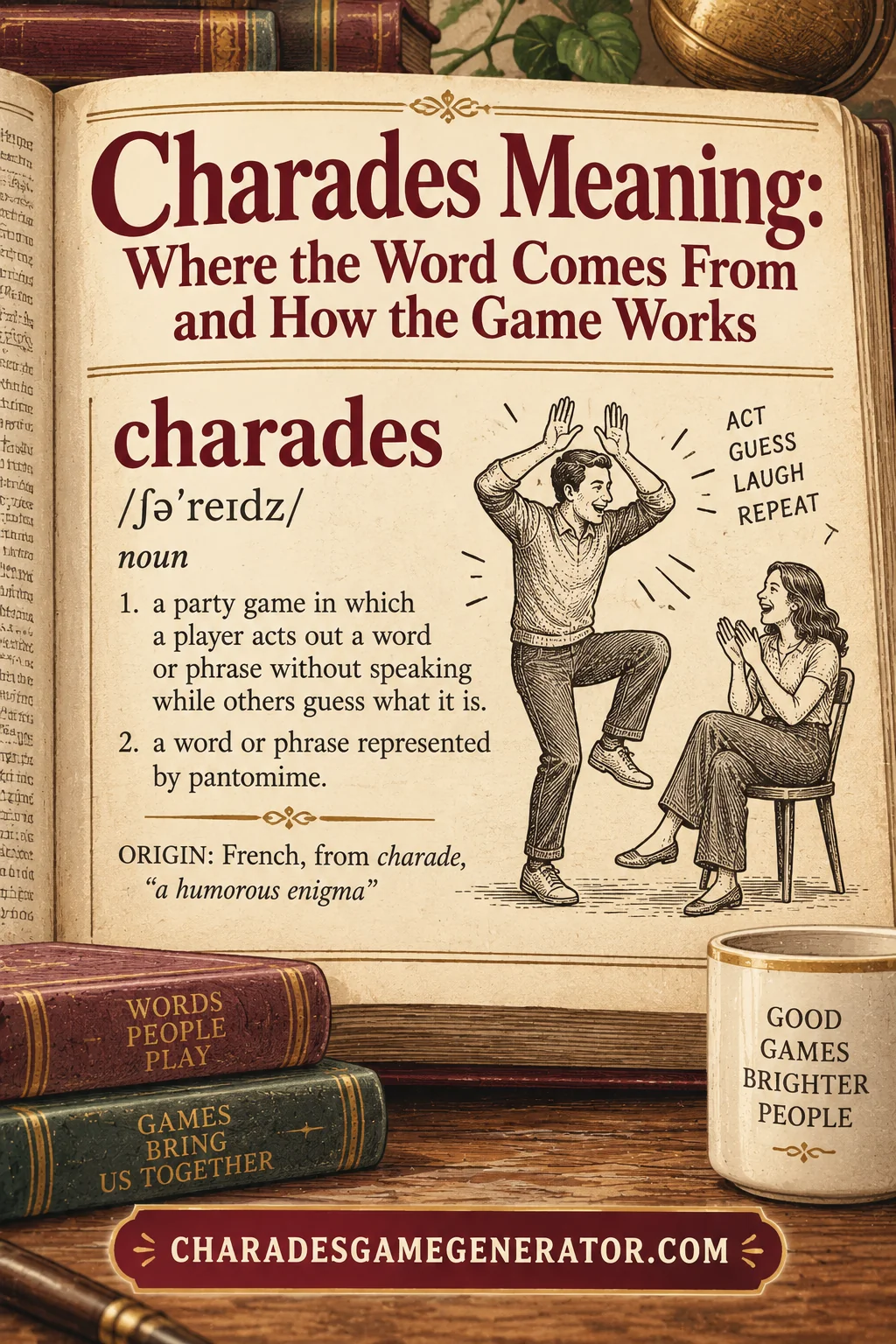
The charades meaning has two parts: the word comes from the French charade, a syllable riddle in verse, which traces back to an Occitan word for chatter or idle talk, and the modern game is the silent acting version of that riddle, where one player mimes a word or phrase while a team guesses against a clock. The second, everyday meaning followed from the first. When someone says an apology was "a complete charade," they mean it was a performance with nothing behind it, exactly the way a mimed clue is a performance standing in for a word.
So the same word covers a rhyming puzzle from the 1700s, a party game played in living rooms tonight, and an insult about insincerity. The thread connecting all three is substitution: something acted or described in place of the thing itself. Here is where the word came from, how it turned into the game, and how the game is actually played.
What Are Charades: The Word's Origin
The English word arrived from French in the second half of the eighteenth century. The French charade is generally traced to Occitan charrada, meaning chatter, gossip, or a long idle conversation, from a verb meaning to chatter. That root is worth sitting with, because it explains the tone of the original. A charade was not a solemn puzzle. It was drawing-room talk shaped into a riddle.
The original form was verbal and written, not physical at all. A charade broke a word into syllables and gave a clue for each one, then a clue for the whole. A composer might describe "my first" as a small animal, "my second" as a unit of weight, and "my whole" as something you find in a garden. The audience assembled the parts. These riddles ran in newspapers and magazines, and writing a clever one was a social accomplishment.
That syllable-by-syllable structure survives in the modern game. When a player taps two fingers on their forearm to signal "second syllable," they are performing a rule inherited directly from a printed verse puzzle nobody has read in two hundred years.
From Verse Riddle to Acted Game
The shift from spoken to acted charades happened in France and then in Britain during the nineteenth century. The acted form, sometimes called charade en action, replaced the written clue with a small silent scene. Instead of describing the first syllable, a group would perform a tiny sketch containing it, then another for the second, then a final scene for the whole word.
Victorian parlor games spread the acted version widely, and it crossed into the United States along with the rest of that parlor repertoire. Over time the syllable structure loosened. Modern play usually mimes a whole title rather than staging separate scenes per syllable, though the syllable gesture is still standard equipment.
The last big change came from broadcast. Televised versions of the game in the mid-twentieth century standardized the hand signals, the timer, and the team format, and pushed the whole thing toward speed. What had been a leisurely evening entertainment became a two-minute sprint, which is roughly how it is played now.
What Is Charades as a Game, Precisely
Here is the definition in one sentence: what is charades is a team guessing game in which one player silently acts out a written word or phrase, without speaking, mouthing, spelling, or pointing at objects, while their teammates call out guesses before time runs out.
The formal elements:
- Two teams, or more if the group is large.
- A prompt pool of words or phrases, drawn at random and hidden from the guessers.
- One actor per turn, who reads the prompt privately.
- A time limit, usually sixty to one hundred twenty seconds.
- Points for each correct guess within the limit.
- A ban on sound and text. No talking, no mouthing words, no writing, no spelling letters in the air.
That last rule is the one that makes it a game rather than a conversation. Every other restriction is negotiable by house rule; that one is not.
How a Turn Actually Runs
- The actor draws a prompt and reads it silently. If it is unfamiliar, most groups allow one swap.
- The actor signals the category and the shape of the answer before miming anything: how many words, which word they are starting with, how many syllables in that word.
- The timer starts.
- The actor mimes. Teammates shout guesses continuously. The actor may nod, shake their head, or gesture "keep going," "close," or "opposite."
- When someone says the exact phrase, the turn ends and the point is scored.
- Play passes to the other team.
The rhythm of good play is fast and loud. Guessers who wait politely for a complete performance are guessing badly, because a stream of wrong guesses gives the actor something to react to. The best actors work off the guesses rather than sticking to a plan.
The Standard Gestures
These signals are close to universal, and teaching them takes about ninety seconds:
| Signal | Gesture |
|---|---|
| Number of words | Hold up that many fingers |
| Which word you are doing | Hold up fingers again, then start |
| Number of syllables | Tap that many fingers on your forearm |
| Which syllable | Tap that many fingers again |
| Sounds like | Tug your earlobe, then mime the rhyming word |
| The whole thing | Sweep both arms in a wide circle |
| Small word | Pinch thumb and forefinger together |
| Longer or shorter word | Stretch or squeeze hands apart |
| Correct, keep going | Point at the guesser and nod hard |
| Close | Wave a flat hand back and forth |
| Opposite | Cross wrists and flip them over |
| Past tense | Wave a hand backward over your shoulder |
Category signals vary more, but the common set is: crank an old film camera for a movie, open your palms like a book for a title, draw a rectangle for a television show, mime singing for a song, and make air quotes for a phrase or saying.
What "Charade" Means Outside the Game
The figurative sense is worth knowing because it comes up far more often in ordinary writing than the game does. A charade in this sense is an empty pretense, an act performed to disguise the truth: a negotiation that was a charade, a charade of concern, keeping up the charade. It carries contempt. Calling something a charade accuses the performer of knowing it was hollow.
This meaning grew directly out of the game. If a charade is a performance that stands in for a word, then a charade in life is a performance standing in for a sincerity that is not there. Note the singular form here. The game takes the plural, charades, but the figurative sense is nearly always singular: the whole thing was a charade, not charades.
One grammatical oddity while we are here. Even though the game's name is plural, it takes a singular verb: charades is a good game for a crowd, not charades are. This trips people up constantly, and it is the same pattern as billiards, darts, and dominoes.
Pronunciation
In American English it is shuh-RAYDZ, with the stress on the second syllable and a long A. In British English it is shuh-RAHDZ, with the vowel of "father." Both are correct in their own regions, and neither is a mistake. The American pronunciation is the one that follows the English spelling pattern; the British one preserves more of the French vowel.
Categories That Play Well
The prompt pool decides whether an evening works. Some categories reliably produce good rounds:
- Actions. Anything a body can do is the easiest tier: swimming, sneezing, parallel parking, wrapping a gift.
- Animals. Universally known, physically distinctive, and safe for young players.
- Movies and shows. The classic category, but only if everyone present has plausibly seen them.
- Occupations. Rich in props and posture. Firefighter, dentist, referee, barber.
- Idioms and sayings. The hardest and the funniest, because they force syllable work.
- Household objects. Underrated. Miming a stapler with nothing in your hands is genuinely difficult.
Bad categories share one trait: they are abstract with no physical hook. Concepts like "patience" or "economy" produce a minute of flailing and a resentful team.
Difficulty, Honestly Rated
| Prompt type | Difficulty | Why |
|---|---|---|
| Single common action | Easy | One clear gesture carries it |
| Animal | Easy | Shape and movement are distinct |
| Occupation | Medium | Needs two or three linked gestures |
| Movie title | Medium | Depends on shared knowledge |
| Idiom or proverb | Hard | Requires syllable and sounds-like work |
| Abstract noun | Very hard | No physical referent at all |
Mix the tiers. A pool that is all hard prompts kills momentum in two turns, and a pool that is all easy prompts gets boring by the third round.
Playing Online and Across Distance
The game moves to video calls with almost no loss, which is why charades online has become a normal way to play with family in different cities. The actor turns their camera on and everyone else guesses in audio. Two adjustments help: mute everyone except the guessing team so the noise stays manageable, and use a shared timer visible to all rather than one person counting.
For the prompts themselves, online charades needs a source both teams trust. A player picking prompts from their own head will unconsciously choose things they can act, which is unfair. Pull from a list nobody wrote for this game, or use a charades generator that draws random words by category so the actor sees the prompt and the guessers do not. You can also play free charades with nothing but a bowl of folded paper slips, which is how the game ran for two centuries and still works perfectly well.
Players search for this a dozen ways: free charades, charades free, printable lists, and word banks by age group. They all point to the same need, which is a supply of prompts that nobody at the table has already seen.
Choosing the Best Charades Words for Your Group
The best charades prompt is one where the actor knows immediately how to start. If a player stands frozen for ten seconds, the prompt failed, not the player.
For young children, use animals and simple actions only, drop the syllable rules entirely, and let them make sounds. For teenagers, movies and songs work well and the competitive edge is welcome. For a mixed family group, actions and occupations bridge the age gap better than anything drawn from pop culture, because a nine-year-old and a seventy-year-old rarely overlap on titles.
For a large party, split into teams of four to six. Bigger teams mean most people never act, and the ones who never act stop paying attention.
Frequently Asked Questions
What is the literal charades meaning? The word comes from French, from an Occitan term for chatter or idle talk. It first named a written syllable riddle in verse, then the acted version of that riddle, and finally the modern silent guessing game. The separate sense of a hollow pretense grew out of the game.
Is charades singular or plural? The name is plural in form but singular in use. Say "charades is a great party game." A single round or a single clue is called a charade.
What are charades in the figurative sense? Used that way, a charade is a pretense: an act put on to hide the truth, as in "the meeting was a charade." That sense is almost always singular and always carries disapproval.
Do you have to use the syllable gestures? No. They are inherited from the original verse form and many groups skip them for simple prompts. They become genuinely useful for long titles and idioms, where breaking the phrase into parts is the only workable approach.