Charades Ended in a Tie: Fair Tie-Breaker Rounds
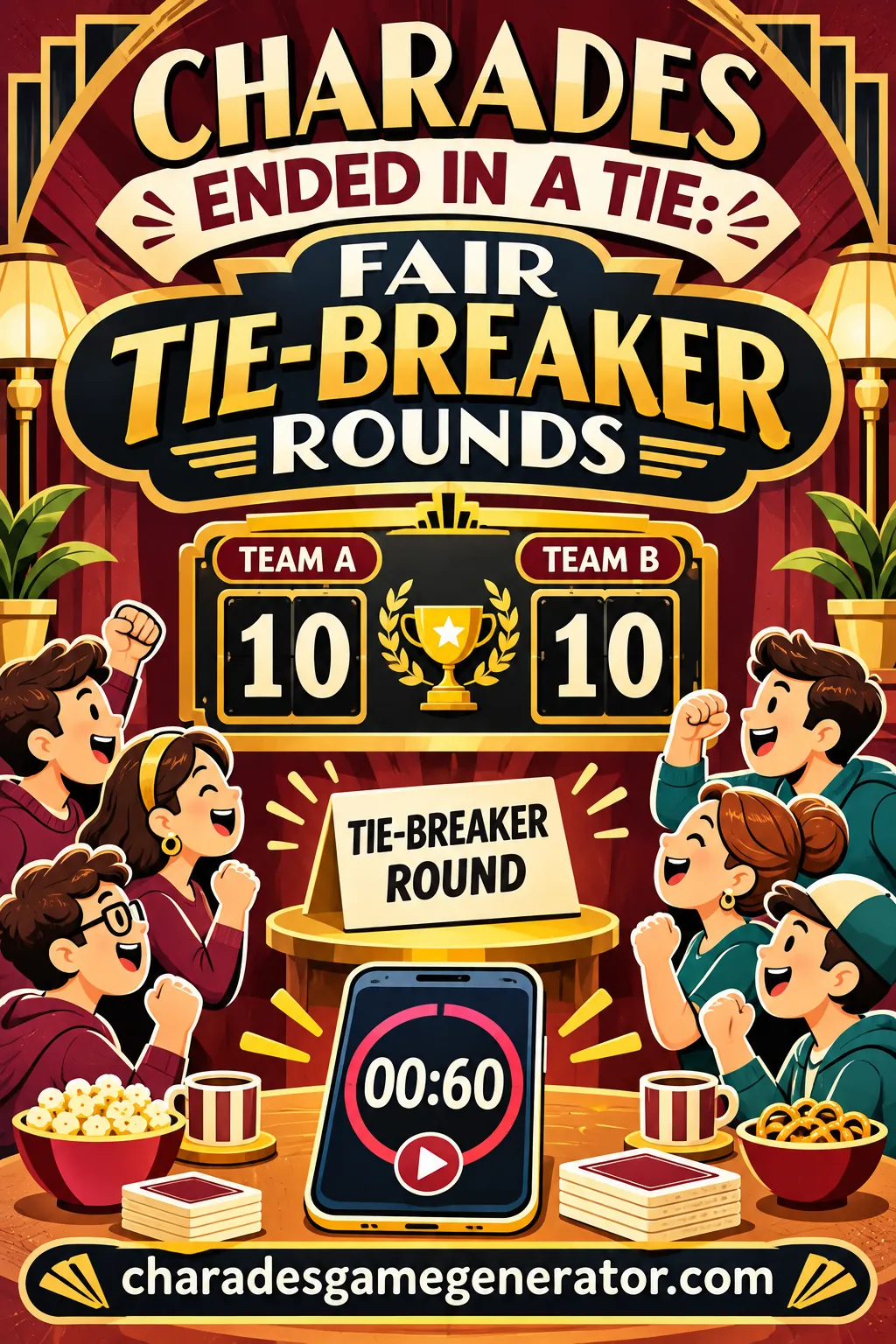
The fairest charades tie breaker is a 60-second sudden-death round: each tied team picks one captain, each captain draws a single Hard word, and the team that guesses its word fastest wins. If neither team gets its word, you run it again with a fresh pair of words. It takes about three minutes, it's easy to explain, and nobody can say the result came down to luck.
You can run the whole thing on the free charades game on our homepage, using its built-in timer and Hard difficulty setting. Below you'll find the sudden-death rules step by step, the exact settings to use, six other tie-breaker formats for different groups, 80 tie-breaker words sorted by level, a host script, and answers to the arguments that come up when the score is level.
Why a Tie Needs a Plan Before the Game Starts
Ties happen more often than you'd think. With 3 or 5 rounds and two evenly matched teams, it's very easy to finish level. One team gets four words in a turn, the other gets four, and suddenly the last round ends with the Current Scores showing the same number for both sides.
That's when the trouble starts. One player suggests "just call it a draw." Someone else wants another full round. A third person thinks the team with fewer skips should win. Each idea is reasonable, which is exactly why they clash. When nobody agreed on a tie-breaker ahead of time, every option looks like it favors somebody.
The fix is simple. Announce your tie-breaker before the first turn. It takes ten seconds: "If we tie, we'll do one sudden-death word per team, 60 seconds, fastest guess wins." Once it's said, nobody can claim the rule was invented to help one side.
A good tie-breaker has four qualities:
- It's quick. People are ready to finish. A tie-breaker should take minutes, not another half hour.
- It's equal. Both teams get the same timer, the same difficulty and the same number of chances.
- It's clear. Everyone knows what counts as a win before it starts.
- It's exciting. The last few minutes of a game should feel like a finale, not paperwork.
Calling it a draw meets the first three, but it usually fails the last one. Most groups want a winner. Sudden death gives them one.
Should you even break the tie?
Not always. For young kids or a relaxed family evening, a tie can be a lovely ending: everyone wins, everyone gets a cheer, and you go to bed happy. If the mood is friendly and nobody is keeping track of a prize, consider saying, "We tied! That means we're all champions tonight."
But if there's a trophy, a bragging-rights tradition, a classroom prize or a group of competitive grown-ups, have a tie-breaker ready. You'll be glad you did.
The 60-Second Sudden-Death Round
This is the main method, and it's the one we'd suggest for most groups. It's fair because both teams face the same conditions, and it's dramatic because everything comes down to one word.
The rules in plain words
- Each tied team picks one captain to act. The team decides; the host doesn't.
- Flip a coin or play rock-paper-scissors to decide which captain goes first.
- The first captain draws one Hard word and has 60 seconds to get the team to guess it.
- The host notes the time when the word is guessed. A phone stopwatch works well for this.
- The second captain does the same, with a new Hard word and a fresh 60 seconds.
- The faster correct guess wins. If only one team gets its word, that team wins.
- If neither team gets its word, both captains draw again for a second sudden-death round.
- No skips. Once a captain sees the word, that's the word.
That last rule matters. Skipping turns a tie-breaker into a hunt for an easy card, and the team that goes second gets to see how many skips the first team used. Locking in the first word keeps it even.
Why one word instead of "most words in a minute"
You might wonder why sudden death uses a single word rather than a regular timed turn where you count words. Both can work, but one word has real advantages:
- It's harder to dispute. There's only one guess to judge, not five or six.
- It's tense. Everyone in the room watches one performance from start to finish.
- Both captains face similar odds. With a single Hard word each, you're comparing two performances, not two runs of luck through the deck.
- It's short. The whole thing, including setup, fits in about three minutes.
If your group prefers counting, the "Overtime turn" format below does exactly that.
What if both teams take exactly the same time?
It almost never happens if you use a stopwatch, but plan for it anyway. If the times match to the second, run another sudden-death round. Don't try to split hairs over tenths of a second unless your stopwatch shows them and everyone agreed to use them.
Sudden-death rules at a glance
| Rule | What to do |
|---|---|
| Who acts | One captain per tied team, chosen by the team |
| Who goes first | Coin flip or rock-paper-scissors |
| Word difficulty | 😤 Hard for both teams |
| Time limit | 60 seconds per captain |
| Skips allowed | None |
| How to win | Faster correct guess, timed by the host |
| If both fail | Draw again for another sudden-death round |
| If both times match | Draw again for another sudden-death round |
| Who judges | The host, or a neutral player not on either team |
How to Set It Up in the Game
You don't need anything special for sudden death. The free online charades game already has the timer, the Hard words and the team turns. You just use it in a slightly different way for the final showdown.
Exact settings for the sudden-death round
When your main game ends in a tie, tap Play Again and set up a short new game just for the tie-breaker:
- Teams: choose 2 (just the tied teams; see below for three-way and four-way ties).
- Category: pick one both teams agree on. A wide category like Actions, Places or Animals keeps it fair, since nobody has a home-field advantage. If your main game used a special theme, such as Christmas or Office Party, you can keep it for the finale.
- Timer: 60 sec.
- Rounds: 3, the shortest option. You'll only use the first turn for each team, so the remaining rounds don't matter. If the first sudden-death round fails to settle it, the next turns are already waiting.
- Difficulty: 😤 Hard.
- Custom words: optional. If you'd rather use the tie-breaker words below, tap ✏️ Add Custom Words, type a few, and tap + Add after each one.
Running the round with the game screen
- The first captain takes the phone. The host opens a stopwatch on a second phone and gets ready.
- When the captain sees the first word, the host starts the stopwatch and says "Go!"
- The captain acts. The team guesses.
- The moment the word is guessed, the captain taps ✓ GOT IT! and the host stops the stopwatch. The captain then puts the phone face down. Any further words that appear during the rest of the turn don't count.
- If the timer ends first, the Time's Up screen appears. That team didn't get its word.
- The host writes down the time, or "no guess."
- Tap Next Team's Turn and repeat for the second captain with a fresh stopwatch.
About the skip button: the game has a ↷ Skip — too hard! button on every card, and in a normal turn that's great. For sudden death, agree out loud that nobody taps it. A captain who skips loses the tie-breaker. It's an honor rule, and because everyone is crowded around watching, it's easy to keep.
If you'd rather not track time
Some groups don't want a stopwatch. That's fine. Use the "first to get it" variation: both captains act their words at the same time, side by side, each with their own team guessing. Whichever team shouts the right word first wins. You'll need two phones running the game, or one phone and a few custom words written on slips for the second captain. It's loud, chaotic and really fun.
Quick settings table by group
| Group | Teams | Category | Timer | Rounds | Difficulty | Tie-breaker format |
|---|---|---|---|---|---|---|
| Family with young kids | 2 | Kids or Animals | 90 sec | 3 | 😊 Easy | Team relay or friendly draw |
| Mixed-age family | 2 | Actions | 60 sec | 3 | 🎲 Mixed | Sudden death |
| Teens | 2 | Movies or Superheroes | 60 sec | 3 | 😤 Hard | Sudden death |
| Competitive adults | 2 | Any | 60 sec | 3 | 😤 Hard | Best of three captains |
| Classroom | 2 | Kids or Places | 60 sec | 3 | 🎲 Mixed | Overtime turn |
| Big party, 3 or 4 tied teams | 3 or 4 | Office Party or Places | 30 sec | 3 | 😤 Hard | Lightning bracket |
For young kids, swapping 😤 Hard for 😊 Easy keeps the finale fun instead of frustrating. A sudden-death word that nobody can guess is no way to end a seven-year-old's birthday party.
Six More Fair Tie-Breaker Formats
Sudden death works for most groups, but it isn't the only option. Here are six other formats, each with its own strengths. Pick one before the game, announce it, and you're covered.
1. Best of three captains
Instead of a single captain per team, three different players act one Hard word each, alternating between teams. Each correct guess within 60 seconds earns a point. After three pairs, the team with more points wins. If it's still tied, go to sudden death.
This takes longer, around eight minutes, but it involves more players and rewards the whole team rather than one star actor. It's a great choice for competitive groups who care about fairness above all.
2. Overtime turn
Each tied team plays one more regular 60-second turn with ✓ GOT IT! and ↷ Skip allowed. The team with more words in its overtime turn wins. If the overtime totals match, play another overtime turn.
This feels familiar because it's just one more round of the game everyone has been playing. It's ideal for classrooms and casual groups. The only downside is that two teams can easily tie again, since you're counting the same way that caused the tie in the first place.
3. Fewest skips wins
If you've been tracking skips during the game, the team with fewer total skips wins. No extra play needed.
This only works if you agreed on it before the game and someone was counting. Don't spring it on people at the end, or the team with more skips will feel ambushed. The game's scoreboard tracks points, not skips, so you'll need someone with a pen.
4. Team relay
Every player on each team acts one word in a row, passing the phone down the line. The team that finishes all its players' words first wins. Use 😊 Easy or 🎲 Mixed words so each player has a fair shot.
It's loud, it's fast, and everyone gets one last moment in the spotlight. Relay works well for families and youth groups, where you want the finale to include the shy players too, not just the confident actors.
5. Lightning bracket (for three or four tied teams)
When three or four teams are tied, pair them up. Each pair plays a sudden-death round, and the winners meet in a final sudden-death round. With three teams, one team gets a bye in the first round, chosen by coin flip or by who had fewer skips during the game.
6. Opponent's choice
Each team writes one tricky word for the other team's captain to act. Both teams use the same timer, and the faster guess wins. Use ✏️ Add Custom Words to type both words in, or write them on slips.
This one is a crowd favorite with teens and adults. Set a clear limit, though: words must be family-friendly, actable and something everyone in the room would recognize. Otherwise you'll get an impossible word, and the round turns into a complaint session.
Comparing the formats
| Format | Time needed | Players involved | Best for | Watch out for |
|---|---|---|---|---|
| Sudden death | About 3 minutes | 2 captains | Most groups | Needs a stopwatch |
| Best of three captains | About 8 minutes | 6 players | Competitive adults | Takes longer |
| Overtime turn | About 3 minutes | 2 actors | Classrooms, casual play | Can tie again |
| Fewest skips | Instant | Nobody | Pre-planned only | Needs a skip count |
| Team relay | 5 to 10 minutes | Everyone | Families, youth groups | Big teams take longer |
| Lightning bracket | 6 to 10 minutes | 4 to 6 captains | 3 or 4 tied teams | Needs a clear bracket |
| Opponent's choice | About 4 minutes | 2 captains | Teens, adults | Unfair word picks |
If you play a lot of quick-fire rounds, our speed charades guide has more fast formats that also double as tie-breakers.
80 Tie-Breaker Words, Sorted by Level
A tie-breaker word should be hard enough to create tension but fair enough that a good actor can get it in a minute. These lists were picked with that balance in mind: every word is concrete, actable and familiar, but each one takes a little creativity. Type a handful into ✏️ Add Custom Words before the finale, or keep this page open and let the host read one to each captain.
Easy tie-breakers (kids and family games)
Use these when young players are on the tied teams. They're simple, but each one has a fun twist to act.
| Set A | Set B | Set C | Set D |
|---|---|---|---|
| Snowball fight | Blowing out candles | Jump rope | Ice skating |
| Brushing hair | Flying a kite | Making a sandwich | Washing a dog |
| Climbing a tree | Riding a horse | Building blocks | Catching a fish |
| Blowing bubbles | Popcorn popping | Scarecrow | Rainbow |
| Bouncing a ball | Tying shoelaces | Zipping a jacket | Licking an ice pop |
Medium tie-breakers (mixed ages)
These work for families with older kids, classrooms and casual adult games.
| Set A | Set B | Set C | Set D |
|---|---|---|---|
| Lighthouse | Parachute | Scuba diver | Car wash |
| Wedding cake | Bowling strike | Rock climbing | Snorkeling |
| Sleepwalking | Hot air balloon | Ferris wheel | Lawn mower |
| Pizza delivery | Haunted house | Garage sale | Fire drill |
| Rowing a boat | Pottery wheel | Magnifying glass | Paper airplane |
| Mailbox | Treasure map | Window washer | Camping tent |
Hard tie-breakers (teens and adults)
These are the true sudden-death words. They're actable, but they make the captain think.
| Set A | Set B | Set C | Set D |
|---|---|---|---|
| Earthquake | Avalanche | Beekeeper | Revolving door |
| Chimney sweep | Ventriloquist | Traffic jam | Lost luggage |
| Bad haircut | Jury duty | Power outage | Static electricity |
| Writer's block | Spring cleaning | Losing your keys | Online shopping |
| Moving day | Spilled glitter | Self-checkout | Parallel parking |
| Echo | Deja vu | Time travel | Gravity |
| Sunburn | Allergy season | Brain freeze | Group photo |
| Lost signal | Fortune cookie | Daylight saving time | Flat tire |
| Stage fright | Autocorrect | Escape room | Monday morning |
That's 20 easy, 24 medium and 36 hard words. For an even bigger pool, the hard charades words list has plenty more challenge words to pull from.
How to pick a fair pair
When you use your own list, try to give both captains words of similar difficulty. A few quick guidelines:
- Match the type. If one captain gets an object ("lighthouse"), give the other an object too, not an idea like "deja vu."
- Match the length. One-word cards against one-word cards, two-word cards against two-word cards.
- Let the host draw blind. The host reads two words off the list without looking at what's next, then flips a coin to see which captain gets which.
- Or let the game pick. Using the game's own Hard words means nobody in the room chose the word, which removes any suspicion of favoritism.
Fairness Rules and Common Tie-Breaker Arguments
The final minutes of a close game bring out everyone's competitive side. Here are the arguments that come up most, and how to settle each one in a sentence.
"Going second is an advantage!"
It can be, a little, since the second captain knows the time to beat. Two easy fixes: use a coin flip so the order is random, or don't tell the second team the first team's time until both are done. The host writes it down silently and reveals both times together. That second option also makes for a great dramatic reveal.
"Their word was easier than ours!"
This is the most common complaint. The best defense is letting the game draw the words on Hard difficulty, so no person chose them. If you're using a custom list, use the "fair pair" tips above. Either way, the rule is set before anyone sees a word, and it doesn't change afterward.
"The captain mouthed the word!"
Same as in the regular game: mouthing, whispering or spelling with fingers doesn't count. In sudden death, a broken rule means that team loses the tie-breaker, so be sure everyone knows that before the round starts. Keep the tone light, but hold the line.
"We guessed it right as the timer ran out!"
The guess must be complete before the Time's Up screen appears. The host's stopwatch is the tiebreaker for the tie-breaker. If the host honestly can't tell, run another sudden-death round rather than awarding the win on a coin toss.
"That was close enough!"
Decide before the finale what counts as a correct guess, and use the same standard you used all game. If plurals and verb endings counted in the main game, they count in sudden death too. Changing the rules for the last round is the fastest way to start an argument.
"The other team was shouting guesses to confuse us!"
Only the acting team may guess. The other team stays quiet during sudden death. A good host makes this the opening line: "Opposing team, hands in your laps and lips sealed." If they interrupt, the acting team gets a fresh word and a fresh 60 seconds.
"Why does our worst actor have to go?"
They don't. Each team picks its own captain. Some teams pick their best actor, some pick their best guesser's favorite partner, some pick the youngest player for fun. It's the team's call, and they make it before seeing the word.
"We tied again!"
It happens. Just run another round with fresh words. To keep it from going on forever, set a limit: after three tied sudden-death rounds, call it a shared victory. Most groups never get that far, but it's nice to have a finish line. If you want to set up scoring rules that make ties less likely in the first place, the charades scoring guide covers bonus points and round totals.
A quick fairness checklist
Read this through before the finale starts:
- Tie-breaker format announced before the main game.
- Captains chosen by their own teams.
- Order decided by coin flip or rock-paper-scissors.
- Same timer, same difficulty, same category for both teams.
- No skips during sudden death.
- Opposing team stays silent.
- Host judges and times every turn.
- Same guess standard as the main game.
Variations by Age and Group Size
The right tie-breaker depends a lot on who's in the room. Here's how to adapt it.
Preschoolers and young kids
Little ones don't need sudden pressure at the end of a game. Use a team relay with 😊 Easy words, a 90 sec timer and plenty of cheering. Or skip the tie-breaker entirely and declare a group win. If you'd like a winner anyway, let both teams act the same easy word at the same time and give everyone a high five when it's guessed. A shared finish can be the happiest one.
Older kids and tweens
This age loves a real showdown. Sudden death with 🎲 Mixed words works great, and kids enjoy being the timekeeper or the host. Let them choose their own captains, and give the losing team a "next game we'll pick the category" consolation.
Teens
Teens usually want the drama. Use 😤 Hard words, opponent's choice or best of three captains. Make the reveal of the times a big moment. A quick countdown from the host before revealing who won goes a long way.
Adults
Adults often care more than they let on. Announce the tie-breaker early, stick to it, and keep it short. For a dinner party, sudden death is ideal. For a competitive game night, best of three captains feels more thorough. A 60 sec timer is the sweet spot for both. Our guide to choosing a charades time limit explains why that length works so well for most players.
Two or three players
With very small groups, there may not be teams at all. If two players are tied for points, each one acts one Hard word for the other players to guess, and the faster guess wins. With only two players, each acts one word for the other, and the faster guesser takes the win.
Large groups and three or four teams
Use the lightning bracket. Pair the tied teams, run sudden-death rounds, then hold a final. Keep everyone involved by letting eliminated teams act as judges or timekeepers. In a hall or classroom, putting the finalists in the middle of the room with everyone else in a circle around them makes the finale feel like a real event.
Mixed ages on each team
When every team has both kids and adults, let each team decide whether a child or grown-up is captain. Many families love having the youngest player act the final word, with the whole team cheering them on. It turns the tie-breaker into a memory instead of a contest.
A Host Script for the Final Showdown
The host's words set the mood. Here's a script you can read word for word or adapt to your own style.
Before the main game starts:
"One quick rule before we play. If the scores are tied at the end, we'll have a sudden-death round. Each team picks a captain, each captain gets one Hard word and 60 seconds, no skips, and the fastest guess wins. If nobody gets it, we go again. Everyone good? Great."
When the game ends in a tie:
"Well, look at that. It's a tie! You know what that means. Sudden death! Teams, you've got thirty seconds to choose your captain."
Before the coin flip:
"Captains, step up. Call it in the air. Winner chooses whether to go first or second."
Before the first captain acts:
"Here's how it works. Your team only. The other team stays silent. You get one word, no skips. The clock starts when you see the word. Ready? Go!"
After the first captain:
"Time is written down. I'm not telling anyone yet. Second captain, you're up."
The reveal:
"Team one guessed their word in... (pause) ...thirty-four seconds. Team two guessed theirs in... (longer pause) ...twenty-eight seconds! Team two wins!"
If nobody guessed:
"No guesses from either team. That means we go again! Fresh words, same rules."
Closing:
"That was a great game, and an even better finish. Thanks for playing fair and keeping it fun. Want a rematch?"
A rematch is just one tap away. Open the charades game, set your teams, choose your category and timer, and announce your tie-breaker before the first turn. Then let the best captain win.
Frequently Asked Questions
What is the fairest charades tie breaker?
A 60-second sudden-death round is the fairest for most groups. Each tied team picks a captain, each captain acts one Hard word with no skips, and the faster correct guess wins. If neither team gets its word, both draw again.
How do you break a tie in charades with three teams?
Use a lightning bracket. Pair two teams for a sudden-death round while the third gets a bye chosen by coin flip, then the winner faces the third team in a final round. With four tied teams, run two pairs and a final.
Can you play overtime in charades?
Yes. An overtime turn gives each tied team one more regular timed turn, and the team with more correct words wins. It's simple, but teams can tie again, so keep sudden death ready as a backup.
Should skips be allowed in a tie-breaker round?
Most groups say no. Skipping lets a captain hunt for an easy word, and the second team gains an advantage by seeing how many skips the first team used. Locking in the first word keeps both sides even.
Who should act in a charades tie-breaker?
Each team chooses its own captain. Some teams pick their strongest actor, while others give the honor to the youngest player or the person who hasn't had a turn in a while. The host never chooses for a team.
How long should a tie-breaker round be?
Sixty seconds per captain works well for most groups. Young kids may need 90 seconds, while very fast groups can try 30 seconds per word. The whole finale, including choosing captains, usually takes three to five minutes.
What if both teams guess at the same time?
If you're timing with a stopwatch, the shorter time wins. If both times match or you can't tell, run another sudden-death round with fresh words. Avoid settling it with a coin toss, since that feels unfair after a close game.
Is it okay to just call a tie a draw?
Absolutely. For young kids or relaxed family evenings, a shared win can be the nicest ending. Just agree before the game whether you'll break ties, so nobody feels the rule changed at the last minute.
How do you stop ties from happening so often?
Play an odd number of rounds, such as 5 or 7, and keep the same timer for every team. You can also add a small bonus, like an extra point for finishing a turn with no skips. Fewer ties means fewer tie-breakers, though many groups end up loving the sudden-death finale.