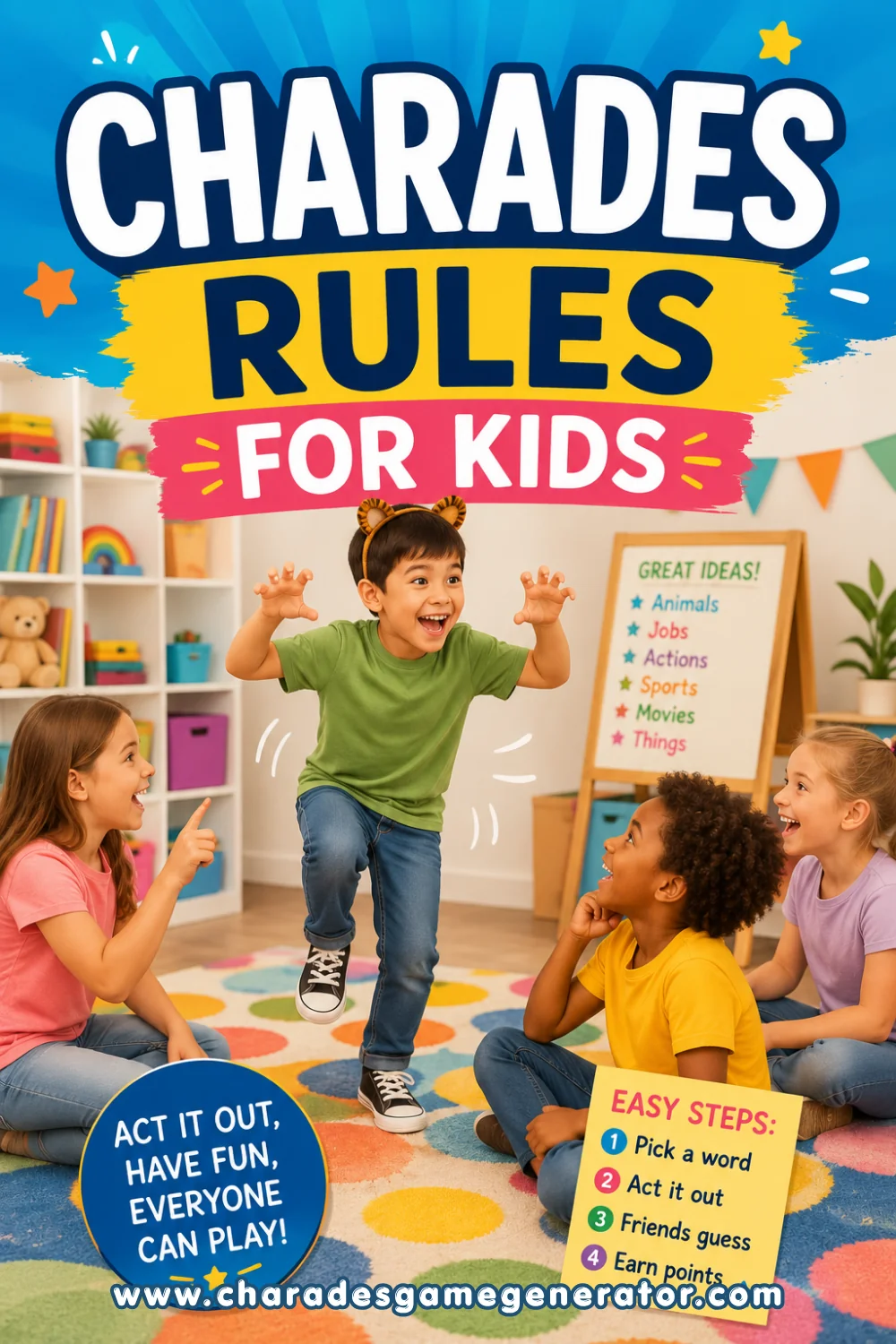
Family Charades: 100 Word Ideas & Rules for All Ages

Family charades is charades played with mixed ages in the same room — one person acts out a prompt silently while their team guesses — with the prompt list and the rules adjusted so a six-year-old and a grandparent can genuinely compete. That adjustment is the whole trick. Ordinary charades with a single pile of cards fails a family within four turns, because the moment a first-grader draws "The Shawshank Redemption," the game stops being fun for them and awkward for everybody watching.
I've run this on Christmas Eve with fourteen people ranging from four to eighty-one, and at a rained-out family reunion where it saved the afternoon. Here's everything that made it work: the prompts, the timing, the team structure, and the handful of house rules that keep the little ones in it.
The Rules, Precisely
Teams. Two teams. Deal them out so each team has a similar mix of ages — never adults versus kids, which produces a blowout in either direction.
A turn. One player draws a prompt, gets fifteen seconds to think, then acts it out silently while their own team guesses. Correct guess before the buzzer scores a point.
Time limit. Ninety seconds for kids under eight, sixty seconds for everybody else. If a round is dragging, drop to forty-five and watch the energy jump.
Silence. No talking, no mouthing words, no sound effects, no spelling in the air. This is the rule that makes it charades instead of a guessing game.
No pointing at real objects. You can't point at the dog to clue "dog" or at Grandma to clue "grandmother."
Scoring. One point per correct guess. Add a bonus point for anything guessed under twenty seconds. Play to fifteen, or for a fixed number of rounds so you can promise a clear ending — important when small children are involved and bedtime is real.
The Standard Gestures Everyone Should Learn First
Spend two minutes on this before you start. It doubles the speed of every round.
| Gesture | Meaning |
|---|---|
| Fingers held up | How many words in the prompt |
| Fingers up, then tapped on the forearm | Which word I'm acting now |
| Tapping fingers on the forearm | How many syllables |
| Tugging your earlobe | "Sounds like…" |
| Thumb and finger pinched together | A little word — a, the, of, and |
| Both arms sweeping wide | "The whole thing at once" |
| Cranking an old movie camera | It's a movie |
| Palms open like a book | It's a book |
| Drawing a rectangle in the air | It's a TV show |
| Hand cupped by the mouth | It's a song |
| Beckoning toward yourself | "Closer, keep going" |
| Touching your nose | "Exactly right" |
Teach kids the nose-touch first. It's their favorite and they'll use it constantly.
Keeping Young Kids Genuinely In the Game
This is the part most guides skip, and it's the part that decides whether family charades works. Six things, all tested.
1. Sort the prompts into age piles before you start. Not one bowl — three. A green bowl for ages 4–7, a yellow for 8–12, a blue for teens and adults. Everyone draws from their own bowl. This single change fixes about eighty percent of the problems.
2. Let pre-readers be whispered to. An adult reads the card silently into the child's ear. Nobody minds. The alternative is a four-year-old staring at a card they can't read while a timer runs.
3. Give kids the longer clock. Ninety seconds, and say so publicly so it doesn't feel like a secret handicap. "Kids get ninety, grown-ups get sixty, that's the deal."
4. Allow a tag-team turn. A child under eight can bring a partner up with them to act together. It removes stage fright entirely, and two people acting "elephant" is funnier than one.
5. Let them pass once per round. Unlimited passes ruin the game. One pass saves a kid from a miserable minute.
6. Give the youngest player the last turn of the game. They get the loudest cheer either way, and they go to bed thinking they're the reason the team won.
100 Family Charades Prompts by Age
Ages 4–7 — animals and simple actions (30)
Every one of these is a single physical thing a small child can show with their body.
- Elephant
- Monkey
- Snake
- Frog
- Cat
- Dog
- Chicken
- Penguin
- Bird flying
- Fish swimming
- Bunny hopping
- Bear
- Brushing your teeth
- Eating spaghetti
- Riding a bike
- Sleeping
- Swimming
- Jumping rope
- Blowing out birthday candles
- Opening a present
- Washing your hands
- Building a snowman
- Putting on shoes
- Drinking through a straw
- Tying your shoes
- Waving goodbye
- Being very cold
- Being very hot
- Tiptoeing
- Baking cookies
Ages 8–12 — jobs, sports, and everyday scenes (25)
- Firefighter
- Astronaut
- Chef
- Dentist
- Mail carrier
- Lifeguard
- Playing basketball
- Bowling
- Skateboarding
- Fishing
- Surfing
- Ice skating
- Playing the drums
- Playing the violin
- Taking a selfie
- Doing homework
- Mowing the lawn
- Raking leaves
- Walking a dog that pulls
- Carrying too many grocery bags
- Being stuck in an elevator
- Getting a shot at the doctor
- Losing a tooth
- Missing the school bus
- Camping in a tent
Teens and adults — movies, TV, and books (25)
- Jaws
- Titanic
- Home Alone
- The Wizard of Oz
- Jurassic Park
- Finding Nemo
- The Lion King
- Frozen
- Toy Story
- Star Wars
- Ghostbusters
- Back to the Future
- The Sound of Music
- Rocky
- E.T.
- Charlotte's Web
- Harry Potter
- The Hunger Games
- Little Women
- Where the Wild Things Are
- Wheel of Fortune
- The Great British Bake Off
- Shark Tank
- Jeopardy
- American Idol
Anyone — funny scenes for mixed teams (20)
These are the crowd-pleasers. Put them in a shared bowl that any age can draw from.
- A cat knocking things off a table
- Trying to fold a fitted sheet
- Someone who ate something way too spicy
- Waiting in a very long line
- Sneaking a cookie before dinner
- A dog seeing its reflection
- Trying to take a family photo
- Assembling furniture with no instructions
- Someone who sat on a wet bench
- Losing your keys
- Trying not to laugh in a quiet room
- Getting gum stuck on your shoe
- A phone ringing at the worst moment
- Someone who just woke up
- Reaching for something on a high shelf
- Walking into a spider web
- A very slow internet connection
- Grandma finding a good sale
- Everyone arguing over the thermostat
- The moment the wifi comes back
Rather than writing all of that out by hand, you can shuffle a family-friendly pack at charadesgamegenerator.com and have it deal prompts one at a time on a phone or tablet — handy when the game happens on a whim and nobody has scissors. If you would rather have charades to print, paste the lists above into a document, set them in a large font, and cut the slips before anyone arrives — paper still beats a phone when the room is loud and somebody's battery is dying.
Team Setup by Family Size
| People | Teams | Time per turn | Notes |
|---|---|---|---|
| 4–5 | No teams — play cooperatively | 60 sec | Everyone guesses, track total correct |
| 6–8 | 2 teams of 3–4 | 60 / 90 sec | Every person acts twice per round |
| 9–14 | 2 teams | 60 / 90 sec | The sweet spot for family charades |
| 15–24 | 3 teams | 45 / 75 sec | Shorter clock or it runs too long |
| 25+ | 4 teams | 45 sec | Consider reverse charades instead |
For four or five people, don't force teams. Play cooperatively: one person acts, everyone else guesses, and the family tries to beat its own record for correct guesses in ten minutes. Little kids especially prefer this — nobody loses.
A Session That Actually Holds Attention
Ninety minutes of charades is too long for anybody. Here's a forty-five-minute shape that ends while people still want more.
Warm-up (4 min). Three animal prompts, no scoring. Let the youngest go first.
Round one — everyone's own age bowl, 60/90 sec (12 min). Standard scoring.
Lightning round — the funny-scenes bowl, 30 seconds each (6 min). No think time, draw and go. This is where the room gets loud.
Round two — age bowls again, double points (12 min). The comeback round.
Finale — reverse charades, one turn per team (6 min). The whole team acts, one person guesses. Chaotic, and it gets the shy relatives involved because they're hidden in the crowd.
Then stop. Announce the score, hand out something small, and put the bowls away while people are still laughing. The instinct to run "one more round" is how family game night turns into a tired argument.
Variations Worth Knowing
Reverse charades. The whole team acts a single prompt and one designated player guesses. The best variation for families, hands down — no one is on the spot alone, and watching four people try to be a washing machine is genuinely funny.
Charades relay. Team members line up. The first person sees the prompt and acts it for the second, who acts it for the third, without ever saying it. The last person guesses. A telephone game with bodies. Ridiculous.
Draw or act. The player chooses to act it or draw it. Rescues the family members who hate performing but will happily sketch.
Two-card draw. The actor draws two prompts and picks one. Eliminates "I got a terrible card" completely, and costs nothing.
Category rounds. Announce that this whole round is animals, or movies, or holidays. Guessing gets much faster, which is great when energy is flagging.
Holiday edition. Christmas morning, Thanksgiving dinner prep, trick-or-treating, wrapping a gift badly, untangling lights, carving a turkey, the airport at the holidays. Themed rounds land well at gatherings because everyone in the room has lived them.
Shared-interest round. Build one bowl out of something the whole family already knows. Bible charades ideas work exactly the way the holiday round does — Noah's ark, parting the Red Sea, David and Goliath, the loaves and fishes — because nobody needs the story explained before they can guess it.
Grandparents' round. Prompts from an older generation — rotary phone, drive-in movie, TV antenna, roller rink, home perm. The kids fail hilariously and the grandparents finally get a round they own.
What Actually Goes Wrong
- One shared bowl. A young child draws an adult movie title, freezes, and loses interest in the whole game. Sort the prompts.
- Adults versus kids teams. Somebody gets crushed. Mix the ages.
- Abstract prompts. "Happiness," "friendship," "patience" — unactable. Every prompt should be a thing you can see happening.
- No time limit. Turns stretch to three minutes, the guessing team gets bored, and the pace dies.
- Unlimited passes. The pile gets picked over and the same easy cards circulate.
- Letting the silence rule slide. One person adds a sound effect, then everyone does, and it becomes a shouting match.
- Playing too long. Forty-five minutes is a great family charades session. Ninety is a hostage situation.
- Not clearing a space. People need to lie down, crawl, and flail. Move the coffee table before you start, not after somebody hits their shin on it.
Room and Prep Notes
- Acting space: six feet by six feet, minimum, with the actor facing their own team.
- Timer: something everyone can see. A phone face-down on the arm of a chair causes arguments.
- Timekeeper: ideally a person not on either team. A grandparent who'd rather watch than act is perfect for this and it gives them a real job.
- Score: write it somewhere visible. Kids care about the score far more than adults do.
- Prompt slips: fold them. People peek, including adults, especially adults.
FAQ
How do you play family charades with different ages? Sort the prompts into separate bowls by age — one for young children, one for older kids, one for teens and adults — and have each person draw from their own. Give kids under eight ninety seconds instead of sixty, and let them act with a partner if they want. Mix ages across teams rather than adults against children.
What are good family charades ideas for young children? Single physical things a small body can show: elephant, monkey, frog, penguin, brushing your teeth, eating spaghetti, riding a bike, blowing out birthday candles, building a snowman. Avoid movie and book titles for anyone under about eight.
How long should a family charades turn be? Sixty seconds for teens and adults, ninety for children under eight, and thirty for a fast lightning round. Cap the actor's planning time at fifteen seconds before starting the clock, or turns stretch out and the guessing team loses interest.
How many people do you need for family charades? Six is the comfortable minimum for two teams. With four or five, skip teams entirely and play cooperatively — one person acts, everyone guesses, and the family tries to beat its own record. It scales up to about twenty-four across three teams.
Can you play family charades without cards? Yes. Have each team secretly write prompts for the other team, or use a free generator on a phone that deals prompts one at a time. Writing prompts for the opposing team is a good five-minute activity on its own and gets everyone invested.
What do you do when a shy family member won't act? Offer three outs: reverse charades where the whole team acts together, the draw-instead-of-act option, or the job of timekeeper and scorekeeper. Never force a turn — one uncomfortable person changes the mood of the entire room.