Telephone Charades: The Chain Version That Gets Chaotic
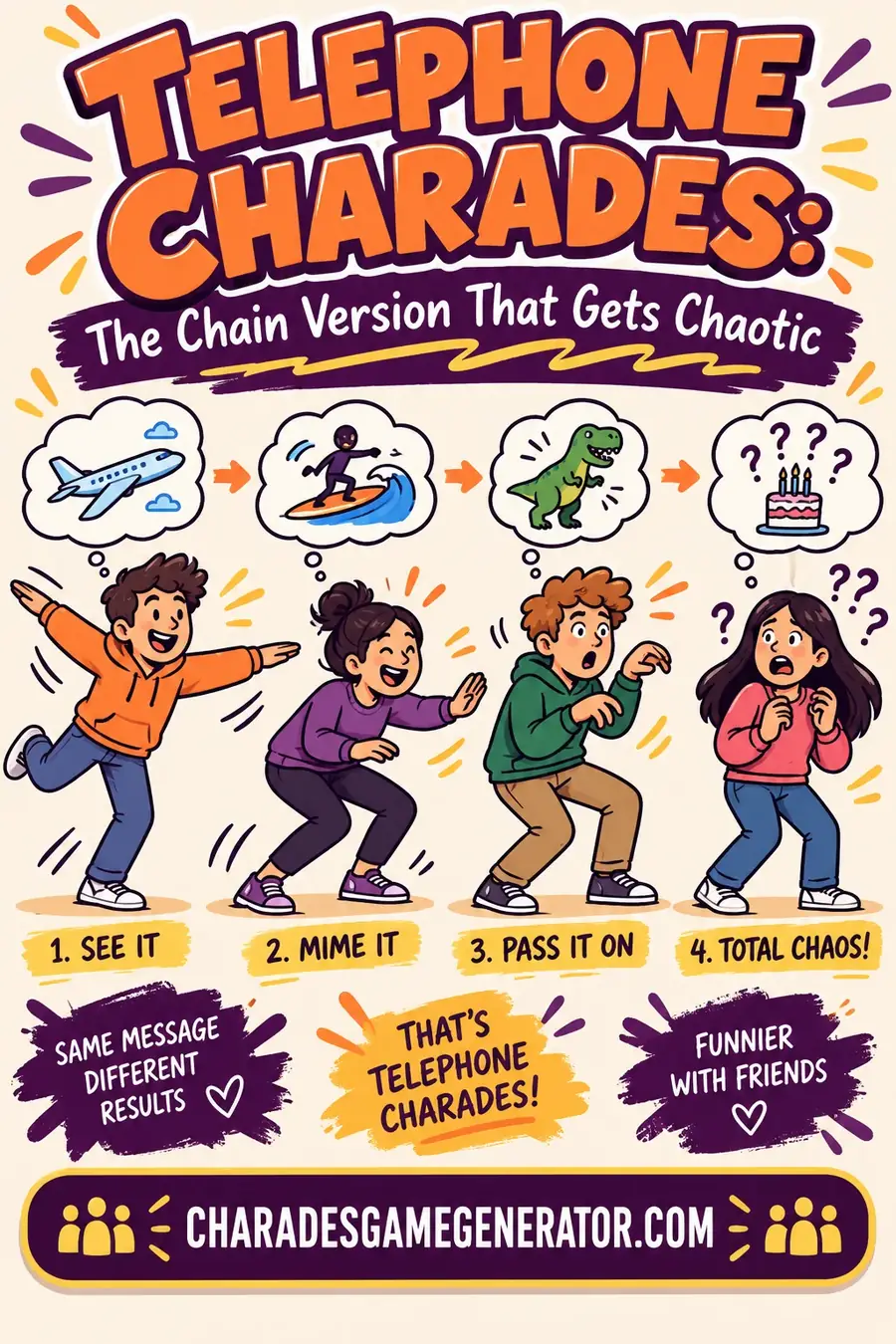
Telephone charades is regular charades passed down a chain: one person acts the clue for the next, who acts what they think they saw for the next, and so on — with only the final person guessing out loud. The comedy comes from watching a clear, recognizable mime degrade into something unrecognisable over four or five people.
It's the rare party game that's funnier when people are bad at it.
The Rules
- Four to six players line up, all facing the same direction except the first.
- Everyone except player one closes their eyes or faces away. Only player one and the audience see the clue.
- Player one taps player two, who turns around and watches player one act the clue. No sound, no lip-syncing, no pointing at objects.
- Player two then taps player three and acts out what they think they just saw.
- Continue down the chain. Each person only ever sees the person immediately before them.
- The last player guesses out loud. That's the payoff.
- Then walk it backwards. Ask each player in reverse order what they thought they were acting. This is the funniest part and skipping it wastes the whole round.
Why the Backwards Reveal Matters
Most groups run the game and stop at the final guess. That's a mistake.
The real comedy is in the divergence — finding out that player two thought it was "milking a cow," player three thought it was "playing an accordion," and player four thought it was "an argument." The transformation is the joke, and you only get it by asking each person in turn what they believed they were doing.
Ask them in reverse order, from last to first, so the reveal builds toward the original clue.
Clue Selection
This is where most rounds fail before they start.
Good telephone charades clues have one clear physical action with distinctive detail. Something that can survive one round of copying but not four.
Strong clues: - Milking a cow - Riding a mechanical bull - Fishing and catching something huge - Conducting an orchestra - Getting attacked by bees - Ice skating badly - Making a pizza from scratch - Trying to get a cat into a carrier - Rock climbing - Blowing up a balloon and losing it - Parallel parking - Washing a very large dog - Surfing - Playing tug of war alone - Chopping wood
Weak clues: abstract concepts (freedom, jealousy), anything requiring dialog, single simple actions (walking, sleeping) that survive the chain unchanged, and anything that needs cultural knowledge some players lack.
The test: if a clue is too simple, it arrives intact and there's no joke. If it's too abstract, it dies at player two and the rest is noise. You want it to degrade, not vanish.
If you'd rather not pick clues yourself, a charades generator deals one instantly, which also stops the clue-picker from unconsciously choosing something too easy.
Group Size
| Players in chain | Result |
|---|---|
| 3 | Usually arrives intact — not much comedy |
| 4 | Good, mild degradation |
| 5 | The sweet spot |
| 6 | Excellent chaos |
| 7+ | Often unrecognisable by the middle, and the chain drags |
Five is the reliable number. With a bigger group, run two chains simultaneously or rotate people in and out rather than making one enormous chain.
Running It Well
Set a per-person time limit — 30 to 45 seconds. Without one, players over-explain and the mime gets longer and less clear at each step, which drags the round.
Have the audience stay quiet. Reactions and laughter from watchers tip off the next player in the chain that something specific happened. Half the fun for the audience is having to suppress it.
Rotate the starting position each round. Being first is the easiest job and being last is the funniest; everyone should get both.
No talking, no lip-syncing, no pointing at real objects. The standard charades rules apply and are what force creativity.
Film it if the group is comfortable. This is one of the rare party games that's genuinely funny on replay, because you can watch the transformation happen in sequence.
Variations
Two-team race. Two chains, same clue, first to a correct final guess wins. Adds pressure and speeds it up considerably.
Written finish. The last player writes their guess rather than saying it, revealed after the backwards walk-through. Builds anticipation.
Themed rounds. All clues from one category — sports, kitchen activities, animals. Slightly easier, useful for younger groups.
Sound version. Same chain structure but with sound effects instead of mime, no words. Different skill, equally chaotic.
Two clues at once. Start a clue from each end of the line simultaneously, meeting in the middle. Genuinely confusing and best saved for a group already warmed up.
Why It Works Better Than Standard Charades
Nobody performs alone. In regular charades, one person acts while everyone watches and judges. Here, everyone is both performer and audience, which lowers the stakes considerably for self-conscious players.
Being bad is the point. A poor mime produces a funnier result than a good one, which removes the pressure that keeps some people out of standard charades entirely.
The payoff is shared. No individual wins or loses — the group collectively produces the joke.
For standard charades word lists and rules, see good charades ideas.
Why the Game Works
The mechanic is worth understanding, because it explains how to run it well.
It's a degradation game, not a performance game. The comedy comes from information loss across a chain, which means the interesting content is generated by the group collectively rather than by any individual being funny. Nobody has to be good at charades for the round to work.
It removes the spotlight. Standard charades puts one person in front of an audience while everyone judges. Telephone charades has each person performing to exactly one viewer, which is a completely different social ask — and considerably easier for anyone self-conscious.
Failure is the point. In standard charades, failing to convey the clue is a failure. Here it's the entire joke. That inversion means the pressure disappears, and people who refuse to play normal charades will often play this.
The reveal is collective. No individual wins or loses. The group produces a result together and finds out what happened together.
Group Management
Five in the chain is the sweet spot. Four works, six produces excellent chaos, seven or more usually degrades to unrecognisable too early and the round drags while people wait.
With a large group, run two chains simultaneously and compare results. Two chains starting from the same clue and arriving at wildly different places is funnier than one long chain.
Rotate positions every round. First is the easiest job and last is the funniest. Everyone should get both.
Keep the waiting short. The players at the end of the chain are standing with their eyes closed for several minutes. A 30-45 second cap per person keeps it moving.
Have the audience suppress reactions. Laughter tips off the next person that something specific happened. Half the fun for watchers is having to hold it in.
Clue Selection in Detail
The single biggest factor in whether a round works.
Too simple and it survives intact. "Walking" arrives at the end unchanged and there's no joke. The clue needs enough component parts that something can go wrong.
Too abstract and it dies immediately. "Jealousy" fails at player two and the rest of the chain is noise.
The sweet spot is a specific physical action with distinctive detail. Milking a cow. Conducting an orchestra. Getting attacked by bees. Parallel parking badly. These have multiple components — a posture, a motion, a context — and the components degrade at different rates, which is what produces the transformation.
Two-part clues work especially well. "A ninja ordering coffee." "Grandma skateboarding." The mismatch between the two elements is usually the first thing lost, which produces a satisfying divergence.
If picking clues yourself is slowing things down, a charades generator deals one instantly and removes the tendency of a human picker to unconsciously choose things that are too easy.
Variations Worth Trying
Two-team race. Two chains, same clue, first to a correct final guess wins. Adds pressure and speeds things up considerably, though it slightly reduces the comedy since people rush.
Written finish. The last player writes their guess rather than saying it, revealed after the backwards walk-through. Builds anticipation and makes the reveal a proper moment.
Themed rounds. All clues from one category — sports, kitchen activities, animals, jobs. Slightly easier, and useful for younger groups who benefit from a narrower field.
Sound telephone. Same chain structure but with sound effects instead of mime, no words. A completely different skill and equally chaotic.
Double-ended. Start a clue from each end of the line simultaneously, meeting in the middle. Genuinely confusing and best saved for a group already warmed up.
Drawing telephone. The chain passes drawings rather than mimes. Slower, quieter, and produces an artifact you can keep — a good option for a group that finds physical performance too much.
Reverse reveal. Instead of walking backwards through the chain, have everyone act out what they thought they were doing simultaneously. Chaotic, fast, and funny in a different way.
Common Problems
The clue arrives intact. The clue was too simple. Pick something with more component parts.
The clue dies at player two. Too abstract. Physical actions only.
People peek. Position the line so each person genuinely can't see past the person in front, or have them face away until tapped.
The chain drags. Impose a per-person time limit and stick to it.
Someone refuses to act. Let them be first in the chain — that position sees the written clue and performs to one person, which is the lowest-pressure role available.
The audience gives it away. Reactions are the biggest leak. Ask watchers to stay quiet until the final guess, which is genuinely hard and part of the fun.
Setting Up the Room
Line, not circle. A circle lets people see past the person in front. A straight line facing one direction is the correct arrangement.
Enough space between players that gestures don't overlap and nobody is crowded.
A clear performance space at the front where the audience can see but the chain can't.
Good lighting. Sounds trivial and matters — mime is entirely visual, and a dim room loses detail that would otherwise transmit.
Somewhere for the clue. Written on a card or a phone, shown only to player one and the audience.
A Final Note
The step most groups skip is the backwards walk-through, and it's where the actual comedy lives. Finding out that a clue about milking a cow passed through "playing an accordion" and "an argument" before arriving at "washing a dog" is the entire payoff. Don't stop at the final guess.
Running Charades: The Relay Cousin of This Game
If telephone charades is too slow for a large, restless group, running charades is the version to reach for.
The setup: teams sit at one end of the room, and a host stands at the other with a stack of clues face down. One player from each team runs to the host, reads a clue silently, runs back, and acts it out for their team. As soon as the team guesses, the next player runs. First team through the stack wins.
Why it works where telephone charades does not:
- Everyone acts. Nobody sits through six turns waiting for their moment.
- It burns energy. For a room of kids, a youth group, or a corporate day, that is the entire point.
- It scales. Two teams or six, ten players or forty, the format holds.
Two practical notes. Keep clues short — a runner has to hold the phrase in memory across the room, so three words is the ceiling. And clear a genuine lane between the teams and the host, because the failure mode of running charades is not confusion, it is collisions.
Backwards Charades Topics That Work in a Group
Backwards charades inverts the whole game: the entire team acts, and one person guesses. It sounds like a small change and it is not — a group of six all miming the same clue simultaneously produces a very different kind of chaos than one performer does.
Because the acting is a crowd, the clue has to have parts. The best backwards charades topics are scenes and systems rather than single objects, so that different people can take different components:
- Places with roles: an airport, a hospital emergency room, a restaurant kitchen, a courtroom, a farm.
- Events: a wedding, a rock concert, a fire drill, a parade, a traffic jam.
- Machines and systems: a car wash, a factory line, a washing machine, a solar system.
- Sports and games: a soccer match, bowling, a tug of war, a marathon.
- Weather and nature: a thunderstorm, a blizzard, a swarm of bees.
Skip the abstract nouns entirely here, and skip anything a single mime does perfectly well — "brushing teeth" gives five people nothing to divide up. Thirty seconds is usually enough per clue, since a whole team acting gets there fast or not at all.
Frequently Asked Questions
How many people do you need for telephone charades? Five in the chain is ideal. Four works, six produces excellent chaos, and beyond seven the clue usually becomes unrecognisable too early and the round drags.
What makes a good telephone charades clue? One clear physical action with distinctive detail — milking a cow, conducting an orchestra, getting attacked by bees. Too simple and it survives the chain intact; too abstract and it dies immediately.
Do you tell everyone the clue at the end? Yes, and more importantly, walk backwards through the chain asking each player what they thought they were acting. That reveal is the funniest part of the game and it's the step most groups skip.
Can you play telephone charades with kids? It works well with children from around age seven or eight, using simple physical clues. Shorter chains of four suit younger groups, since long chains produce a result too disconnected from the original to feel satisfying.