Charades Category Ideas: 40 Themes and How to Build Your Own
A charades category is a promise you make to the guessers: whatever this card says, it belongs to this world. That promise is the entire reason categories exist, and it's why the best charades category ideas are narrow enough to guide a guess but wide enough to hold thirty cards. Below are forty categories that hold up in real rooms, sorted by who they suit, plus the method for sizing one to your group and inventing a house category for a specific party.
Categories do more work than most people realize. Announce "animals" before a turn and a mediocre mime becomes guessable, because the room has stopped considering every noun in English and started considering about two hundred. Announce nothing, and even a good mime can die.
What a Category Is Actually For
A category narrows the guessing space, which is the only lever you have for making charades easier or harder without changing the words themselves.
Take "Frozen." Handed to a player cold, it's a hard card — is it a movie, a state of matter, a feeling? Handed to a player under the heading "Animated Movies," it's a two-second card.
That's the trade. Wide categories make the game harder and the successes more impressive. Narrow categories make it faster and friendlier. You choose the width based on who's in the room, and you can change it mid-game.
Three things a good category does:
- It bounds the guesses without giving the answer away.
- It's known by everyone playing. A category the room can't picture is worse than no category.
- It has depth. If you can only think of nine examples, it's not a category, it's a list.
40 Charades Category Ideas, Sorted by Room
Here are forty charades category ideas that survive contact with real players. The energy column tells you what the category does to the pace — loud and physical, or slow and thoughtful.
| Category | Best for | Energy | Depth |
|---|---|---|---|
| Animals | Everyone, especially under 8 | High | Enormous |
| Everyday Actions | Beginners of any age | Medium | Enormous |
| Occupations | Ages 7+ | Medium | Large |
| Movies | Ages 10+ | High | Enormous |
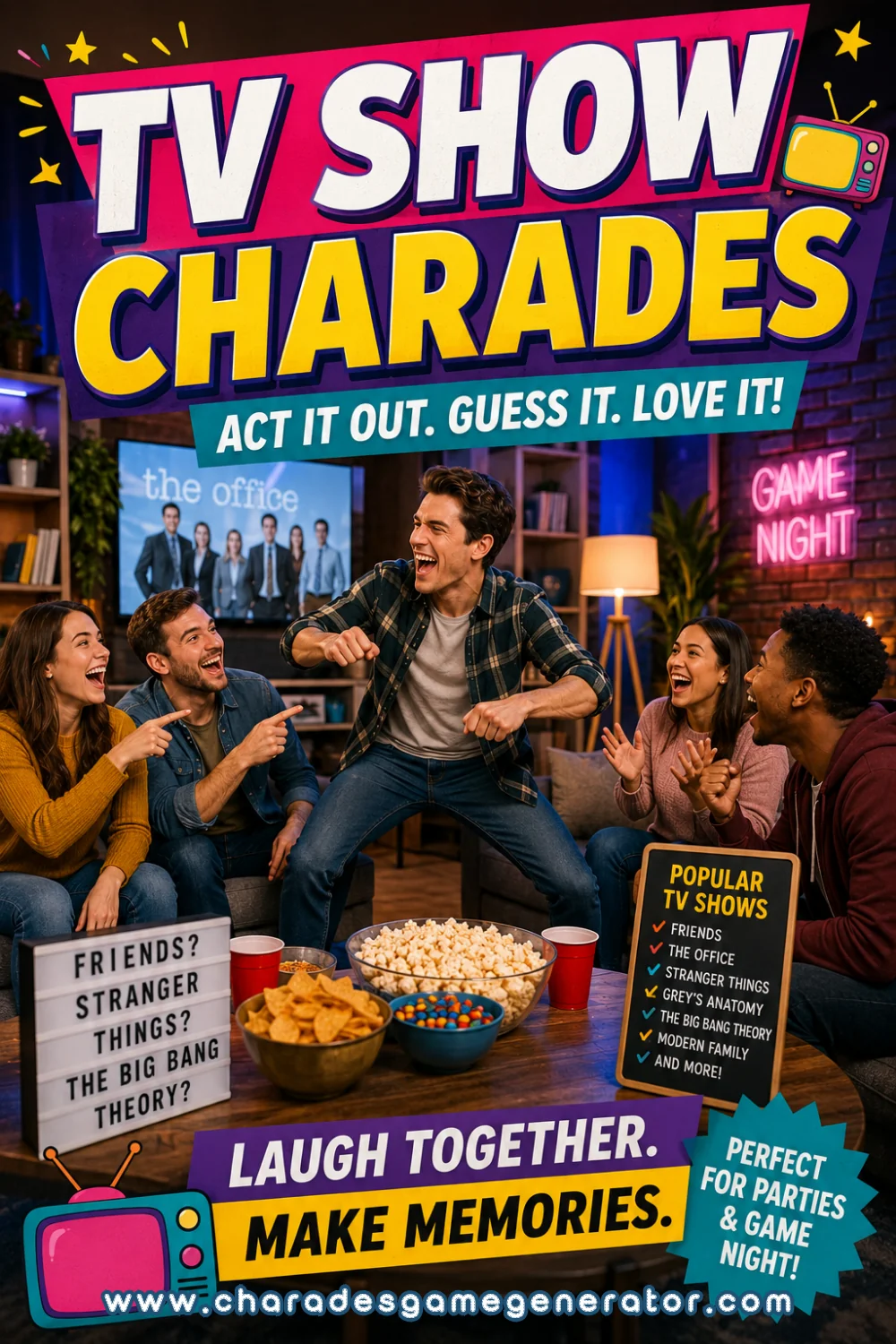
| TV Shows | Adults, teens | Medium | Large |
| Books | Readers, classrooms | Low | Large |
| Songs | Mixed ages, singalong crowds | High | Enormous |
| Sports | Active groups, teens | High | Large |
| Emotions | Expressive players | Medium | Medium |
| Household Objects | Kids, warm-ups | Low | Large |
| Food and Cooking | Everyone | Medium | Enormous |
| Places and Landmarks | Adults, travelers | Low | Large |
| Vehicles | Under 10 | High | Medium |
| Weather | Under 10, classrooms | Medium | Small |
| Idioms and Sayings | Experienced adults | Medium | Large |
| Fairy Tales | Under 10, families | High | Medium |
| Superheroes | Ages 6–14 | High | Medium |
| Dinosaurs | Under 9 | High | Small |
| Musical Instruments | Music classes, families | Medium | Medium |
| Board Games and Toys | Ages 6–14 | Medium | Medium |
| Historical Figures | Classrooms, trivia crowds | Low | Large |
| Fictional Characters | Fandom-heavy groups | Medium | Enormous |
| Jobs From 100 Years Ago | Adults, history buffs | Low | Medium |
| Things in a Kitchen | Warm-ups, kids | Medium | Large |
| Vacation Moments | Adults | Medium | Large |
| Airport and Travel | Adults | Medium | Medium |
| Office Life | Coworkers, holiday parties | Medium | Medium |
| Chores | Families | Medium | Medium |
| Things That Are Annoying | Adults, late rounds | High | Enormous |
| Bad First Dates | Adults only | High | Medium |
| At the Doctor | Ages 8+ | Medium | Small |
| Camping and Outdoors | Scouts, summer parties | High | Medium |
| Under the Sea | Under 9 | High | Medium |
| Space and Astronauts | Ages 6–12 | High | Small |
| Christmas | December parties | High | Large |
| Halloween | October parties | High | Large |
| Thanksgiving and Fall | November gatherings | Medium | Medium |
| Spring and Summer | Outdoor parties | High | Large |
| Nursery Rhymes | Under 6, grandparents | High | Medium |
| Anything in This Room | Any group, any time | High | Depends |
That last one is the sleeper. "Anything in this room" turns a living room into a deck, works with zero preparation, and is startlingly funny — someone always draws the dog.
The actual words that fill these categories are collected in the charades terms list, organized easy to hard so you can pull straight from it.
The Core Six: Categories Every Deck Needs
If you build only six categories, build these — between them they cover every age, energy level and skill level in a normal room.
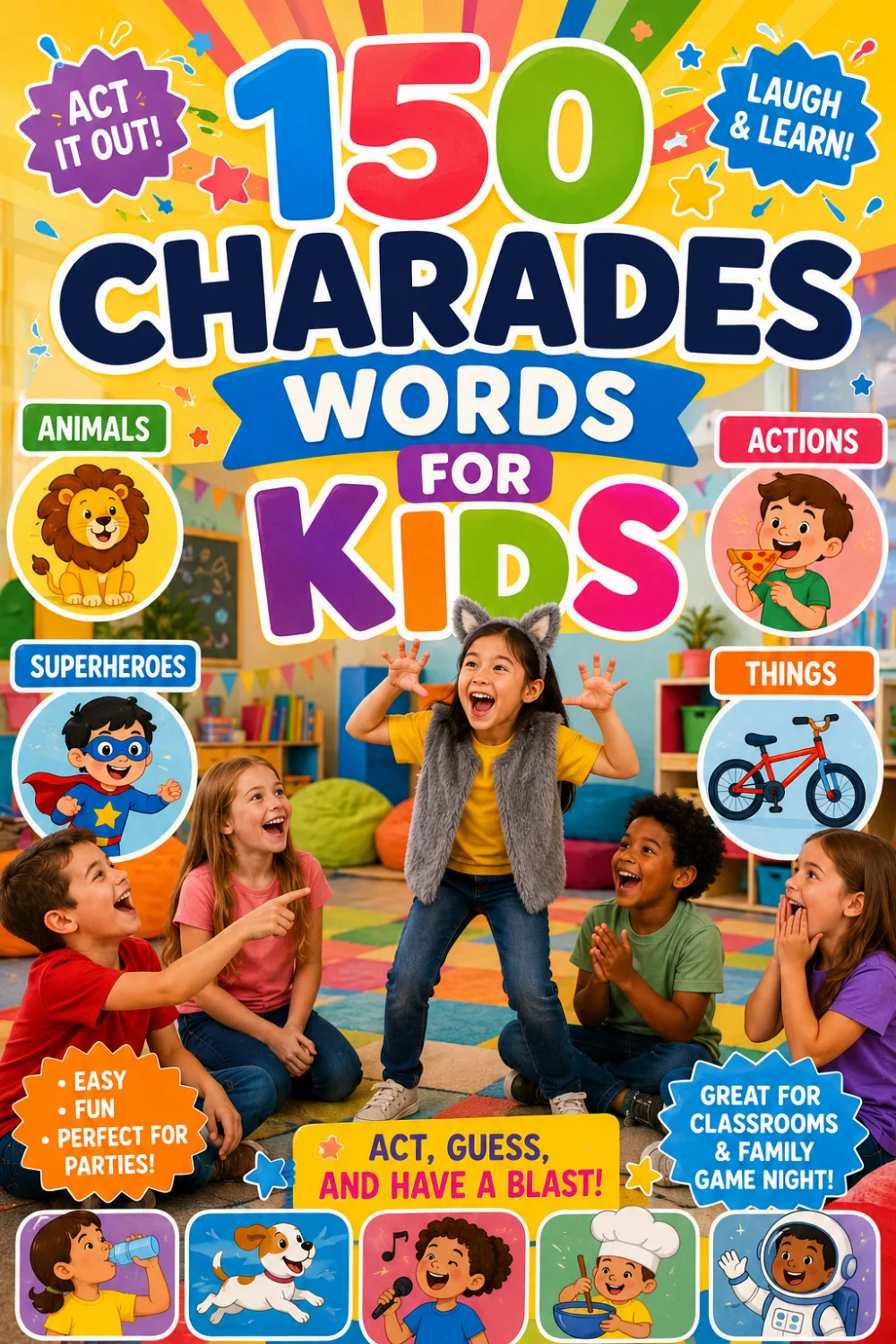
Animals
The most forgiving category in the game and the correct first round for any group with children in it. Animals have distinctive silhouettes, distinctive movements and distinctive sounds that translate into distinctive silent gestures. A three-year-old can act a snake.
Depth is close to unlimited, and difficulty scales cleanly: dog is easy, flamingo is medium, sloth is hard-and-hilarious because the actor has to commit to moving slowly for a full minute.
Everyday Actions
Brushing teeth, parallel parking, folding a fitted sheet. This category is the workhorse because it converts shared experience into instant recognition. Nobody needs cultural knowledge — they need to have lived.
It's also the safest category for a shy player, since the mime is a normal human motion rather than a performance.
Occupations
Jobs come pre-loaded with uniforms, tools and postures. Firefighter, dentist, conductor and beekeeper each have a two-second visual signature.
Occupations scale beautifully by age: little kids get the ten jobs they've seen, adults get auctioneer and air traffic controller.
Movies
The prestige category, and the one that most needs a rule. Restrict it to films everyone in the room could plausibly have seen, or it becomes a quiz. Family gatherings do better with classics than with new releases.
Movies also earn their place because of the movie signal — cranking an old film camera beside your head — which is the most recognizable gesture in charades.
Emotions
Pure acting, no props, no nouns. Emotions are the highest-variance category: a natural performer makes them look easy, a reserved one struggles.
Use emotions as seasoning, roughly one card in six, rather than as a whole round.
Objects
Umbrella, ladder, telescope, shopping cart. Objects are the recovery category — when the game has gotten too clever and rounds are dragging, three object cards in a row reset the pace.
Themed and Holiday Charades Category Ideas
A themed category gives the evening a shape, and it quietly makes the game easier, because everyone at a Halloween party is already thinking about Halloween.
Seasonal sets that work:
- Christmas: decorating a tree, untangling lights, caroling, a gingerbread house, a reindeer, a snow angel.
- Halloween: trick-or-treating, carving a pumpkin, a black cat, bobbing for apples, a costume parade.
- Thanksgiving: carving a turkey, raking leaves, a hayride, saying grace, falling asleep after dinner.
- Summer: a sprinkler, a sandcastle, s'mores, a lemonade stand, a beach umbrella.
Occasion sets that work even better, because they're about the people in the room:
- Wedding shower: the first dance, catching the bouquet, a nervous speech, cutting the cake.
- Baby shower: rocking a baby, assembling a crib, a diaper change, a stroller with a stuck wheel.
- Retirement party: the commute, the coffee machine, the last badge swipe, a fishing trip.
- Classroom end of term: the fire drill, the pencil sharpener, group projects, the last bell.
How to Size a Category to Your Group
Match category width to the widest ability gap in the room, not to the average. One nine-year-old among adults sets the ceiling; ignore that and the nine-year-old stops playing.
| Group | Category width | Example | Cards per category |
|---|---|---|---|
| Preschoolers | Very narrow | Farm Animals | 12–15 |
| Elementary kids | Narrow | Animals | 20–25 |
| Mixed family | Narrow, several of them | Animals / Chores / Fairy Tales | 15 each |
| Teens | Medium | Movies, Sports | 25–30 |
| Adults, casual | Medium to wide | Everyday Actions, Travel | 25–30 |
| Adults, competitive | Wide | Idioms, Abstract Ideas | 30+ |
| Large mixed party | Several narrow, player picks | 4 labeled bowls | 15–20 each |
The last row is the single best structure I know for a big mixed party. Put four labeled bowls on the table. Each player chooses which bowl to draw from. A grandparent picks "Songs," a child picks "Animals," a competitive uncle picks "Idioms," and nobody has to be handed a card that doesn't suit them.
It also removes the argument about fairness, because everyone chose their own difficulty.
How to Build a House Category
A house category is one invented for a specific group of people — the single most memorable thing you can add to a charades night. The method takes ten minutes.
Step 1 — Pick the shared world. Something everyone in the room genuinely knows: the family, the office, the team's season, the neighborhood, the trip you all took.
Step 2 — List twenty-five candidates fast. Don't filter yet. Write everything.
Step 3 — Apply the movement test. Read each one and ask whether you can see the first three seconds of the mime. If you can't, cut it. This usually kills a third of the list, and it's always the third that would have died in play.
Step 4 — Apply the everyone test. Would the quietest, least-involved person in the room recognize this? If it's an inside joke shared by three people, cut it. Inside jokes read as exclusion in a group game, no matter how funny they are to the three.
Step 5 — Apply the kindness test. House categories drift toward teasing. A card about a real person present is fine if it's affectionate and they'd act it themselves. If it would land as a jab, cut it.
Step 6 — Rank what's left and keep the top fifteen. Fifteen good custom cards beat thirty mediocre ones, and you can pad the round with a standard category.
Worked example — a family reunion:
Grandma's garden hose. The drive to the lake. Dad's grill. The dog stealing food off the table. Everyone taking the group photo. Uncle falling asleep in the chair. The card table that wobbles. Setting up the tent. The bug zapper. Finding the cooler. The long goodbye at the driveway.
Every one of those is physical, universal within that group, and warm rather than pointed. That's a house category.
Categories That Fail, and Why
Colors. Nothing moves. There is no silent gesture for beige.
Brand names. Either everybody knows the logo and it's trivial, or a few people don't and it's impossible. Little middle ground.
Anything requiring spelling. Charades is bodies, not letters. Save it for a different game.
Very recent references. A show that came out last month splits the room. Give a reference a year before you put it in a deck.
Two abstractions stacked. "Economic recovery." "Personal growth." One abstract idea can be rescued by a physical image. Two cannot.
A category the host loves and nobody else knows. Cricket positions at an American party. Opera at a kids' birthday. Enthusiasm is not shared knowledge.
Using Categories Mid-Game
Categories aren't only a prep decision. They're a dial you can turn while playing.
Announce the category before the turn. The standard, and the friendliest. The actor may also signal it — mime the film crank for a movie, open your palms for a book.
Hide the category. Harder, and better for experienced groups. The actor's first job becomes establishing what kind of thing this is.
Category roulette. Roll a die or spin for a category, then draw from that pile. Adds a fair amount of noise and keeps anyone from camping in the easy pile.
Category ladder. Round one is Animals, round two Occupations, round three Movies, round four Idioms. Difficulty climbs as the group warms up. This is the structure I use for a two-hour game, and it's why the last round feels like a final rather than a fade.
Team-chosen categories. Each team names the category the other team must draw from. Competitive groups love it. It requires a rule that the chosen category must have at least fifteen cards, or it turns into sabotage.
For the mechanics underneath all of this — turn order, timing, the hand signals and scoring — see how do you play charades. If you're brand new to the game, the charades definition page covers what it is and where it came from. And if you'd rather not build decks at all, the generator at charadesgamegenerator.com lets you pick a category and a difficulty and deals prompts with a timer running.
FAQ
How many charades categories should one game have? Three or four. Fewer than three and the game feels repetitive by the second hour; more than five and nobody remembers what's in which pile. Three categories of twenty-five cards is a good default for a party of ten.
What are the best charades category ideas for a kids' party? Animals, Fairy Tales, Playground Games and Pretend Play. All four are narrow, physical and built from things children have actually done. Skip anything that requires reading a title.
Should I tell players the category before they act? For families, mixed ages and beginners, yes — announce it. For experienced adult groups, hide it and let the actor establish the type of thing first, using the movie, book, TV or song signals. You can switch between the two mid-game to adjust difficulty.
How do I make a category harder without changing the words? Widen it. "Farm Animals" becomes "Animals" becomes "Living Things." Same cards, more guessing space, longer rounds. Removing the announced category entirely is the strongest version of this.
Can two teams use different categories? Yes, as long as the categories are comparable in width and depth. Give one team "Animals" and the other "Abstract Ideas" and the score will reflect the categories rather than the players. Comparable width keeps it fair.
What's a good category for a group that has played a lot? Idioms and Sayings. It's deep, it uses the syllable and sounds-like signals properly, and the moment the whole phrase lands is the best feeling in the game. Follow it with "Things That Are Annoying" for the laugh.