ESL Charades: Teaching English With Charades (Teacher Guide)
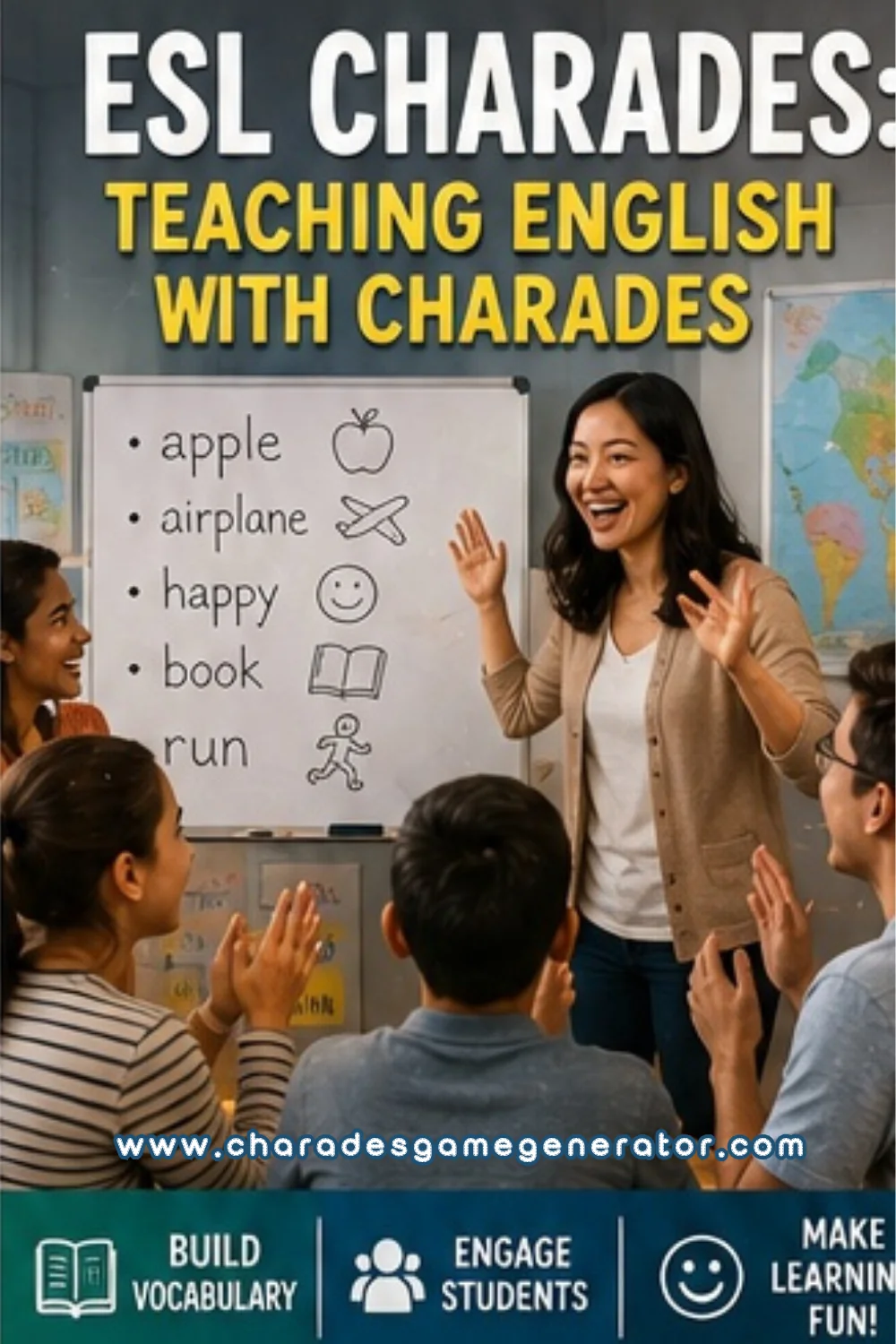
The Best No-Prep Game for the Language Classroom
Ask experienced ESL teachers for their secret weapon, and charades comes up again and again. It's free, needs zero prep, and — crucially — it makes vocabulary stick. When students connect a word to a physical action, they remember it far better than from a flashcard. Plus, it gets a quiet class talking, laughing, and using English without the pressure of perfect grammar.
This guide shows teachers exactly how to use charades to teach English — word lists by level, classroom setup, idiom practice, and the science of why it works so well.
Why Charades Works for Language Learning
- Movement aids memory — physically acting a word boosts retention dramatically.
- Speaking practice — guessers say words aloud, building confidence and pronunciation.
- Low-pressure — students show understanding through action, not perfect sentences.
- Comprehensible input — links new English words to clear visual meaning.
- Engagement — even shy or reluctant learners join in the fun.
- All levels — adapt from single nouns to complex idioms.
ESL Charades Word Lists by Level
🟢 Beginner (Nouns & Simple Verbs)
Run · Eat · Sleep · Read · Drink · Jump · Cook · Dog · Cat · Book · Car · House · Teacher · Doctor · Rain
🟡 Intermediate (Actions & Adjectives)
Cooking dinner · Brushing teeth · Riding a bike · Tired · Excited · Cold · Driving a car · Washing dishes · Angry · Nervous · Reading a book · Playing soccer · Scared · Surprised · Cleaning
🔴 Advanced (Phrases & Concepts)
Running late · Making a decision · Falling in love · Job interview · Catching a cold · Daydreaming · Giving directions · Apologizing · Celebrating · Complaining
💬 ESL Idiom Charades (Advanced Round)
Idioms are notoriously hard for learners — acting them out makes them memorable:
It's raining cats and dogs · Break a leg · Piece of cake · Under the weather · Cold feet · Hit the books · Butterflies in your stomach · A couch potato · Spill the beans · Bite the bullet
Teaching tip: After students guess an idiom, explain its meaning and have them use it in a sentence. The act-guess-explain-use cycle locks it in.
🎭 How to Use Charades in the ESL Classroom
| Goal | How to Use Charades |
|---|---|
| Teach new vocabulary | Students act this week's words to cement meaning |
| Practice verbs | Action words are perfect for miming |
| Review before a test | A fun, low-stress way to recall vocabulary |
| Teach idioms | Act the literal words, then explain the real meaning |
| Build speaking confidence | Guessers call out words aloud, no pressure |
| Warm up the class | A quick energizing round to start the lesson |
Classroom Setup for ESL Charades
- Split into 2–4 teams by table or row.
- One student acts a word from you or the smartboard (no talking, no L1!).
- Their team guesses in English within 60–90 seconds.
- A point per correct guess, tracked on the board.
- Rotate actors so everyone practices.
- Debrief each word — confirm meaning, spelling, and a sample sentence.
Key rule: Guesses must be in English! It's a gentle, fun way to enforce target-language use.
Tips for Effective ESL Charades
- Match words to your lesson — use this week's target vocabulary.
- Allow 90 seconds for lower levels to reduce pressure.
- Insist guesses are in English to maximize practice.
- Debrief every word — meaning, spelling, sample sentence.
- Use the act-guess-explain-use cycle for idioms.
- Use a generator to pull vocabulary by category instantly.
Why Movement Boosts Retention (The Science)
Research in language acquisition shows that pairing words with physical movement — sometimes called Total Physical Response (TPR) — significantly improves recall. The body becomes a memory anchor: when a student later hears "jump," they recall the action they performed. Charades is TPR disguised as a game, which is why ESL teachers love it.
Frequently Asked Questions
How do you use charades to teach English?
Have students act out target vocabulary while classmates guess in English. The movement cements meaning, and guessing aloud builds speaking confidence.
Is charades good for ESL students?
Excellent — it boosts vocabulary retention through movement, gives low-pressure speaking practice, and engages even shy learners across all levels.
What vocabulary works for ESL charades?
Beginners: nouns and simple verbs (run, eat, dog). Intermediate: actions and adjectives (cooking, tired). Advanced: phrases and idioms (running late, break a leg).
How do you teach idioms with charades?
Have students act the literal words, then after guessing, explain the real meaning and have them use the idiom in a sentence to lock it in.
Why does charades help language learning?
Pairing words with physical movement (Total Physical Response) significantly improves memory — the action becomes an anchor that helps students recall the word later.
How do you run charades in a big ESL class?
Split into teams by table, keep rounds to 60–90 seconds, require English guesses, rotate actors, and debrief each word's meaning and spelling.
🔗 More Charades Guides You'll Love
Ready to Energize Your English Class?
You've got level-based word lists, classroom setup, and the science behind why it works — now turn vocabulary practice into the lesson students love. Make it effortless:
👉 Open the free Charades Generator — generate vocabulary by category on the smartboard, with a timer and scoring. No app, no signup. 🍎
Which vocabulary set will you turn into a charades game this week? Your students will remember every word!