Space Charades: 50 Planets, Rockets and Astronaut Words
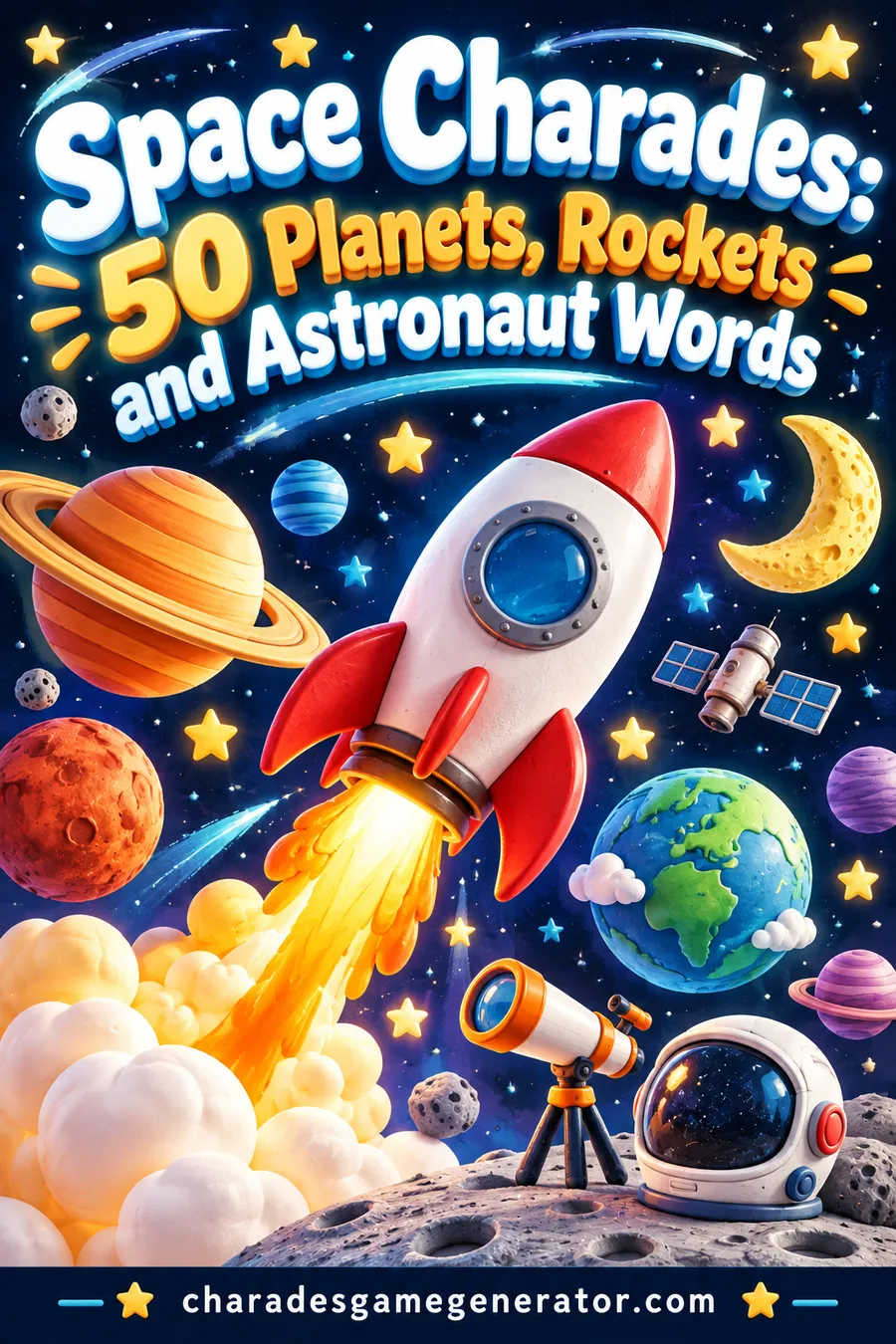
Space charades is a themed round where every clue comes from outer space: planets, rockets, astronaut actions and the things you see in the night sky. Below are 50 ready-to-use words sorted from easy to hard, each with a quick acting hint, plus tips for running the game in a classroom space unit or at a space-theme birthday party.
Space is a natural fit for charades because so much of it is about movement. Rockets blast off, astronauts float, planets spin and comets streak across the sky. Even young players can act a countdown or a moonwalk, and older players get a real challenge from words like "gravity" or "black hole." Teachers, parents and party hosts can pick the level that fits their group and start playing right away.
The 50 Space Charades Words
The list starts with simple, visual words for younger players and builds to science terms that take real creativity to act. Each word has a short hint to help the actor get started.
Easy Space Words (Great for Ages 4 and Up)
- Rocket - Crouch low, count down on your fingers, then shoot straight up.
- Astronaut - Put on a big round helmet and float in slow motion.
- Moon - Make a big circle with your arms over your head, then trace a crescent.
- Star - Open and close your hands to twinkle.
- Sun - Hold your arms in a circle and shade your eyes from the brightness.
- Alien - Wiggle antennae on your head and wave a friendly hello.
- Planet - Hold a big ball and spin it slowly.
- Telescope - Hold a long tube to one eye and peer at the sky.
- Spaceship - Steer with both hands, then zoom across the room.
- Countdown - Hold up five fingers and fold them down one at a time.
- Shooting star - Draw a fast streak across the sky with one finger.
- Floating - Drift around with arms out, moving very slowly.
- Moonwalk - Take big, bouncy, slow-motion steps.
- Space helmet - Lower a round helmet over your head and snap it shut.
- Blast off - Rumble and shake, then leap up with your arms over your head.
Medium Space Words (Ages 7 and Up)
- Earth - Spin a ball, then point down at the ground under your feet.
- Mars - Rub your arms like you are cold and point to something red.
- Saturn - Spin a ball, then trace a big ring around it.
- Jupiter - Mime a planet so huge you can barely wrap your arms around it.
- Comet - Zoom across with a long trailing tail behind you.
- Satellite - Slowly circle around someone while beeping silently with your fingers.
- Space station - Build a big structure in the air, then float inside it.
- Spacesuit - Step into heavy boots and zip up a puffy suit.
- Launch pad - Stand very still on a platform, then point straight up.
- Mission control - Wear a headset and watch a big screen, then give a thumbs-up.
- Space walk - Hold on to a rope and move carefully hand over hand.
- Moon landing - Climb slowly down a ladder and plant a flag.
- Crater - Drop a rock and trace a big dip in the ground.
- Rover - Drive slowly over bumpy ground on six wheels.
- Meteor - Fall fast from above and make a big impact.
- Asteroid - Tumble slowly while holding a lumpy rock shape.
- Space food - Squeeze food out of a pouch and catch a floating crumb.
- Orbit - Walk in a big circle around another person.
- Constellation - Point to dots in the sky and connect them with lines.
- Zero gravity - Make a zero with your fingers, then float upward.
Hard Space Words (Ages 10 to Adult)
- Black hole - Spin in a circle and pretend everything is getting sucked in.
- Gravity - Drop something, then let your body get heavy and sink.
- Galaxy - Swirl your arms in a big spiral.
- Solar system - Stand in the middle as the sun while others circle you.
- Milky Way - Pour milk, then trace a long path across the sky.
- Eclipse - Slide one hand slowly in front of a circle made by the other.
- Nebula - Wave your arms softly to show a colorful cloud in space.
- Space shuttle - Launch upward, then glide down and land like a plane.
- Neptune - Shiver from the cold and point far, far away.
- Space probe - Launch a small object far away, then listen and wait for a signal to come back.
- Northern lights - Wave your arms in long, shimmering ribbons above your head.
- Gas giant - Puff up your cheeks and stretch tall like a giant.
- Rocket stage - Blast off, then drop part of the rocket away behind you.
- Docking - Steer slowly toward something and connect with a gentle click.
- Splashdown - Float down under a parachute, then land with a big splash.
You can deal these one at a time with our free charades generator, which keeps the order random so nobody can skip to the easy ones.
How to Play Space Charades
The rules match regular charades, with a few space-themed touches that make the game more fun for kids.
| Rule | How it works |
|---|---|
| Teams | Split into two "crews," such as Team Rocket and Team Comet |
| Time | Sixty seconds per turn for kids, forty-five for older players |
| No talking | The actor stays silent; space has no sound anyway |
| Countdown start | Everyone counts "3, 2, 1, blast off!" to start each turn |
| Points | One point per correct guess; a bonus for guessing in under 10 seconds |
The countdown start is a small touch that makes a big difference with younger kids. It builds excitement and tells everyone exactly when the timer begins.
The "no sound in space" rule gives you a fun reason to explain why charades is silent. Kids love the idea that they are acting like real astronauts who can't hear each other without a radio.
Using the Game in a Classroom Space Unit
A space unit is one of the best times to bring charades into a lesson. Teachers who already use classroom charades as a brain break can easily swap in the space words below.
Review vocabulary. After teaching the planets or the parts of a rocket, use this game as a fun review. Students who act out "orbit" or "eclipse" have to think about what the word really means.
Build a planet order round. Write the planet names on cards. When a student guesses a planet, they place its card on the board in order from the sun. By the end of the round, the class has built the solar system together.
Act and explain. For older students, the team that guesses the word earns a bonus point if they can explain it in one sentence. This turns a game into a quick check for understanding.
Mix in science actions. Words like "launch," "orbit," "dock" and "land" are verbs, which are easier to act than nouns. They are a great warm-up before tougher nouns like "nebula."
Keep it short. Ten to fifteen minutes is plenty. End the game while energy is still high so students leave wanting more.
Playing at a Space-Theme Birthday Party
A space-theme birthday is a perfect setting for this game. If you are planning one, our birthday party charades page has more ideas for running the game with a group of excited kids.
Turn the living room into mission control. A blanket fort makes a great "space station," and a flashlight works as a spotlight for the actor.
Use name tags as crew badges. Each child gets an astronaut name, and teams are called crews. It makes kids feel part of the theme from the start.
Give everyone a turn. At parties, the goal is fun, not winning. Make sure each child gets at least one chance to act, even if the rounds take a little longer.
Go easy on the hard words. For a party of younger kids, stick with the easy and medium lists. Save words like "nebula" and "gas giant" for older siblings or adults.
End with a group blast off. When the game is over, have everyone crouch down together, count down from ten and jump up at once. It is a fun way to move on to cake.
Choosing the Right Words for Your Group
Preschool and kindergarten. Use only the easy list. Short, very visual words like "rocket," "moon" and "star" work best. Our charades words for kids page has more simple options to mix in.
Early elementary. Mix the easy list with the first half of the medium list. Kids at this age usually know the planets and love acting out a moon landing.
Upper elementary and middle school. Use the medium and hard lists together. Science terms make the game more challenging and connect to what students are learning.
Teens and adults. The hard list is the main event. Words like "gravity," "eclipse" and "docking" take real creative thinking to act out.
Mixed ages. Shuffle all 50 words together and let younger players pass on hard words without losing points. This keeps everyone in the game.
If your kids love themed lists, our dinosaur charades page is another favorite that pairs well with space for a "back in time and out to space" game night.
Acting Tips for Space Words
Use slow motion. Astronauts move slowly in space, so moving in slow motion is a great signal that the word is space-related.
Show size. Space is full of huge things. Stretching your arms as wide as possible helps show planets, galaxies and gas giants.
Use other players. Some space words are easier with a helper. "Orbit" and "solar system" are much clearer when another player circles around you. Allow the actor to pull in one helper for these words.
Break up compound words. "Moonwalk" is "moon" and "walk." "Spaceship" is "space" and "ship." Acting each part can help when the whole word is tricky.
Use sound effects in a bonus round. Regular charades is silent, but a fun bonus round can allow rocket rumbles and beeps. Kids love it, and it gives shy players an easy way to join in.
Mistakes to Avoid
Starting with hard words. If younger kids get "nebula" on the first turn, they may lose interest. Always begin with the easy list.
Using too many planet names in a row. Planets can be hard to tell apart in charades. Mix them with action words and objects so the game keeps moving.
Skipping the explanation. In a classroom, a quick explanation after each guess turns the game into real learning.
Making turns too long. Kids lose focus if a turn drags on. Keep it to a minute or less, and let the actor pass if they are stuck.
Forgetting to celebrate. A cheer or a group "blast off" after each correct guess keeps the energy high.
Getting hung up on facts. Charades is a game, not a test. If a child acts "Mars" as a cold planet and the team still guesses it, count it. Save fact-checking for after the round, when you can talk about what makes each planet special.
Easy Variations to Keep It Fresh
Planet relay. Teams race to act out all eight planets in order from the sun. The first team to reach Neptune wins.
Astronaut training. Use only the action words, like "floating," "space walk," "docking" and "splashdown," and have the whole group copy each action after it is guessed. It doubles as a quick movement break.
Picture cards. For non-readers, draw a simple picture on each card. A rocket, a moon and a star are easy to sketch, and kids can act from the picture alone.
Silent mission. The entire team, not just the actor, must stay silent and write guesses on a whiteboard. It is calmer, which helps in a classroom.
FAQ
What is space charades?
Space charades is a themed version of charades where every clue is about outer space, such as planets, rockets, stars and astronaut actions. Players act out the words silently while their team guesses.
What age is this game good for?
The easy words work for kids as young as four, the medium words suit elementary students, and the hard words challenge older kids, teens and adults. Mixed-age groups can shuffle all three lists together.
How do you act out a planet in charades?
Hold a pretend ball and spin it, then add a clue that sets that planet apart. For Saturn, trace a ring. For Mars, point to something red. For Earth, point at the ground beneath your feet.
Can I use this game in a science lesson?
Yes. It works well as a review game at the end of a space unit. Have students explain each word after guessing it for a bonus point.
How many players do you need?
You can play with as few as three people, but four or more in two teams works best. The game also works with a full classroom split into small groups.
Is space charades good for a birthday party?
Yes. It fits a space-theme party perfectly. Use the easy and medium lists for younger kids, add a countdown before every turn, and give each child at least one turn to act.
👉 Open the free Charades Generator — instant space words, a timer and team scoring. No app, no signup. 🚀