Parts of Speech Charades: 60 Verbs, Adjectives and Adverbs to Act Out
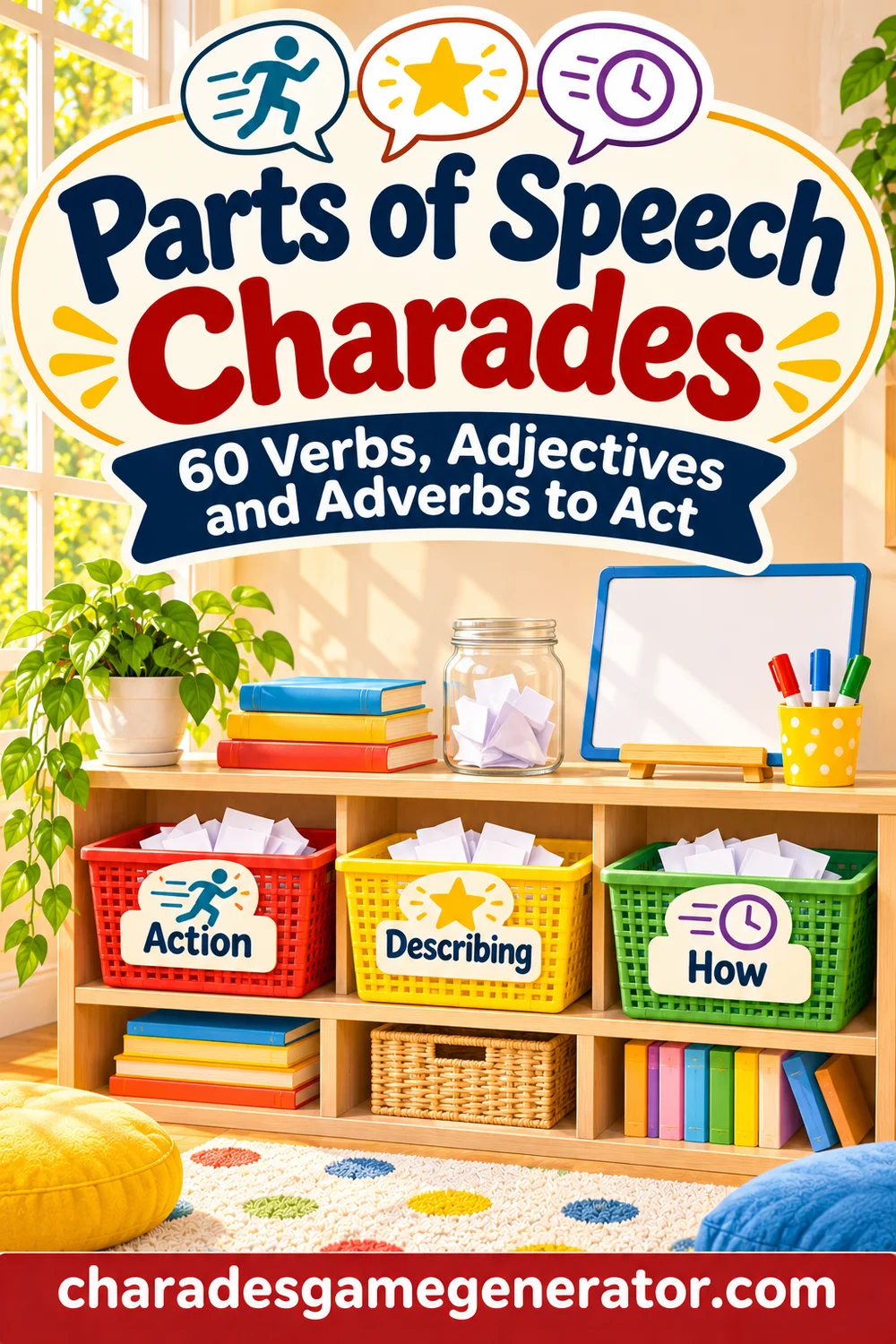
Parts of speech charades is a game where you act out a verb, adjective or adverb, and everyone else guesses the word and names its part of speech. It turns grammar review into movement, so it works well as a quick classroom lesson, a homeschool warm-up or an after-dinner family game.
Below are 60 ideas in four groups: action verbs, feeling and describing adjectives, adverbs that show how something is done and mix-and-match challenges. Draw one in the box to start. The word shows its part of speech, so the actor knows what to act. For people, places and things, see noun charades. For more word play, try vocabulary charades.
How to play parts of speech charades
- Draw a word from the box. It shows the word and its part of speech.
- Act it out for 45 seconds with no talking and no sounds.
- The group guesses the word.
- Name the part of speech. Is it a verb, an adjective or an adverb? Score a point for the word and a point for the part of speech.
- Rotate the actor and keep going.
For younger players, use verbs only. For older players, add a second round where they use the word in a sentence.
Action verbs
- Skip
- Whisper
- Stretch
- Tiptoe
- Climb
- Giggle
- Sneak
- Wobble
- Gallop
- Spin
- Juggle
- Shiver
- Hop
- Pour
- Dig
- Sweep
- Snore
- Sprint
- Tug
- Wave
Adjectives for feelings and looks
- Sleepy
- Proud
- Nervous
- Cheerful
- Surprised
- Dizzy
- Brave
- Grumpy
- Shy
- Excited
- Giant
- Tiny
- Slippery
- Freezing
- Sticky
- Heavy
- Noisy
- Dusty
- Sparkling
- Soggy
Adverbs that show how
- Slowly
- Quietly
- Carefully
- Happily
- Hurriedly
- Gently
- Clumsily
- Sadly
- Proudly
- Bravely
- Sleepily
- Eagerly
- Noisily
- Gracefully
- Politely
- Suddenly
Mix-and-match challenges (verb plus adverb)
- Walk slowly
- Eat messily
- Sing quietly (act, no sounds)
- Run happily
- Reach carefully
- Dance gracefully
- Sneeze suddenly
- Wave proudly
Grammar tips for the guessers
- Verbs show action. If you can do it, it is probably a verb.
- Adjectives describe a noun. Ask: what is it like? Sleepy, giant and slippery are good examples.
- Adverbs describe how. Many end in -ly, like slowly and quietly, but not all do.
- Act the verb, then add the style. To act an adverb, act a simple verb in that manner, like walking quietly.
A classroom grammar review plan
- Warm-up (3 minutes): the class mimes five action verbs together.
- Round 1 (10 minutes): verbs only, with the part of speech shown.
- Round 2 (10 minutes): adjectives and adverbs, with the group naming the part of speech.
- Round 3 (5 minutes): verb plus adverb challenges.
- Exit ticket: each student writes one sentence using a verb, an adjective and an adverb.
Safety and fairness
- Act in your own space and use slow, gentle motions.
- No acting that involves touching, tripping or crowding.
- Make it okay to pass. Some words are harder to act than others.
- Keep the focus on the word, not on who acts best.
More ways to play
- Sentence charades: act a short sentence with a verb, an adjective and an adverb.
- Reverse parts of speech: the group acts a word and one player guesses.
- Part of speech race: teams sort drawn words into three columns.
- English learner round: allow a picture or a gesture to help.
For more learning games, try vocabulary charades, noun charades, classroom charades or ESL charades. Load them into the free charades game to play with teams and a timer.
Frequently Asked Questions
How do you play parts of speech charades?
A player draws a verb, adjective or adverb and acts it out with no talking. The group guesses the word, then names its part of speech. Score a point for each.
Which parts of speech work best for charades?
Verbs are the easiest because they are actions. Adjectives and adverbs work too, especially feelings, sizes and ways of moving.
How is this different from noun charades?
Noun charades focus on people, places and things. This page covers verbs, adjectives and adverbs, which are the words that show action and description.
What age is parts of speech charades for?
It works best for about ages six to twelve, from first-grade verbs to middle-school adverbs, and it also works for English learners.
Can I use this as a classroom review?
Yes. It makes a short grammar review or a brain break. Ask the group to name the part of speech after each correct guess.